


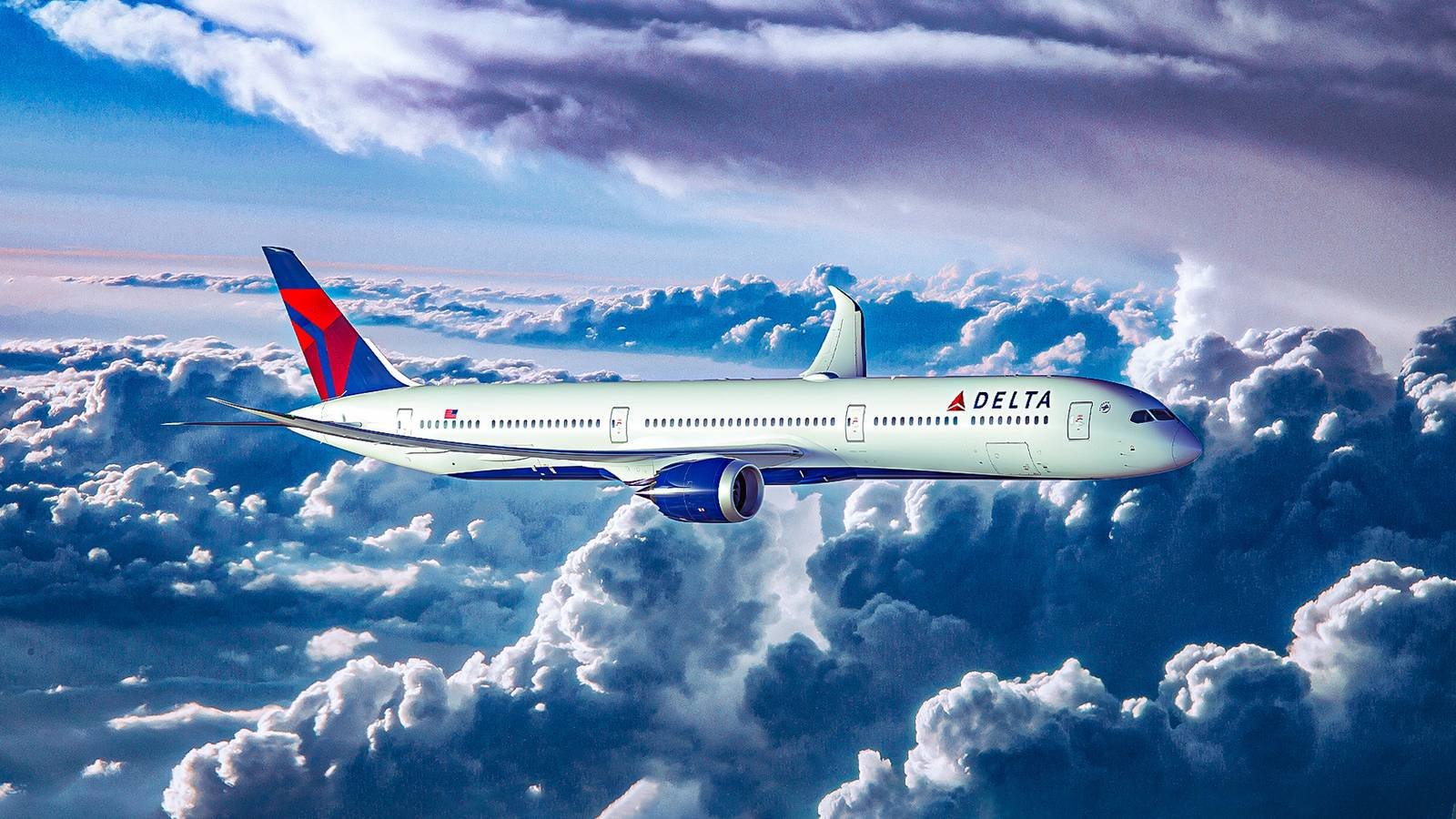
Delta Air Lines recently ordered the Boeing 787-10, the largest member of the Dreamliner family. While the actual service entry of the new model is still years away, the aircraft remains a relevant topic of discussion among analysts and industry enthusiasts due to its implications for the future of the airline’s long-haul strategy. Originally announced in January 2026, Delta’s order covers 30 firm 787-10 jets and options for up to 30 more, marking the airline’s first direct 787 purchase and introducing an entirely new fleet type into its widebody lineup.
Most importantly for this story, Delta has said that its deliveries will not begin until 2031, meaning that the 787-10 is not a near-term launch but rather a major part of the airline’s next-decade fleet renewal plan. The timeline is what makes the order here so interesting to discuss. Rather than a quick fix, the 787-10 is a long-range bet on replacing older, less efficient widebodies while giving Delta more capacity, bigger premium cabins, stronger cargo capability, and better per-seat fuel efficiency on high-demand international routes.
Delta has specifically positioned the aircraft for transatlantic and South American flying, where the 787-10’s size and economics fit neatly with the carrier’s premium-heavy growth model. The real angle is not just when Delta will debut the jet, but why it is willing to wait until 2031 to bring the biggest Dreamliner directly into its operations.
A Brief Overview Of The Boeing 787-10

The dynamic  Boeing 787-10 is the largest version of the Dreamliner, and it has been designed as a high-capacity long-haul widebody that emphasizes seat economics just as much as it does range. The aircraft seats an impressive 336 passengers in a typical two-class layout, measuring 224 feet (68 meters) and has a listed range of 6,330 nautical miles (11,730 km). Compared with the smaller 787-8 and 787-9, the -10 trades off some range for more overall cabin space.
This is a key reason why it tends to make the most sense on dense intercontinental routes rather than the very longest ultra-long-haul services. The 787 as a whole was a program primarily built around the continued improvement of aerodynamics and the addition of more efficient engines, both of which significantly reduced costs for operators. It also included more electronic systems, and it extensively utilized carbon-fiber composites, all aimed at lowering overall fuel burn, reducing maintenance needs, and giving airlines more overall route flexibility.
This is something critical in a world where demand is increasingly rewarding connectivity with higher price premiums. The plane itself is also marketed heavily on passenger comfort. Boeing is quick to highlight large windows, a quieter cabin, and lower cabin altitude, all while Delta’s own announcement stresses that smoother flights, quieter interiors, and a more premium onboard feel will help the plane command a higher price premium in many markets.
Delta Has Decided To Make A Major Investment In The Type

It is not all that challenging to understand why Delta would have a relatively strong interest in the Boeing 787-10, a move which is fundamentally about long-term fleet renewal and the growth of the airline’s increasingly premium-oriented network. In January 2026, the airline announced an order for 30 Boeing 787-10s with options for around 30 more, marking Delta’s first direct 787 purchase and introducing a new fleet type into its operation.
Deliveries are scheduled to begin in 2031, which makes this less a short-term network move rather than a next-decade strategic bet. Delta has said that the aircraft itself will be intended to enter service on high-demand transatlantic and South American routes. This is relatively unsurprising, as these are key places where the 787-10’s larger cabin, stronger cargo capability, and lower fuel burn per seat fit the airline’s business model very effectively.
The airline says that the plane will offer 25% better overall fuel efficiency per seat than the older widebodies it is expected to replace, while also allowing for larger premium cabins with Delta One Suites, Delta Premium Select, and Delta Comfort seats. That premium angle also matters, as Delta entered 2026 leaning further toward high-end leisure and corporate demand, with premium ticket revenue outperforming main-cabin revenue. Delta also selected General Electric Aerospace’s GEnx engines.

The New Delta Air Lines Long-Haul Aircraft Coming In 2026
A look at what these planes will bring to Delta, where they could fly, how they fit into Delta’s network, and what they may look like on the inside.
What South American Routes Could The Plane Enter Service On?

Based on the Delta Air Lines network today, a plausible South American network debut route for the 787-10 could be the nonstop service from Hartsfield-Jackson Atlanta International Airport (ATL) to São Paulo Guarulhos International (GRU). Delta has made it clear that the aircraft is intended for high-demand South American flying, and the city stands out because it is both a major business market and one of the airline’s own key gateways to the continent, with strong onward connectivity strengthened by the Delta-LATAM joint venture.
Services to GRU from JFK Airport in New York City also look like they could be a strong possibility for a few similar reasons. For starters, there is a large amount of local demand, premium traffic, and extensive connecting opportunities beyond Brazil. After that, Atlanta to Buenos Aires also looks very credible. After all, Delta has already been adding frequencies there and upgrading the market with the A330-900neo, which suggests it sees Buenos Aires as a route that can support more premium capacity and better operating economics.
Atlanta to Santiago International Airport (SCL) could also be in the cards, primarily because it is a strong long-haul premium market and the airline already serves that route with a premium-oriented A350-900. This is a strong signal that the carrier views Santiago as a strong long-haul premium market. Flights from Rio to Atlanta or JFK are also plausible, although perhaps more likely as a later or seasonal 787-10 assignment. Lima is a valuable gateway, but probably not the first place Delta would send its largest Dreamliner.
What Transatlantic Routes Could The Aircraft Enter Service On?

The most plausible transatlantic debut routes for the 787-10 are the carrier’s biggest, most premium-heavy Europe markets rather than thinner seasonal launches. Delta itself has said that the aircraft is aimed at high-demand transatlantic flying, and Boeing notes the order is meant to support expansion and modernization on those routes. As such, trunk services such as Atlanta to London Heathrow, Atlanta to Paris, Atlanta to Rome, and Atlanta to Amsterdam would likely be good fits.
Of course, all of these sit naturally within the airline’s largest long-haul hub and feed powerful joint-venture flows with Virgin Atlantic, Air France, and KLM. Elsewhere, Delta’s routes from New York JFK to London Heathrow, JFK to Paris, and JFK to Rome also all look like reasonably strong candidates because JFK is one of Delta’s core premium gateways and the airline has kept adding upscale transatlantic flying there. Delta’s own network updates show just how large this platform already is.
Indeed, for summer 2026, the airline is planning more than 650 weekly flights to nearly 30 European destinations, with continued growth in markets like Atlanta, JFK, Boston, and Seattle. By sharp contrast, thinner leisure-oriented routes, such as Boston to Nice, JFK to Porto, JFK to Malta, or JFK to Sardinia, feel significantly less likely as initial assignments for the 787-10. After all, the 787-10’s massive range and higher seat count make it a better fit for dense, business-and-premium-heavy Europe markets, rather than new leisure routes.

Delta Air Lines’ Widebody Strategy: Why The Airbus A350 & A330 Work Together
A new era for the iconic carrier.
Why Was Delta Only Interested In The 787-10?

Delta has not publicly argued that it has ‘rejected’ the 787-8 or 787-9 so much as choosing the one Dreamliner variant that best matched the gap in its fleet. In Delta’s own announcement, the airline said the 787-10 was the ideal addition to its transatlantic and South American network because it brings more capacity, larger premium cabins, stronger cargo capability, and 25% better fuel efficiency per seat than the older widebodies it will replace.
This kind of logic points directly to operating the 787-10 rather than the smaller variants. The manufacturer notes that the 787-10 has 336 seats in a typical two-class layout, while 296 are present on the 787-9 and 247 are present on the 787-8, although the stretched variant does come with significantly less range.
As for Delta, that is not a weakness but rather the point of the order. The airline already has A330-900neos to fill that smaller segment of its commercial lineup. It also doubled down in January 2026 by ordering more Airbus widebody jets, highlighting the 787-10’s more specialized role.
The Bottom Line

At the end of the day, the 787-10 is an incredibly dynamic and capable aircraft, and it is set to add some impressive extended-range capabilities to the Delta fleet. This jet will allow the airline to open up service on fundamentally different kinds of routes than it otherwise could have. While range and capacity are obvious considerations, the decision to buy an entirely new kind of aircraft is one that the airline does not take lightly.
This is because the type has impressive long-range capabilities, but it is fundamentally different from any of its other aircraft. This means that the plane comes along with significantly higher operational costs, because pilots and mechanics will need to be trained. Therefore, the airline must seem to believe that the plane could add genuine value to its fleet. As a result, Delta decided that it was worth the additional investment.
