


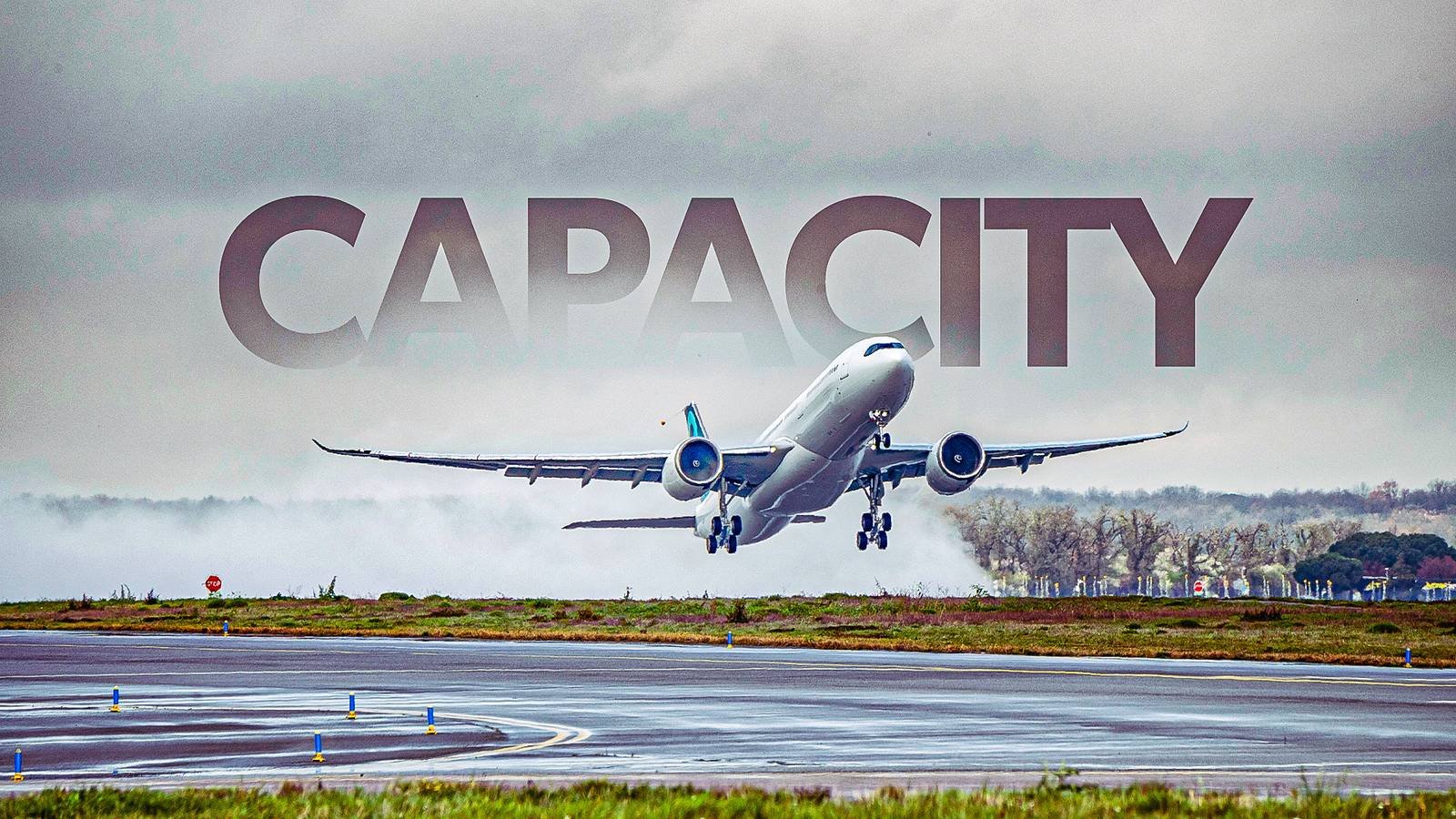
Cebu Pacific’s high-capacity Airbus A330-900neo is notable for being one of the most densely configured widebody aircraft currently in commercial service. The aircraft is set up in an all-economy configuration and carries an unusually high number of passengers for a twin-engine, single-deck jet, placing it among the highest-capacity aircraft in its class, and one of the highest-capacity passenger aircraft in the world currently.
Even though it is much smaller than ultra-large aircraft like the Airbus A380, the A330-900neo’s size, range, and modern design allow it to handle passenger volumes comparable to some of the world’s largest jets in everyday airline operations. This makes Cebu Pacific’s A330-900neo a striking example of how far passenger capacity can be pushed through cabin configuration alone, without altering the basic aircraft design.
Cebu Pacific: The Philippine Low-Cost Carrier
Cebu Pacific is a Philippine low-cost airline founded in 1996 and headquartered in Pasay City, Metro Manila. The airline has major hubs at Manila Airport (NAIA) and Mactan Cebu International Airport (RPVM). The airline has grown into the largest carrier in the country by passenger traffic, playing a major role in domestic connectivity across the Philippine archipelago.
The airline is widely credited with introducing and popularizing the low-cost carrier (LCC) model in the Philippines. Cebu Pacific focuses on affordable base fares, optional add-on services, and high aircraft utilization and passenger numbers to keep costs low. Its route network spans domestic, regional, and long-haul international destinations, connecting the Philippines with much of Asia, the Middle East, and Australia. The carrier operates a modern, Airbus-focused fleet, comprising regional ATR 72s, A320 family, and widebody A330 aircraft, with a focus on fuel efficiency and fleet commonality.
Cebu Pacific has attracted international attention for its innovative high-density seating strategies, particularly on its A330-900neo aircraft, which rank among the highest-capacity twin-engine airliners ever operated. These aircraft are designed for high-demand leisure and labor routes, allowing the airline to transport large numbers of passengers at very low per-seat costs. Combined with frequent seat sales and a strong digital presence, this strategy has made Cebu Pacific a prominent example of how low-cost principles can be successfully scaled to widebody operations.
Cebu’s High-Capacity A330

Cebu Pacific operates one of the highest-density Airbus A330 configurations in the world, which has drawn significant attention within the aviation community. Its new A330-900neo aircraft are fitted in an all-economy configuration with seating for around 459 passengers, an exceptionally high number for a twin-engine widebody aircraft. This makes Cebu Pacific’s A330s among the most densely seated A330s ever certified by Airbus.
This high passenger capacity is achieved through a 9-abreast 3-3-3 economy-class seating layout, rather than the more common 2-4-2 configuration used by many other A330 operators. The cabin also features reduced seat pitch, slimline seats, and the complete removal of premium cabins to maximize available space. The Neo variants are powered by Rolls-Royce Trent 7000 engines, with their A330ceo models, which are not configured in the high-density layout, powered by Rolls-Royce Trent 700 engines.
Cebu Pacific’s high-density A330s are deployed on high-volume domestic and international routes, where large passenger numbers are common. These aircraft highlight the flexibility of the A330 airframe, demonstrating how it can be configured far beyond traditional layouts while remaining fully compliant with safety and certification standards. The result is one of the most extreme seating arrangements seen on a modern twin-engine widebody aircraft.

The Airlines With The World’s Densest Economy Cabins In 2026
Discover which carrier are squeezing the most seats into economy cabins in 2026.
What Is The Reason Behind The High Capacity?

Cebu Pacific uses the high-capacity configuration primarily to maximize seat count and lower cost per passenger. By fitting as many seats as possible into a single aircraft, the airline spreads operating costs, such as fuel, crew, maintenance, and airport fees, across a much larger number of travelers. This significantly reduces the cost per seat, which aligns with Cebu Pacific’s low-cost carrier business model and supports consistently low fares, provided it manages to fill these seats with passengers.
Another key reason is the nature of demand in the Philippines and other markets Cebu operates in. Cebu Pacific serves many routes with extremely high passenger volumes, including major domestic trunk routes and international services carrying large numbers of leisure travelers and overseas workers. On these routes, demand is driven more by price and availability than by premium comfort, making an all-economy, high-density widebody aircraft well-suited to the market conditions.
Finally, the high-capacity A330 allows Cebu Pacific to move large numbers of passengers efficiently using fewer flights. This helps optimize airport slots at congested hubs like Manila, reduces scheduling complexity, and improves aircraft utilization. By deploying a single high-density widebody instead of multiple smaller aircraft, the airline can handle peak demand periods more effectively while maintaining operational simplicity.
How Does Capacity Compare To An Airbus A380?

How does the capacity stack up against the A380? In absolute terms, Cebu Pacific’s high-density A330 seats about 459 passengers, which is still well below the maximum certified capacity of the Airbus A380, which exceeds 800 passengers in a theoretical all-economy layout. However, very few airlines ever operate the A380 anywhere near that limit. The comparison becomes more interesting when looking at actual in-service configurations flown by major A380 operators.
For example, Emirates, the world’s largest A380 operator, uses several layouts. Its highest-capacity A380 configuration seats around 615 passengers, including premium cabins, while many of its other A380s seat 489–517 passengers, depending on layout. Singapore Airlines operates A380s with roughly 471 seats, Lufthansa around 509 seats, British Airways about 469 seats, and Qantas roughly 485 seats. These real-world figures show that most A380s fly with passenger counts that are far below their structural maximum.
This puts Cebu Pacific’s A330 into perspective. While it cannot match the upper limits of an A380 like Emirates’ 600+ seat aircraft, it approaches or even rivals the capacity of many A380s in everyday service. The contrast is striking: a single-deck, twin-engine A330 carrying nearly as many passengers as a double-deck, four-engine superjumbo highlights how cabin density, rather than aircraft size alone, plays a major role in real-world passenger capacity.

Emirates’ Unusual Airbus A380 Cabin: A Peek Inside the World’s Highest-Capacity Jet
Emirates has 15 Airbus A380s with a staggering 615 seats each!
Does Cebu Pacific Apply The Same Concept To Its Other Aircraft?

Cebu Pacific configures its Airbus single-aisle fleet with seat counts that sit near the top end for each aircraft type. Its A320s generally carry around 180 passengers in an all-economy layout, compared with many full-service airlines that operate the same aircraft with 150–170 seats to accommodate business class and wider pitch. The airline’s A321s are even more densely arranged, typically seating about 230–236 passengers, a figure that reflects a clear emphasis on capacity and efficiency rather than cabin comfort, similar to other large low-cost carriers.
The same approach applies to Cebu Pacific’s ATR turboprops, which are used heavily on domestic and short regional routes. Its ATR 72 aircraft are usually fitted with 72 seats, while the newer ATR 72-600 high-capacity versions can carry up to 78 passengers. These numbers are at the upper limit for the type and higher than configurations used by some regional full-service operators, which may trade a few seats for extra legroom or a quieter cabin.
Aircraft Type (Planespotters.net) | Current Fleet |
|---|---|
ATR 72 Freighter | 1 |
ATR 72-500 | 7 |
ATR 72-600 | 14 |
Airbus A320neo | 4 |
Airbus A320ceo | 30 |
Airbus A321neo | 5 |
Airbus A321ceo | 7 |
Airbus A330ceo | 8 |
Airbus A330neo | 13 (As of mid-2025) |
Taken together, these figures show that Cebu Pacific follows a consistent high-density strategy across its fleet. Whether flying jets or turboprops, its aircraft typically carry more passengers than those operated by traditional network airlines, aligning the carrier closely with the global low-cost model that prioritizes low fares, high utilization, and lower cost per seat.
Other High-Density Widebodies

High-density widebody operations exist across different airline models, not just low-cost carriers. A clear example is All Nippon Airways (ANA), which operates specially configured Boeing 787-10s with up to 429 seats on high-demand domestic routes in Japan. This is far above the usual 300–330 seats seen on internationally configured 787-10s, and the aircraft are used almost like large regional jets to move huge passenger volumes efficiently on short sectors.
In the long-haul, low-cost, and leisure market, airlines such as AirAsia X have consistently used dense widebody layouts to keep fares low. Its A330-300s typically seat around 365–377 passengers, compared with roughly 250–300 seats on the same aircraft at full-service airlines. Even when a small premium cabin is included, the overall seat count remains significantly higher than traditional configurations, reflecting a strong focus on cost per seat rather than onboard space.
There are also examples of full-service carriers using economy-heavy configurations on very large aircraft. Emirates’ A380s, for instance, can exceed 600 seats in layouts dominated by economy class, while some Boeing 777-300ERs worldwide are fitted with 380–400+ seats depending on cabin mix. These setups are typically deployed on routes with consistently high demand, showing that high-density widebodies are a deliberate strategy where volume and efficiency outweigh the need for extensive premium cabins.
