


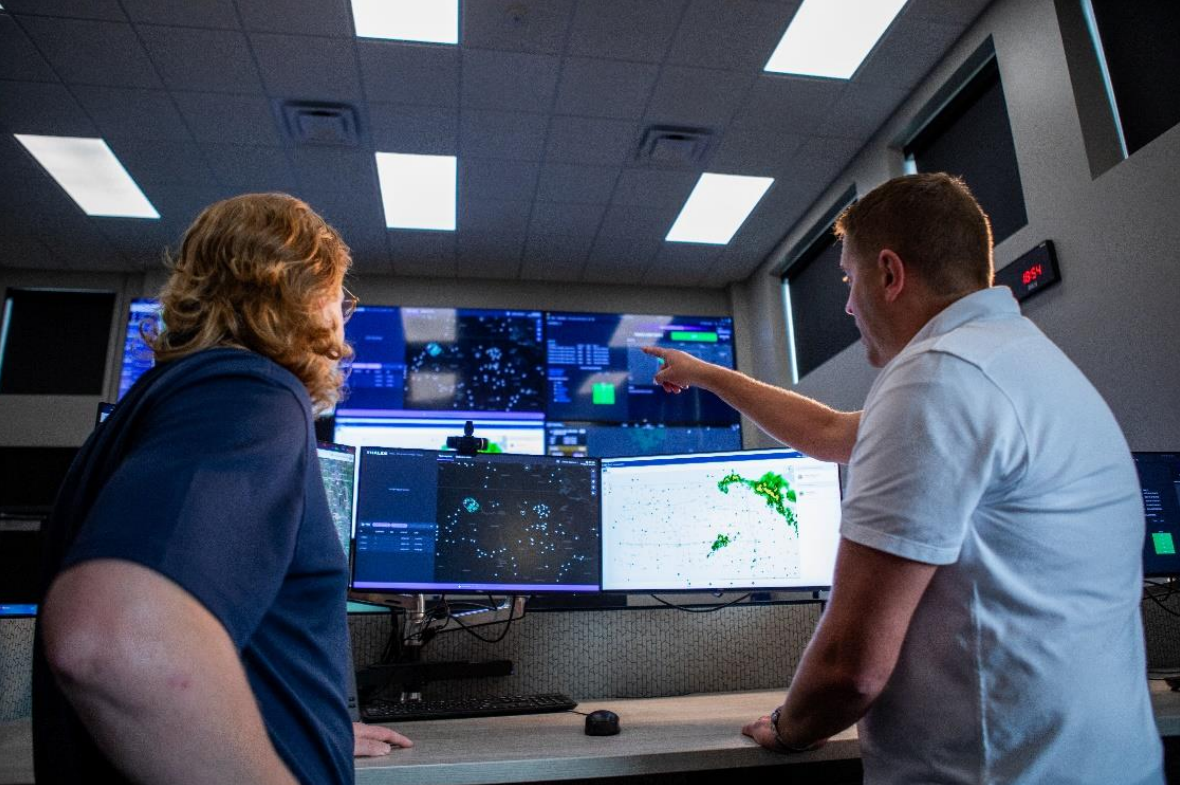
North Dakota is taking the lead on integrating uncrewed aircraft systems (UAS)—from small drones to self-flying air taxis—through a first-of-its-kind arrangement with the FAA.
The state’s Northern Plains UAS Test Site—which oversees Vantis, a statewide UAS traffic management network—is now managing uncrewed drones using unfiltered data straight from the state’s four FAA radars, becoming the first nonfederal entity with that kind of access.
The state is working with partners such as Thales to organize FAA radar data within an “enclave,” which the global aerospace company described as a “secure system that stores, analyzes, and protects national airspace data in a controlled environment.” Thales provides primary surveillance radar, ADS-B, and other deconfliction and situational awareness systems for Vantis.
Senator John Hoeven (R-N.D.), who announced the activation of the Vantis Federal Radar Data Enclave on Friday, said the capability “establishes North Dakota as the national model for managing UAS traffic.”
In other words, the effort could be replicated elsewhere. For now, though, Vantis represents one of the only mechanisms for UAS operators to test key capabilities—such as flight beyond the visual line of sight (BVLOS) of the pilot—in a safe, real-world environment.
“We recognized that bringing this data feed to our state was essential for raising our UAS and counter-UAS operations to the next level,” Hoeven said in a statement. “No other state offers this level of capabilities, and it would take years for this type of system to be implemented anywhere else.”
North Dakota: A Hub for UAS
Vantis, operational since 2020, is the country’s first statewide UAS traffic management network. It is overseen by the Northern Plains test site, one of nine FAA-designated sites for UAS testing.
North Dakota has invested millions in the system, which is designed to provide reliable, repeatable, real-time access to the national airspace system (NAS) for UAS of all sizes. It is intended to study a wide variety of BVLOS operations, including delivery, medical services, agriculture, and inspections of oil and gas facilities, electric utilities, and railroads.
Vantis relies on a network of shared-use infrastructure, including aircraft, ground control stations, and remote surveillance sensors and command and control radios. These are monitored and controlled out of a mission and network operations center in Grand Forks, which opened in 2022.
Thales said it created Vantis’ new radar data system using technology built in the U.S. and certified to the FAA’s most stringent cybersecurity standards. It was tasked with developing security protocols to protect sensitive flight data while also making it available to future government and private entities.
Trevor Woods, executive director of the North Plains test site, said access to the FAA radar data “represents a foundational shift in how we approach shared airspace awareness.”
Even FAA Administrator Bryan Bedford chimed in on the significance of the move.
“Safe, scalable drone operations require more than just technology, they require the right data ecosystem,” Bedford wrote in a social media post. “This milestone in North Dakota is exactly how we move from testing to real-world application while maintaining the highest safety standards in the world. The future of the NAS depends on this kind of data-sharing and innovation.”
Thales, whose systems are integrated at several airfields within the Vantis network, believes the new radar enclave could help North Dakota preview operations that the FAA is preparing for under Part 108.
The proposed rule would allow operators to more easily secure BVLOS permissions. That would let them fly UAS over longer distances and in locations previously off limits, including over large crowds and in controlled airspace near airports.
Those expanded BVLOS privileges will be contingent on the efficacy of UAS detect and avoid systems. Vantis could provide the ideal environment to test them.
Thales said the activation of the enclave further aligns with efforts to modernize the nation’s air traffic control (ATC) systems. Integrating UAS into the airspace is one pillar of the Transportation Department’s Brand New ATC System plan.
Hoeven added that the enclave could support initiatives such as the Point Defense Battle Lab at Grand Forks Air Force Base (KRDR)—a new hub for evolving the U.S. Air Force’s C-UAS capabilities.
Recently, C-UAS has been a major topic of conversation at the federal level, with events such as the FIFA World Cup and America 250 celebration expected to draw major U.S. crowds in 2026. In late 2025, the Federal Emergency Management Agency (FEMA) created its C-UAS Grant Program, which will fund $500 million worth of counter-drone training and technology for all U.S. states and territories.
Could Your State Be Next?
The Vantis Federal Radar Data Enclave is not intended to be limited to North Dakota forever.
Section 905 of the 2024 FAA Reauthorization Act called for the regulator to create a “Radar Data Pilot Program” that gives “qualified users” access to unfiltered radar data. Hoeven worked with former FAA chief Mike Whitaker to ensure North Dakota’s participation in the program, which tests how traditional aviation surveillance systems could be used to enable or expand UAS traffic management. But the provision would allow the FAA to expand radar access to other non-federal entities.
Frank Matus, who leads UAS and AAM integration strategy for Thales, testified to the North Dakota Legislative Assembly in January 2025 that the goal is to “export Vantis to other States, like Michigan.”
“We have to have a flexible airspace system and tools that allow for this type of integration,” Matus told FLYING in January. “The system today doesn’t offer that wide-scale integration.”
Thales’ systems represent a key component of Vantis in places such as Grand Forks Air Force Base, where General Atomics utilizes them daily for MQ-9 Reaper test flights without a chase plane.
But the company is undertaking similar projects in other states, including Michigan. Its systems are installed within a 60-mile UAS corridor between Alpena and Grayling to support activities of the state’s Department of Veterans and Military Affairs, which Matus said is “essentially the Michigan National Guard.”
The corridor comprised the air portion of the Uncrewed Triple Challenge, a three-leg air, land, and sea race the state conducted in 2025. It has since been expanded to provide full radar coverage between the two cities, enabling BVLOS flights up to 4,000 feet.
Thales Canada is also working with Dallas-based cargo drone developer Jaunt Air Mobility and a company called Vertiko Mobility on the Corridair project—an experimental air corridor between the Montreal suburb of Joliette and the community of Manawan more than 100 miles away. Like Vantis, it is intended as a low-risk test environment for BVLOS operations.
