


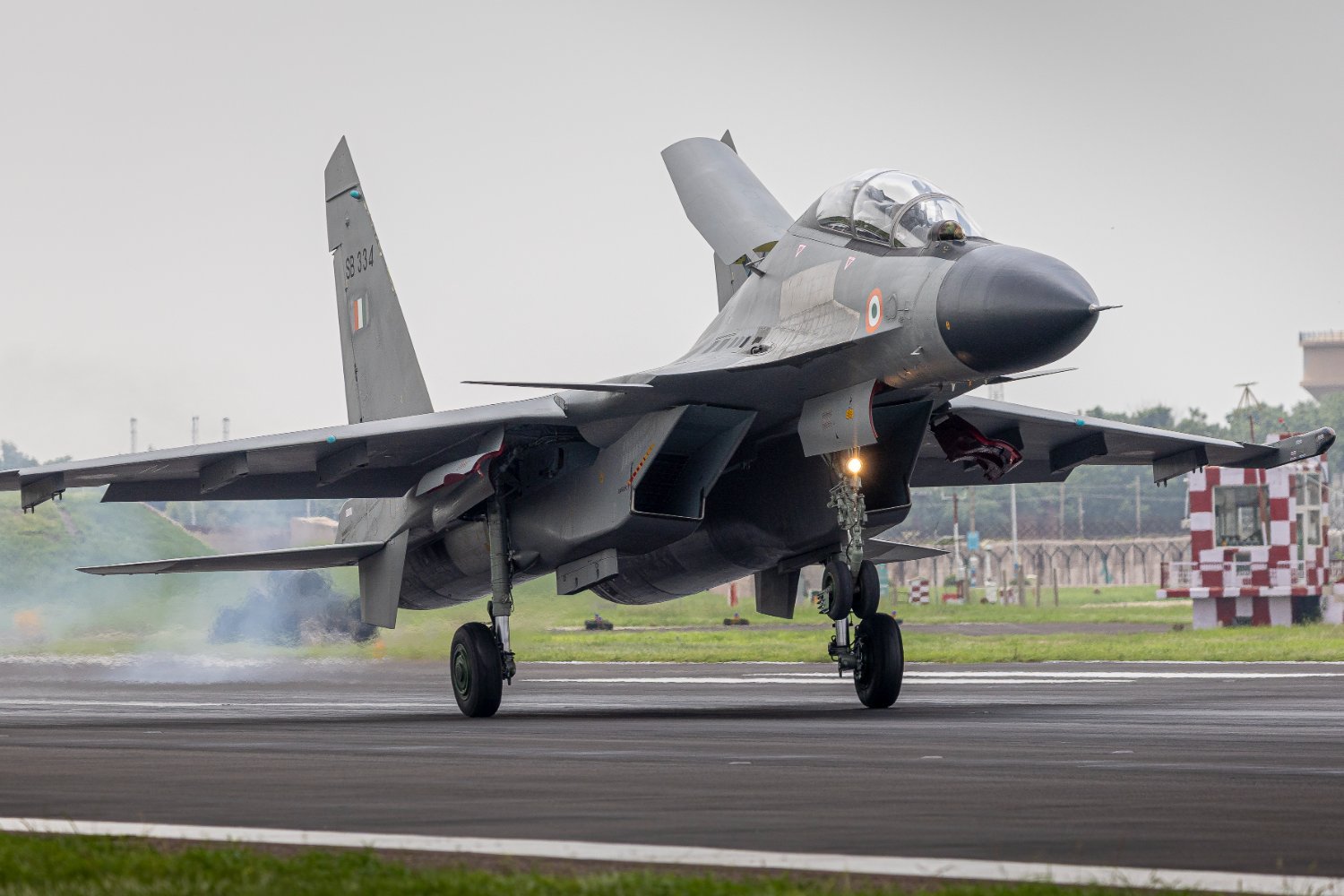
India has approved a series of defense acquisitions worth about $25 billion, including a major upgrade program for its Sukhoi Su-30MKI fighters, as part of a wider effort to modernize its armed forces and replenish capabilities following tensions with Pakistan.
The package, cleared by the Ministry of Defence, covers the procurement of transport aircraft, additional Russian-made S-400 air defence systems and remotely piloted strike drones. It also includes measures to extend the service life and capabilities of the Su-30MKI, the backbone of the Indian Air Force’s combat fleet.
India currently operates around 265 Su-30MKI fighters, an export variant of the Russian-designed aircraft that entered service in the early 2000s. A significant portion of the fleet was produced locally by Hindustan Aeronautics Limited (HAL), under license, as part of a long-running industrial partnership.
Follow us: WhatsApp | BlueSky | Google News | Instagram | LinkedIn | Facebook
The decision follows another large approval last month valued at roughly $40 billion for additional Dassault Rafale fighters and Boeing P-8I maritime patrol aircraft, underscoring the scale of India’s ongoing rearmament cycle.
The Su-30MKI modernization is expected to significantly expand the aircraft’s role beyond traditional air superiority missions. The upgrade centers on a new indigenous electronic warfare suite based on Gallium Nitride (GaN) technology, developed by India’s defense Research and Development Organisation.
GaN-based systems operate at higher power levels than previous technologies, allowing the aircraft to generate stronger radar and jamming signals. This improves detection range while increasing the ability to disrupt enemy radars and missile seekers across a wide frequency spectrum.
A key shift in the upgrade is the move from self-protection to escort jamming. Instead of focusing only on its own survivability, the Su-30MKI will be able to shield other aircraft by creating an area of electromagnetic interference, helping strike packages penetrate defended airspace.

The new system also incorporates Digital Radio Frequency Memory (DRFM) technology, which can capture and alter incoming radar signals to create false targets. This capability complicates enemy tracking and reduces the effectiveness of surface-to-air missile systems and interceptors.
Another element of the upgrade is the integration of the Virupaksha active electronically scanned array (AESA) radar. Unlike earlier configurations, the radar and electronic warfare systems will operate in a fused architecture, allowing simultaneous target detection and jamming without mutual interference.
To manage this increased complexity, the aircraft will receive a new mission computer with artificial intelligence-based functions designed to analyze threats and automatically deploy countermeasures.
India’s defense ministry said the latest approvals form part of a record level of procurement activity in the current fiscal year, which includes dozens of projects aimed at strengthening capabilities across all branches of the armed forces.
