


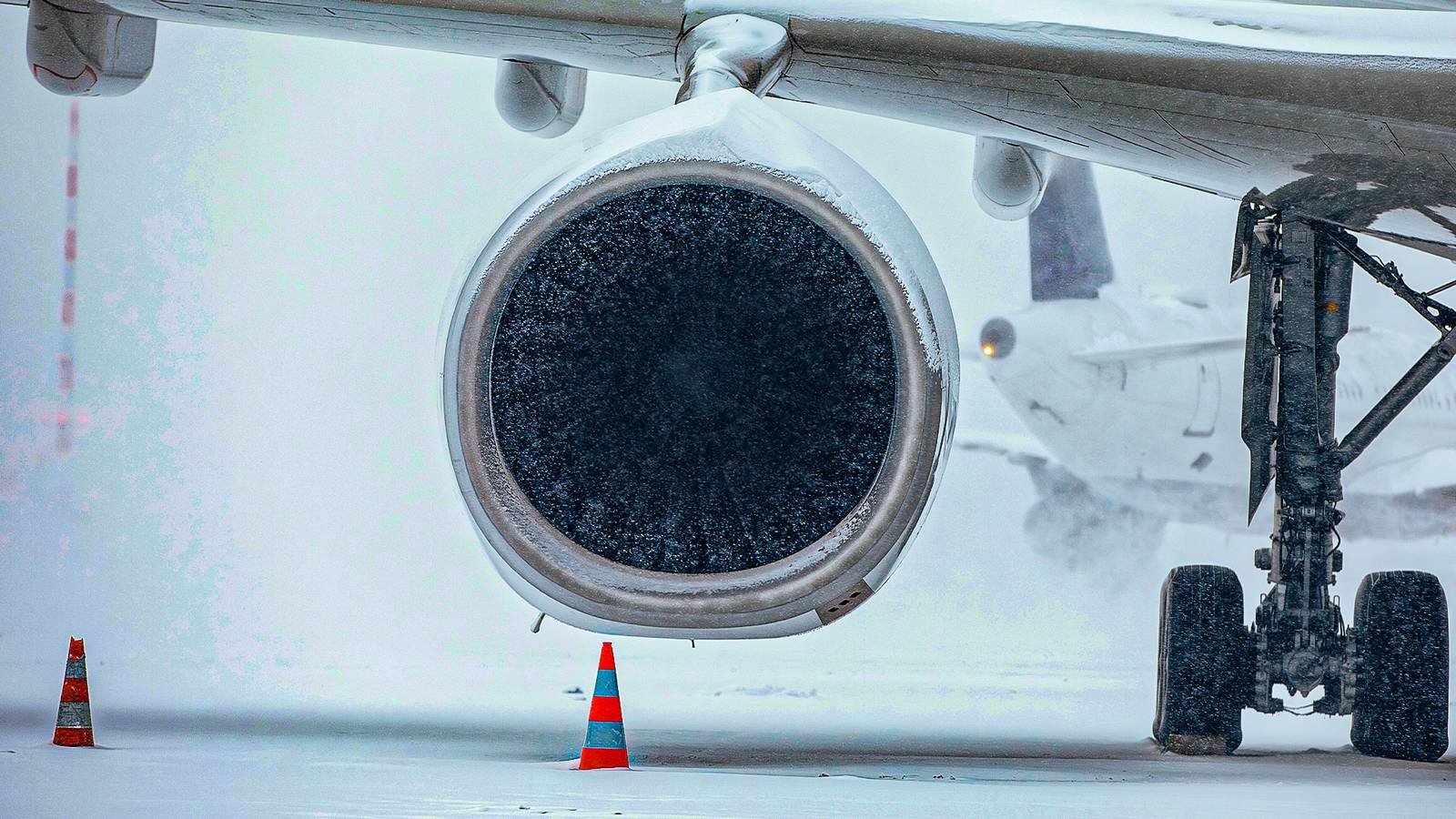
Snow and jet engines have a complicated relationship. On one hand, winter operations in many countries, including the US, routinely involve departures in falling snow and sub-zero temperatures. From regional aircraft taking off at Minneapolis-St. Paul International Airport (MSP) to widebodies pushing back at New York John F. Kennedy International Airport (JFK), aircraft operate safely in conditions that look anything but friendly to machinery that depends on massive volumes of air.
On the other hand, snow has played a role in a range of incidents over the years, from minor performance anomalies to serious power losses, but can snow actually increase engine thrust? The idea sounds counterintuitive, but it is rooted in a real historical practice seen in early aircraft like the Boeing 707 and the Douglas DC-8, which used water injection systems to boost take-off thrust. In this article, we will consider whether falling snow can create a similar effect in modern aircraft engines.
The Physics Behind The Phenomenon

At the heart of the argument is a basic thermodynamic principle: when water changes from liquid to vapor, it expands dramatically. Inside a jet engine’s combustor, temperatures can exceed 1,500 degrees Celsius, and if water droplets enter that environment, they flash into steam almost instantly. Steam occupies far more volume than liquid water, and that rapid expansion can increase mass flow through the turbine section.
In the early days of commercial aviation, engineers deliberately exploited this effect, and water injection systems sprayed distilled water into the engine, cooling the incoming air and increasing its density while also adding mass flow and thrust. This is the historical basis for the claim that moisture (or snow) can increase engine performance.
However, there is an important distinction between controlled water injection and random ingestion of snow or slush, as, in water injection systems, the amount, temperature, and purity of the water were carefully managed. Meanwhile, snow falling into an engine inlet during a departure from the likes of Chicago O’Hare International Airport (ORD) or  Denver International Airport (DEN) is anything but controlled.

What Is The Key Difference Between Turbojets & Turbofans?
Turbojets excel in high-speed flight, while turbofans offer better efficiency. Learn about history, differences and impact on the world of aviation!
How Do Modern Turbofan Engines Handle Moisture?

Modern high-bypass turbofan engines, like those found on popular aircraft families such as the Boeing 737 or Airbus A320, are certified to operate in heavy rain and snow. During testing, manufacturers often run engines in artificial precipitation to demonstrate that they can ingest significant amounts of water without flameout or surge.
In light snowfall, most of what enters the inlet melts quickly as it contacts warm engine surfaces or mixes with relatively warm intake air. From a purely theoretical standpoint, this added water mass can slightly increase exhaust mass flow. However, that does not automatically translate into a meaningful increase in thrust
This is because engine control systems are designed to maintain certain performance measures, such as turbine inlet temperature and spool speed. If extra mass flow slightly alters internal conditions, the aircraft’s digital engine control will adjust fuel flow to maintain limits, and in many cases, this system effectively cancels out any minor boost effect before it becomes noticeable.
Does Water Injection Add Thrust?

When it comes to commercial aircraft from decades ago, such as the Boeing 707 and the Douglas DC-8, water injection did add thrust, although early turbojets and low-bypass turbofans were relatively underpowered by modern standards. On hot days, especially from airports like  Phoenix Sky Harbor International Airport or
  Miami International Airport (MIA), aircraft performance could be marginal, and water injection systems provided a temporary thrust increase for take-off.
By spraying distilled water into the engine, operators could reduce compressor inlet temperatures and increase mass flow, and the result was higher thrust, allowing aircraft to meet climb gradients or operate from shorter runways. However, these systems were heavy, maintenance-intensive, and consumed large quantities of demineralized water. As aircraft engine technology improved, higher compression ratios and better materials eliminated the need for such systems.
By the time aircraft like the Boeing 757 and Boeing 767 became widespread, water injection was largely a thing of the past. The key point is that this kind of water injection was engineered, and the amount of water was calibrated for maximum benefit without destabilizing combustion. Naturally occurring snowfall is not a calibrated system.

White Out: How Do Airports Manage Winter Storms?
A hot topic after recent events!
The Risks Of Snow Ingestion

While small amounts of moisture may be harmless, snow can create very real hazards. The US National Transportation Safety Board ( NTSB) has warned about power losses linked to ice crystal ingestion at high altitudes, as ice crystals can enter the engine core, melt, and then refreeze on internal components. This would disrupt airflow and potentially lead to compressor stalls or flameouts.
This is not a theoretical concern, and high-altitude ice crystal icing has been implicated in multiple incidents involving modern turbofan engines. For example, aircraft cruising over convective weather systems have experienced unexpected power rollbacks, even when away from visible cloud.
On the ground, wet snow and slush pose different risks, as if snow accumulates in the inlet while an aircraft is parked at the gate, chunks can break free during engine start and cause foreign object damage. That is why ground crews carefully inspect and clear inlets before departure.
Modern aircraft engine anti-ice systems exist precisely because ice formation can degrade performance, and bleed air is routed to heat critical components, preventing ice buildup that could reduce airflow or damage fan blades. If snow ingestion truly provided a reliable thrust boost, anti-ice systems would not be necessary.
Performance Calculations In Winter Operations

Today, pilots normally calculate take-off performance using conservative assumptions. For example, on a snowy day at Denver International Airport (DEN), pilots operating a  United Airlines Boeing 737 MAX 8 will consider various elements, including runway contamination, braking action reports, and reduced acceleration. Snow on the runway increases rolling resistance and reduces tire friction, often requiring higher thrust settings, not lower ones.
Cold air itself can improve engine performance, as lower ambient temperatures increase air density, which increases mass flow through the engine. This can significantly enhance thrust and climb performance. For example, a chilly morning departure from Anchorage Ted Stevens International Airport (ANC) can yield better performance margins than a sweltering afternoon at  Dallas/Fort Worth International Airport (DFW).
Ranking | Destination | Number Of Passengers | Airline(s) |
|---|---|---|---|
1 | Seattle-Tacoma International Airport (SEA) | 987,000 | Alaska Airlines, Delta Air Lines |
2 | Fairbanks International Airport (FAI) | 175,000 | Alaska Airlines |
3 | Minneapolis-St.Paul International Airport (MSP) | 123,000 | Alaska Airlines, Delta Air Lines |
4 | Chicago O’Hare International Airport (ORD) | 105,000 | Alaska Airlines, American Airlines, United Airlines |
5 | Portland International Airport (PDX) | 101,000 | Alaska Airlines |
At the former, Alaska Airlines is by far the largest operator, commanding a 63% market share, putting it ahead of  Delta Air Lines, with 13%. The busiest routes from the facility in 2025 are outlined in the table above. It is easy to confuse the benefits of cold, dense air with the presence of snow, but the thrust increase pilots experience on a cold winter’s day is due primarily to lower temperatures, not falling precipitation.
In other words, snow may be present, but it is not the main contributor to the increase in thrust. In fact, heavy snowfall can reduce visibility, complicate de-icing procedures, and introduce additional delays. With that in mind, most major commercial airlines, such as  American Airlines and
  Alaska Airlines, build winter operations plans around mitigating risk, not exploiting theoretical thrust gains.

How Many Engine Types Power The Boeing 787 Dreamliner?
The Boeing 787 Dreamliner soars through the skies, but what powers this marvel of aviation?
So, Can Snow Increase Thrust?

Shutterstock | Simple Flying
In a technical sense, yes. Water entering a jet engine and vaporizing can increase exhaust flow, and the historical precedent of water injection on early aircraft like the Boeing 707 demonstrates that adding water can produce measurable thrust gains under controlled conditions.
However, in everyday airline operations, falling snow does not function as an improvised water injection system. The quantity and consistency are unpredictable, and engine control systems are designed to maintain limits, not capitalize on random environmental inputs. Certification standards by the US Federal Aviation Administration (FAA), for example, require engines to tolerate precipitation without adverse effects, not to derive performance benefits from it.
In practical terms, any thrust increase from melting snow would be negligible compared to the overall thrust output of a modern high-bypass turbofan. A typical engine on a Boeing 737-800, for example, can produce more than 20,000 lbs of thrust, and the small amount of water contained in light snowfall would represent only a tiny fraction of the engine’s total mass flow.
Moreover, under certain conditions, snow and ice can reduce thrust or even cause power loss, which is why anti-ice systems, careful pre-flight inspections, and conservative performance calculations remain central to winter flying. Moisture can, under the right conditions, contribute to increased thrust, but in the complex, highly regulated world of modern airline operations, snow is treated as a factor to manage, not a performance enhancer to exploit.
