


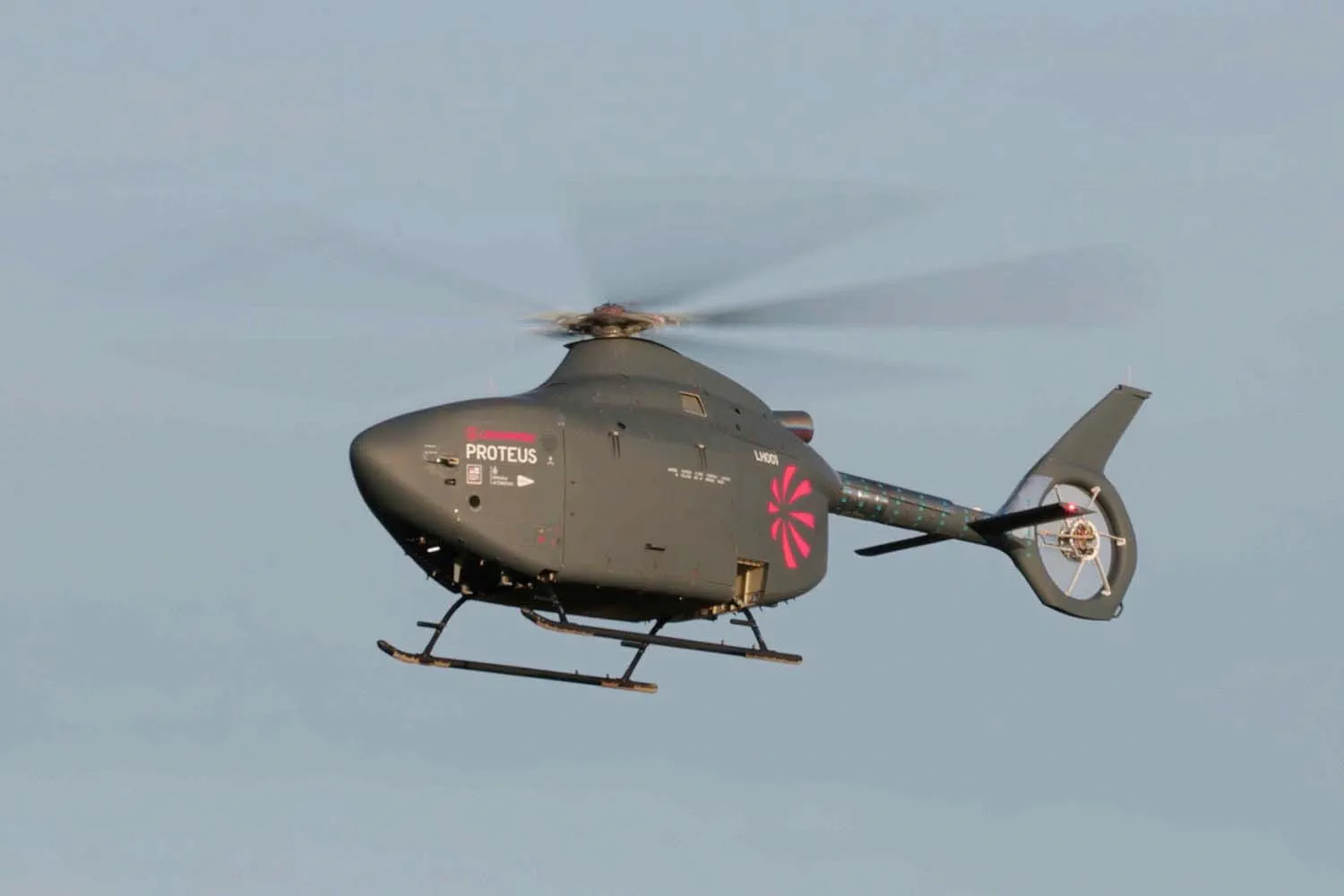
Having flown its Proteus autonomous rotary-wing testbed at the start of this year, Leonardo Helicopters UK is now waiting on Ministry of Defence (MoD) decisions to set a course for its Rotary-Wing Unmanned Air System (RWUAS) technology maturation and product development roadmap.
The Proteus technology demonstrator – delivered as part of a four-year, £60 million RWUAS Phase 3a contract awarded to Leonardo by the MoD in June 2022 – completed two short test flights in January this year. With the Phase 3a programme wrapping up, the company is expecting the MoD’s forthcoming Defence Investment Plan to provide clarity on the Royal Navy’s (RN’s) future investment plans.
Sponsored through the RN’s Anti-Submarine Warfare (ASW) Spearhead initiative, Proteus has been designed to mature technologies applicable to the RN’s Maritime Aviation Transformation Strategy (MATX), which has set out a vision for a ‘hybrid’ air wing in which the majority of RN aviation roles will transition to uncrewed and increasingly autonomous systems over the next 15 years. In this context, Proteus has been designed to generate evidence that a large autonomous and modular UAS can deliver or contribute to the delivery of military maritime effects with fewer people and at lower cost.
The Proteus air vehicle is a 3-tonne class single-engine design featuring a large modular payload bay designed for approximately 1,500 kg of payload. While the aerostructure and architecture are new, Leonardo has leveraged ‘off-the-shelf’ components from its existing rotary-wing portfolio – most notably the engine and dynamic components from the Kopter AW09 light helicopter — to reduce cost and development risk.
Having achieved a full military permit to fly from the UK Military Airworthiness Authority, Proteus completed two short test flights at Predannack airfield in Cornwall on 10 January. This flight test milestone effectively marked the culmination of RWUAS Phase 3a activity.
According to Mike Roberts, Leonardo’s product marketing specialist for uncrewed systems and UK future programmes, the aircraft is now entering a period of scheduled maintenance at the company’s Yeovil plant while engagement continues with the MoD on next steps. “Obviously, we hope to continue to fly….that’s a discussion we’re having,” he said. “But the really important point is that we continue to develop the ‘brain’ – that autonomous functionality that will enable future systems to operate. This is very much a ‘digital first’ approach utilising our synthetic environment and our full systems integration rig.”

Programme manger Michael Schunke expanded this point. “The use of a digital twin reduces the need for physical flight testing [and] de-risks the activity when you do go into flight test,” he said. “It minimises the time you need, and it gives you more confidence in what you’re going to achieve because you’ve done all that in digital environment.
“This is the first time that an aircraft development programme, certainly that we’re aware of in the UK, has used a Digital Twin to that extent.”
The primary focus for RWUAS Phase 3a has been directed towards the ASW ‘find’ mission, including the development of modular payload concepts for the carriage and deployment of ASW mission equipment including G-size sonobuoys, magnetic anomaly detection and active dipping sonar. Reflecting this, the Proteus mission system has been developed to facilitate autonomous functionality on ASW operations with significant onboard data processing to generate tracks to inform initial classification.
“To inform [the ASW ‘find’ mission] we performed a demonstration in our synthetic environment utilising autonomous flight control laws to demonstrate the viability of that platform,” Roberts said. “This was successfully achieved in July of 2024.
“We then went on to evaluate the potential contribution of a Proteus-type RWUAS to a range of other use cases. This looked at over 16 different mission sets, ranging from airborne early warning to persistent wide area surveillance and intra-theatre lift.”
He continued. “It is important to stress that this isn’t a remotely piloted air system. Proteus has been designed from concept to be autonomous, to reduce the number of people involved in the operation of the aircraft [and] with the opportunity to move to one operator, multiple assets on mission in a networked system, and multiple missions performed from a single operator.”
Leonardo remains sanguine about prospects for further funding for a next stage of RWUAS development and technology maturation. “We’ve got to a point now where we’ve demonstrated flight, and we’ve demonstrated that we’ve got the autonomy to a [certain] point,” said Adam Wardrope, Leonardo Helicopters UK’s vice president market development.
“We now need to go to the next phase of the programme…that is very much dependent on the customer. We’re now in negotiation with the Royal Navy and the MoD about the next stage of funding and what they want to achieve from that. So that’s how we could spiral, and what further development we could do.
“The Strategic Defence Review and the Defence Industrial Strategy both pointed to a future of autonomy, so therefore we’re reasonably confident that further investment will come,” Wardrope added. “Certainly, the Royal Navy MATX vision and the hybrid carrier air wing vision really does feature something like Proteus, so again we’re relatively optimistic that further funding will come.”
“I’m also now starting to engage with international customers, international partners that might be interested in the programme. Those nations are operating in a very similar environment and a very similar way to the Royal Navy. The more investment we get, the more partners we get, the quicker we can get on and develop this.”
Proteus itself has been designed as a low-cost technology demonstrator, and is not representative of a production platform. Both Leonardo and RN sources suggest that requirements for range/endurance, payload, and operation from naval platforms in poor weather/high sea states are likely to condition a twin-engined autonomous RWUAS in the 5-8 tonne class, albeit with only a modest increase in overall footprint.
“As part of Proteus we have generated a lot of evidence to our customer on what the future will look like,” Roberts told Naval News. “What that is we can’t disclose, but we have done a lot on how the Proteus moves forward as a programme and the roles it can perform. The platform could end up being slightly larger than what it is today.”
While autonomy represents a significant growth opportunity for Leonardo going forward, the company still sees major prospects for crewed rotorcraft. “We see Proteus as a complementary capability over an iterative development [cycle],” said Roberts. “There is a clear requirement for the Royal Navy to increase mass, and to build in autonomous systems [as part of a hybrid force].
“But the crewed platform remains core, even in MATX.”
