


Mexico’s nationwide trucker and farmer strike stretched into a second day Tuesday, with ongoing highway blockades, mounting congestion around Mexico City and continued disruptions to key freight corridors across the country.
What began Monday as a coordinated protest across at least 20 states has evolved into a prolonged logistics disruption, with some transport groups signaling the strike could continue until the federal government delivers concrete security and cost relief measures.
Blockades persist across central Mexico, key corridors
As of early Tuesday, road closures remained in several critical corridors linking the State of Mexico with Mexico City, creating a “mobility crisis” in the country’s most important freight hub, according to El Manana.
Authorities and media outlets reported continued disruptions on highways including:
- Mexico–Toluca corridor (La Venta toll plaza)
- Federal Highway 136 (Mexico City–Veracruz)
- Federal Highway 110 in Guanajuato
- Siglo XXI Highway in Morelos
- Key toll plazas and access roads in central Mexico
In some locations, traffic was completely paralyzed for hours, with limited alternative routes and long queues of trucks and passenger vehicles.
Nationwide, protests were reported in at least 13 to 16 states, including Veracruz, Michoacán, Chihuahua, Sinaloa, Tamaulipas and Baja California, with truckers and farmers using tractor-trailers to block highways and intermittently allow traffic to pass.
Strike shows signs of fragmentation — but tensions rising
Conflicting reports from Mexican media suggest the strike may be fragmenting. Some outlets report that ANTAC and allied groups have temporarily suspended blockades pending talks with federal authorities, while localized protests continue in parts of the country.
At the same time, several major trucking and business organizations have distanced themselves from the actions and called for dialogue, highlighting divisions within the sector and uncertainty around how long freight disruptions may persist.
Some reports also indicated that certain blockades were lifted late Monday following a proposal from Mexico’s Interior Ministry; other groups have continued or resumed protests Tuesday, underscoring divisions within the movement, according to El Sur.
Leaders from the National Association of Transporters (ANTAC) pushed back against the government’s claim that there is “no reason” for protests, arguing that authorities are ignoring widespread insecurity, extortion and violence facing drivers.
“To say there are no reasons is to ignore the serious insecurity on the highways, where colleagues lose their lives or their property every day,” the group said according to Aristegui News.
Major industry organizations such as CANACAR have distanced themselves from the blockades, warning that highway closures increase risks for drivers and cargo and can drive up freight costs and spoil perishable goods.
Security concerns, costs continue to drive protests
Transporters and agricultural producers reiterated that the strike is rooted in longstanding issues, including:
- Cargo theft and violent highway robberies
- Extortion by criminal groups and alleged abuses at checkpoints
- Rising diesel prices and operating costs
- Lack of effective government response to security concerns
Protest leaders say the situation is “unsustainable” and are demanding direct talks with President Claudia Sheinbaum, along with measures such as eliminating diesel taxes, increasing highway patrols and creating a specialized prosecutor for cargo theft.
Mexico cargo theft and highway security — by the numbers
- 6,263 cargo truck robbery investigations opened in Mexico in 2025 (official cases)
- 16,000+ estimated cargo theft incidents annually including unreported crimes
- 50–60 cargo theft incidents per day nationwide
- 7+ billion pesos estimated annual economic losses from cargo theft
- 20 states affected by April 6 trucker and farmer strike and blockades
- Major affected freight corridors include Mexico–Querétaro, Mexico–Puebla, Mexico–Pachuca, Federal Highway 45, and border crossings in Ciudad Juárez, Tijuana and Mexicali
Risk to freight, cross-border flows
The ongoing disruptions are hitting core domestic and cross-border supply chains, including routes connecting central Mexico to manufacturing hubs, ports and U.S. border crossings.
In northern Mexico, blockades in Tamaulipas disrupted access to routes feeding cross-border trade lanes, while elsewhere, protesters temporarily halted freight rail movements and blocked access to major industrial facilities.
Industry leaders warn that prolonged disruptions could lead to higher transportation costs, delivery delays and increased cargo theft risk as trucks remain stationary on highways.
“The movement of goods can be affected to the point that perishable products become unusable, and road blockades leave operators and merchandise vulnerable,” said CANACAR President Augusto Ramos Melo.
Outlook: uncertain as negotiations stall
As of Tuesday morning, negotiations between protest leaders and federal authorities appeared ongoing but unresolved, with transport groups warning the strike could remain indefinite without concrete commitments.
Some organizers have also alleged intimidation and repression by authorities in certain states, raising tensions and further complicating efforts to reach an agreement.
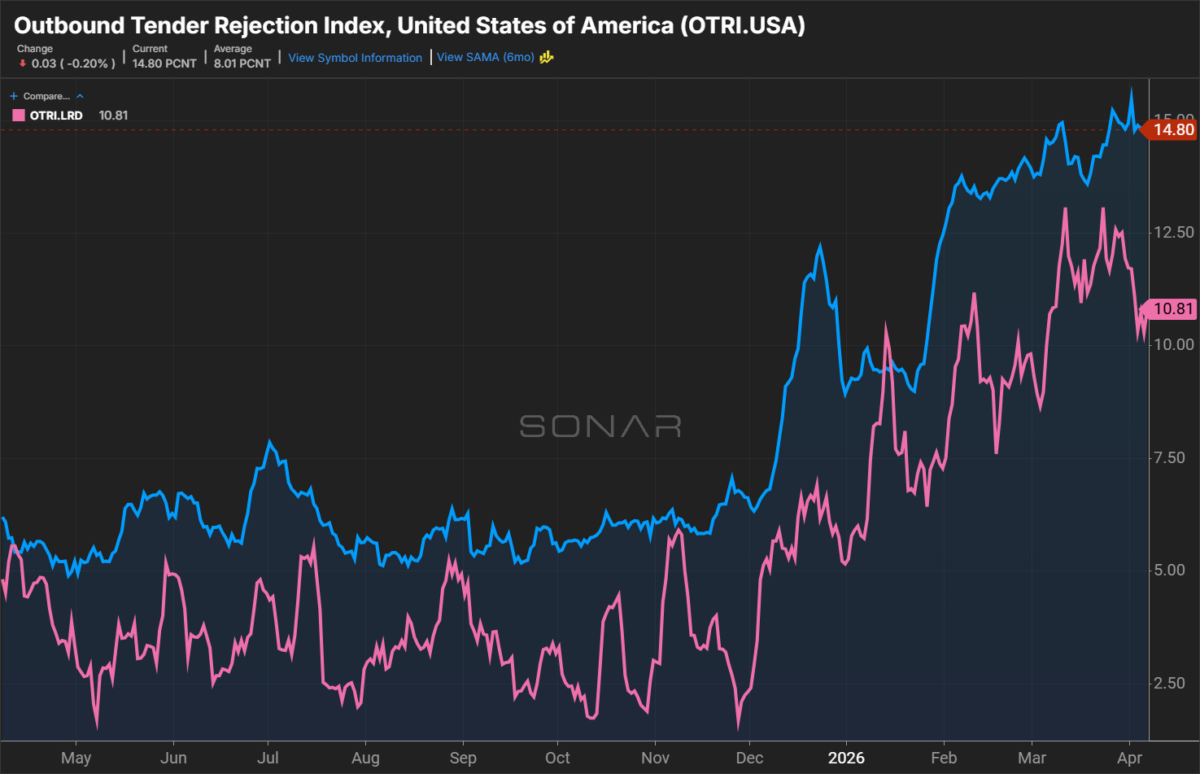
SONAR: Tightening U.S. capacity raises risk of cross-border spillover
SONAR, a freight market analytics and data platform, suggests the U.S. truckload market was already tightening heading into the Mexico disruptions — amplifying the potential impact on cross-border freight.
- SONAR’s Outbound Tender Reject Index (OTRI.USA) is hovering around 13%–14% in early April, up sharply from sub-5% levels seen through much of 2023–2025.
- That level signals moderate capacity tightening, with carriers increasingly rejecting contracted loads and pushing freight into the spot market.
- As of April 6, SONAR data is showing that rejection rates in Laredo, Texas, are up 37% year over year.
The post Mexico freight disruption lingers as truckers’ strike fractures appeared first on FreightWaves.
