


NASA’s Artemis II mission made history as the first human spaceflight to orbit the moon in more than half a century, sending four astronauts farther from Earth than any human has ever ventured. But the space agency does not quite know what will come next.
The first crewed lunar landing under Artemis is tentatively scheduled for Artemis IV in early 2028 after NASA overhauled the program in February. Artemis III, originally intended to be a crewed landing, was changed to a low-Earth orbit test flight scheduled for mid-2027.
“The entire sequence of Artemis flights needs to represent a step-by-step buildup of capability, with each step bringing us closer to our ability to perform the landing missions,” Amit Kshatriya, associate administrator of NASA, said in February. “Each step needs to be big enough to make progress but not so big that we take unnecessary risk given previous learnings.”
Both Artemis III and IV will incorporate at least one commercially built human landing system (HLS) vehicle that is designed to ferry the astronauts between lunar orbit and the moon’s surface.
However, NASA does not yet know who will provide it, despite spending nearly $7 billion on HLS development since awarding contracts to SpaceX and Blue Origin in 2021 and 2023.
U.S. Transportation Secretary Sean Duffy said in October, as interim NASA administrator, that the agency would open SpaceX’s HLS contract—which covers the first two crewed lunar landings under the original Artemis framework—to Blue Origin and others. It has paid out at least 65 percent of the approximately $4 billion it owes SpaceX for that project.
NASA Administrator Jared Isaacman has since indicated he plans to follow through on Duffy’s pledge.
SpaceX and Blue Origin in November submitted revised lunar landing profiles intended to meet the space agency’s urgency. But what would happen if they can’t?
Next Up: Artemis III
Duffy’s rationale for reopening SpaceX’s contract was that the company is “behind” on its HLS, which is based on its gargantuan Starship rocket.
Starship has completed 11 suborbital test flights in the past three years but is far from being ready to deliver humans to the moon. In 2025, the rocket suffered multiple catastrophic mishaps that disrupted air travel and kept it grounded for weeks.
Lori Glaze, acting associate administrator for NASA’s Exploration Systems Development Mission Directorate, in March predicted Starship Version 3 (V3)—intended as the model’s flagship variant—would fly in April. That timeline has already moved to May, SpaceX CEO Elon Musk said last week.
A slip could complicate NASA’s plans for Artemis III.
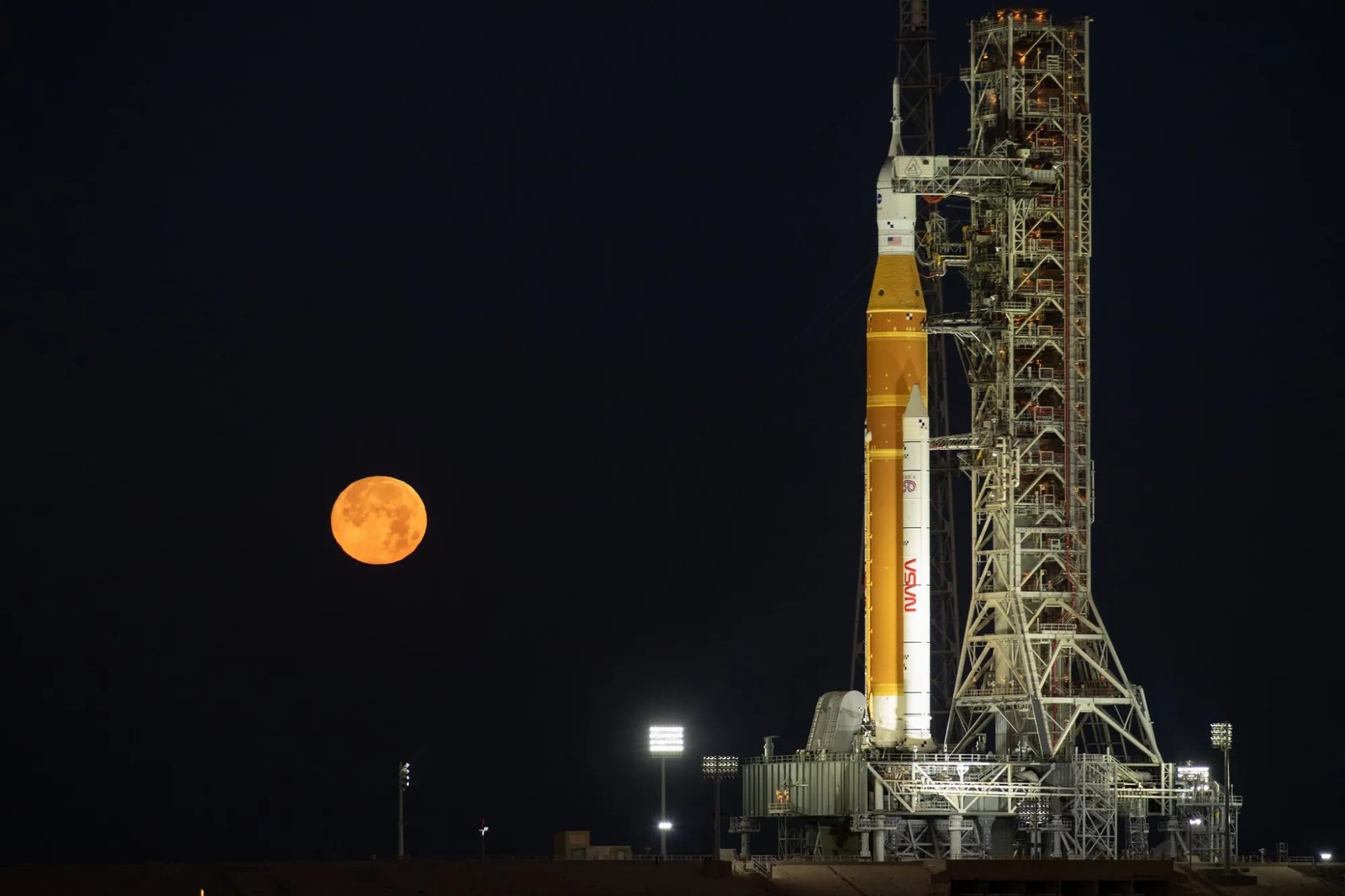
The Space Launch System (SLS) rocket and Orion crew capsule for that mission are scheduled to be rolled to Kennedy Space Center in Florida by mid-to-late April. The test flight is intended to gauge spacecraft performance and operational capabilities in low-Earth orbit before sending a crew to the moon.
The astronauts will launch to orbit in Orion and aim to rendezvous and dock with both HLS vehicles. But if Starship isn’t ready, Blue Origin’s Blue Moon Mark 2 could be the only target. Blue Moon Mark 1, a smaller version of the lander, is set to make its debut orbital flight in a few months.
Artemis III will be NASA’s only opportunity to test the combined life support, communications, and propulsion systems of the docked spacecraft in space before sending humans to the moon. If one HLS does not perform as expected, the space agency could face delays to Artemis IV—or be forced to use the other without fully testing it.
Beyond Artemis III, NASA will require SpaceX and Blue Origin to complete uncrewed, pre-landing lunar ascent demonstrations. But those missions “will not be in configurations fully representative of their planned crewed vehicles,” per a March report from NASA’s Office of the Inspector General (OIG).
If neither company is ready for Artemis III, NASA could turn to a third provider with experience on the Artemis program such as Boeing, Lockheed Martin, or Northrop Grumman.
In addition to the HLS vehicles, Artemis III could be the first test of new spacesuits developed by Axiom Space, developed primarily for moonwalking and lunar exploration.
Artemis IV and Beyond
Artemis IV, scheduled for early 2028, will launch a crew in Orion atop the SLS to lunar orbit, where it will rendezvous with an HLS that launched earlier. The astronauts will spend about a week near the lunar south pole, becoming the first humans to do so.
According to NASA, the HLS provider will be determined by whichever vehicle is most ready for the mission. That is not the only question mark.
Also unclear is which contractor will supply a new SLS upper stage. NASA had been planning larger, more powerful SLS variants. But it canceled them in February in favor of standardizing the design, citing delays to Boeing’s development of a future upper stage structure. The interim cryogenic propulsion stage (ICPS) that powered Artemis II will be out of commission by Artemis IV, so NASA will need to look for alternatives.
Another uncertainty is Orion’s heat shield, which unexpectedly cracked during the uncrewed Artemis I mission in 2022. An improved heat shield will be installed for Artemis III. But since that mission will remain in Earth orbit, its ability to protect a crew traveling nearly 24,000 mph as it returns from the moon will be tested for the first time on Artemis IV.
If that mission goes to plan, the space agency expects Artemis to really take off.
In March, NASA revealed plans to conduct semiannual crewed landings beginning in 2028, double what it announced in late February. It will overhaul its Commercial Lunar Payload Services (CLPS) and Lunar Terrain Vehicle (LTV) programs and enlist the NASA Force—private sector employees appointed to temporary agency positions—to support an increased cadence.
Artemis V in late 2028 would kick off NASA’s plan to build a permanent, $30 billion moon base. It will use the CLPS and LTV programs to begin delivering satellites, lunar drones, and other assets to the moon. In 2029, it plans to begin installing power, communication, and mobility systems that would allow astronauts to live and work there for weeks, or even months.
By 2032, NASA aims to establish a continuous human presence on the moon. It will begin long-duration, long-distance surface missions, using nuclear propulsion to explore craters and other regions in which humans have never set foot.
The space agency plans to use the lunar regolith for 3D printing or to extract oxygen, water, and other materials that would let a crew sustain itself. It will build multiple habitats and potentially use them as bases for missions to Mars and beyond.
In short, NASA has an entire universe of plans for the Artemis campaign. But the specifics will depend on what happens in the next few years.
