


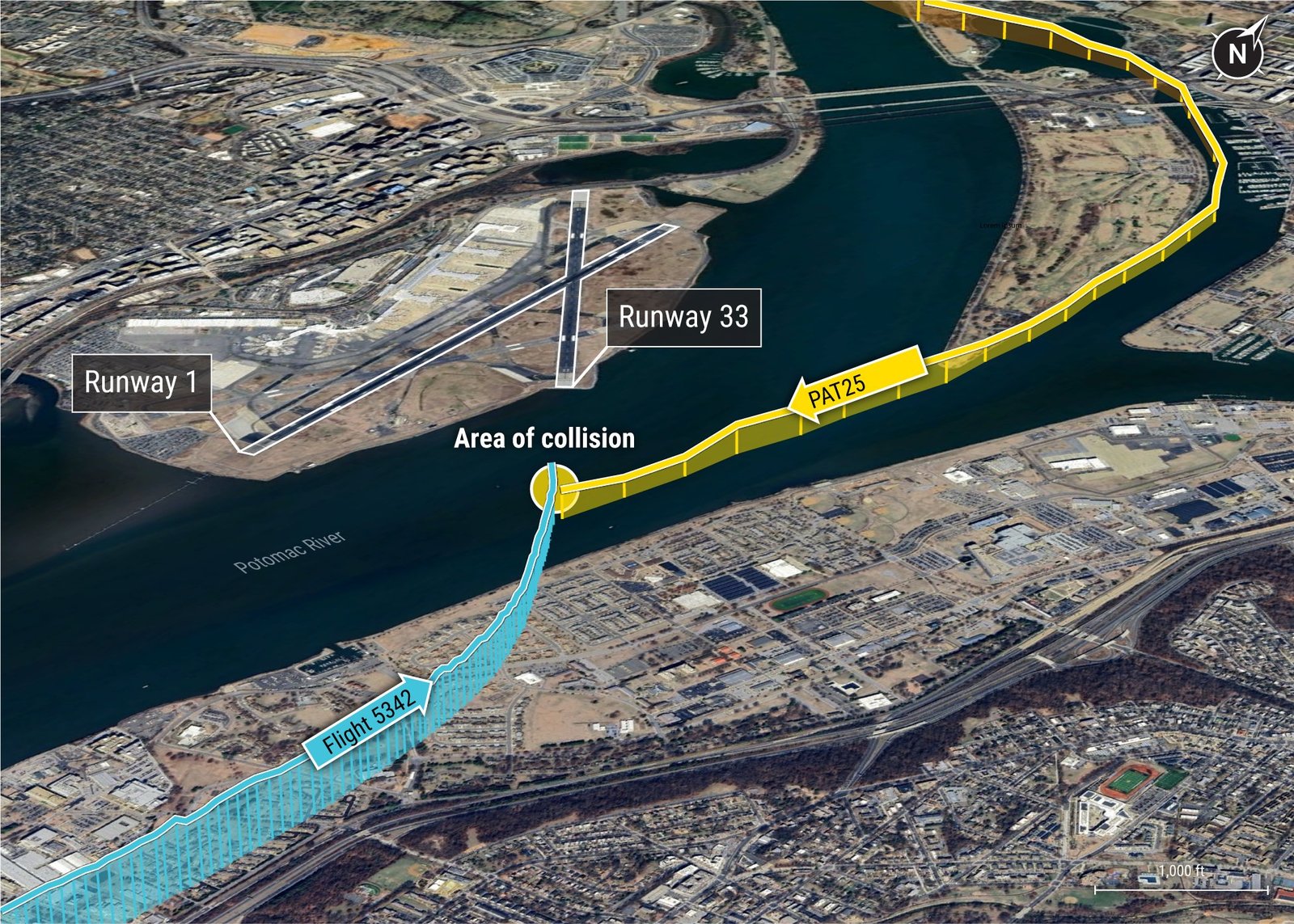
The National Transportation Safety Board (NTSB) released its full final report Tuesday, which determined that flawed airspace design and systemic safety management failures led to the January 29, 2025 midair collision between a regional jet and an Army Black Hawk helicopter near Ronald Reagan Washington National Airport that killed 67.
In its nearly 400-page DCA final report, the NTSB found that the Federal Aviation Administration placed Helicopter Route 4 too close to the Runway 33 approach path without adequate safeguards. Investigators said the FAA failed to act on data and repeated warnings that showed increasing midair collision risk in the DCA terminal area.
The Board also cited heavy reliance on pilot-applied visual separation in one of the country’s most complex airspace environments. On the night of the accident, the DCA tower combined helicopter and local control positions during a busy period, increasing controller workload and reducing situational awareness. A blocked radio transmission prevented the helicopter crew from hearing part of an instruction to pass behind the arriving CRJ.
Investigators said the Army crew, operating with night vision goggles, believed they had the traffic in sight but were flying above the published route altitude. The report also noted limitations in both aircrafts’ collision-avoidance systems. While the regional jet’s TCAS functioned as designed, it did not issue a higher-level resolution advisory because of altitude limits. The helicopter had no integrated traffic alerting system. Investigators said next-generation systems such as ACAS Xa and ACAS Xr could have significantly reduced collision risk.
The NTSB issued 33 recommendations in its DCA final report aimed at airspace redesign, improved collision-avoidance technology, and stronger safety management oversight.
In its probable cause finding, the Board cited the FAA’s airspace design decisions, failure to mitigate known risks, overreliance on visual separation, high controller workload, and inadequate Army oversight of altimetry procedures.
The DCA final report describes a chain of systemic vulnerabilities that investigators say were visible in safety data long before the fatal collision.
