


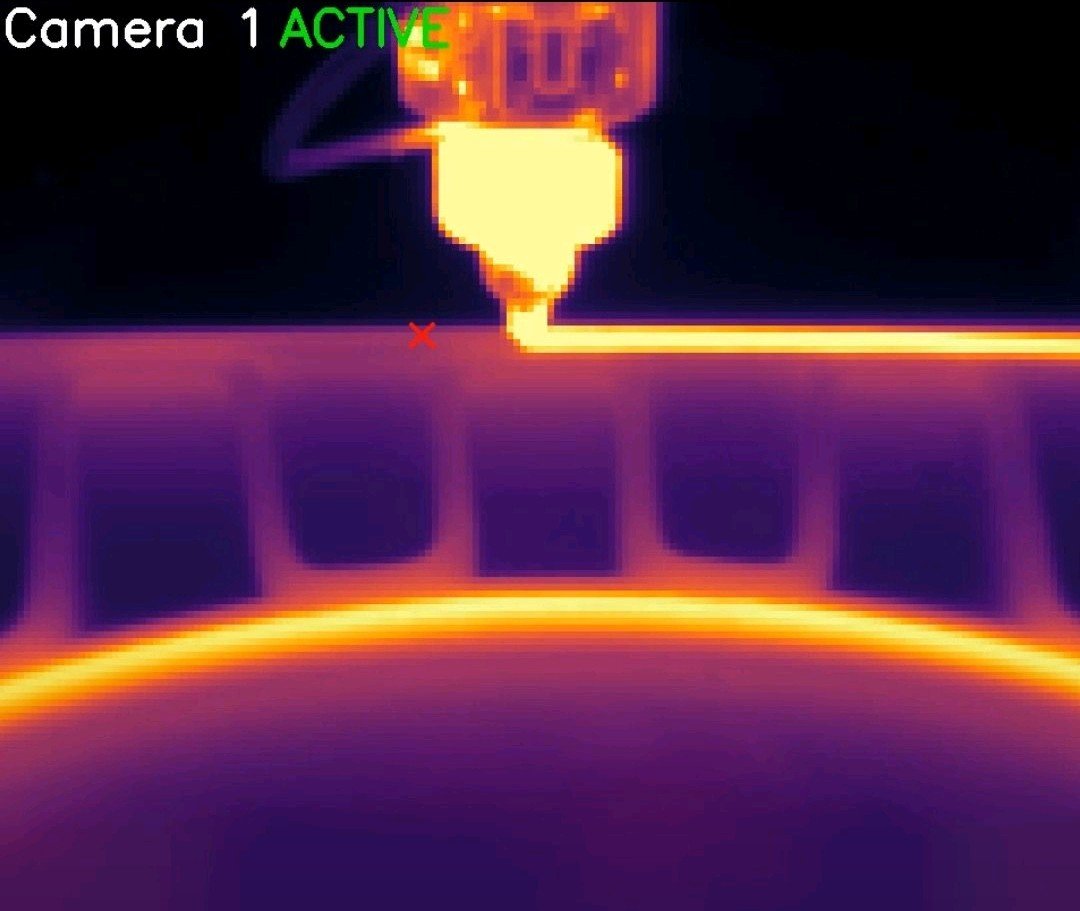
Dutch 3D printing service provider Royal3D has launched the Interlayer Control System (ICS), a thermal monitoring tool for industrial 3D printing operations.
The Rotterdam-based provider’s system uses a 160 x 140 pixel thermal camera to continuously track nozzle positions across XYZ coordinates, measuring and logging interlayer temperatures as a print runs.
Temperature inconsistencies between layers can cause poor layer adhesion, internal stresses, warping, and misprints, and these issues typically go undetected until after a job is completed, at which point the material is already wasted and production timelines have taken a hit. The Interlayer Control System addresses this by giving operators visibility into interlayer temperatures in real time, before problems have a chance to compound.
“Royal3D is excited to share this technology with other 3D printing companies,” said Fulko Roos, Founder of Royal3D. “Our goal is to empower manufacturers to take control of their quality processes, reduce material waste, and improve efficiency across the board. This is more than a tool but it’s a pathway to smarter, data-driven manufacturing.”

Real-Time Data at Every Layer
Beyond catching problems early, the system also builds a thermal record that operators can use to better understand how specific materials behave under different temperature conditions. For instance, Royal3D notes that a profile that works well for PETG may not produce the same results with PP, and that analysing accumulated thermal data over time helps fine-tune parameters on a per-material basis.
On the technical side, the system requires a PLC-controlled installation capable of returning real-time XYZ nozzle coordinates and is specifically designed for Robotic Arm 3D printers. It runs on a dedicated computer and slots into existing setups.
Getting it up and running takes four steps, with the first three covering hardware and software installation and system integration, and the fourth handling calibration. Day-to-day, the system is fully automated and needs no hardware maintenance, though Royal3D recommends periodic calibration checks to keep measurements accurate.
The company says adoption of the system leads to fewer misprints, better layer adhesion, less material waste, reduced post-processing, fewer manual quality checks, and shorter lead times.

A Growing Focus on Print Temperature
Monitoring interlayer temperature in real time is not simply a matter of pointing a thermal camera at a printer. The challenge lies in correlating thermal readings with the exact position of the nozzle at any given moment during a live print, a level of precision that general process monitoring does not provide.
The approach has been gaining traction in large-format additive manufacturing. Ai Build’s Thermal Shield, deployed on the Rapid Fusion Medusa hybrid 3D printer, uses a similar infrared camera-based approach to monitor interlayer temperatures during 3D printing, automatically adjusting print settings to maintain optimal thermal conditions and logging process data for traceability in sectors such as aerospace and automotive.
Elsewhere, US-based large-format 3D printers manufacturer Thermwood added thermographic imaging to its LSAM machines to monitor surface temperatures during printing, feeding real-time imagery to operators who adjust print speed and cooling accordingly.
3D Printing Industry is inviting speakers for its 2026 Additive Manufacturing Applications (AMA) series, covering Energy, Healthcare, Automotive and Mobility, Aerospace, Space and Defense, and Software. Each online event focuses on real production deployments, qualification, and supply chain integration. Practitioners interested in contributing can complete the call for speakers form here.
To stay up to date with the latest 3D printing news, don’t forget to subscribe to the 3D Printing Industry newsletter or follow us on LinkedIn.
Explore the full Future of 3D Printing and Executive Survey series from 3D Printing Industry, featuring perspectives from CEOs, engineers, and industry leaders on the industrialization of additive manufacturing, 3D printing industry trends 2026, qualification, supply chains, and additive manufacturing industry analysis.
Featured image shows Royal3D’s Interlayer Control System thermal camera feed showing real-time heat distribution at the nozzle during a live print. Image via Royal3D.
