


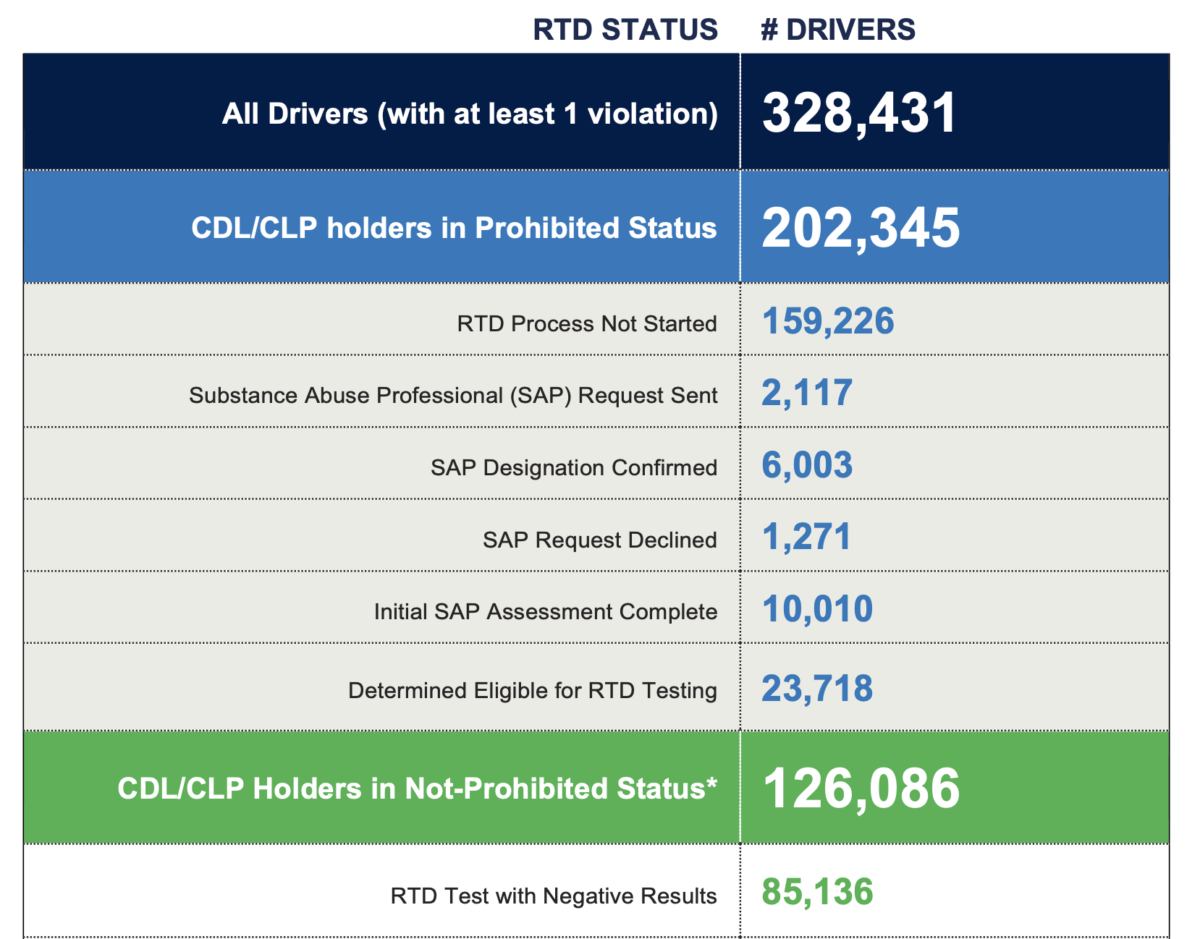
The chart below is real. It comes directly from FMCSA’s Drug and Alcohol Clearinghouse. It is publicly available. And based on the coverage it has received relative to its significance, it might be the most important piece of data in the trucking industry that the industry has largely ignored.
Here is what it says, in plain language, and then here is what it means for every carrier operating in the current environment.
What the Chart Actually Shows
The FMCSA Drug and Alcohol Clearinghouse launched in January 2020. It is a federal database that tracks every drug and alcohol testing violation for CDL and CLP holders in the United States. When a driver tests positive or refuses a test, the violation is reported to the Clearinghouse. From that point forward, the driver is in “prohibited” status — they cannot legally perform safety-sensitive functions, including operating a commercial motor vehicle, for any DOT-regulated employer until they complete the Return-to-Duty (RTD) process.
As of January 2, 2026, the Clearinghouse shows 328,431 total CDL and CLP holders with at least one violation on record. Of those:
202,345 are currently in “prohibited” status — meaning they cannot legally drive a commercial vehicle right now, today. Their CDL has been downgraded to a standard passenger license by their state following the Clearinghouse-II rule that took effect November 18, 2024.
Breaking down where those 202,345 prohibited drivers are in the process:
- 159,226 have not started the RTD process at all. They received a violation, and they have done nothing. No SAP evaluation request sent, no contact with a Substance Abuse Professional, nothing.
- 2,117 had an SAP request sent but it has not been confirmed
- 6,003 have a SAP designation confirmed — they are assigned to a SAP but have not completed the evaluation
- 1,271 had their SAP request declined
- 10,010 completed the initial SAP assessment
- 23,718 have been determined eligible for RTD testing — they finished the SAP process and are waiting to pass a return-to-duty drug test
On the other side: 126,086 are in “not prohibited” status, meaning they went through the RTD process and completed it. Within that group, 85,136 have a negative RTD test result on file, and 40,950 have completed their entire follow-up testing plan.
The Number That Defines the Story: 159,226
More than 159,000 CDL and CLP holders with active violations in the federal database have not taken a single step toward getting back in compliance. Not one. No SAP contact, no evaluation, no engagement with the process at all.
That is 78.7% of all currently prohibited drivers — and it is not a surprise to anyone who has been watching this data accumulate since 2020. In March 2025, The Trucker reported that 63.2% of drivers with a positive substance test had never started the RTD process and had essentially “chosen to change careers” rather than go through the steps to requalify. The January 2026 data shows that percentage has gotten worse, not better.
The RTD process requires a driver to complete a DOT-qualified Substance Abuse Professional evaluation, finish any recommended treatment or education, pass a return-to-duty drug test, and then undergo a minimum of six unannounced follow-up tests during the first twelve months back on the road. The entire process can cost between $2,000 and $5,000 out of the driver’s pocket. For a driver who left trucking, got a job in another industry, or simply cannot afford the process, the path back to a CDL is financially and logistically demanding enough that most are not taking it.
What this means in aggregate is that 159,226 people who at one point held commercial driving credentials — people who knew how to operate an 80,000-pound vehicle, who had passed a CDL exam, who had experience behind the wheel of a heavy truck — are parked. Permanently, for most practical purposes. They are not coming back.
Clearinghouse-II Changed Everything — Effective November 18, 2024
Before November 18, 2024, a driver with a prohibited Clearinghouse status could still hold a CDL. States were not required to connect their licensing systems to the Clearinghouse in real time. A driver could fail a drug test, never complete RTD, and still carry a valid CDL in their wallet — and still get hired by a carrier that either didn’t run the Clearinghouse query or falsely assumed the CDL itself meant the driver was clean.
Clearinghouse-II closed that. Since November 18, 2024, every state driver licensing agency is required to query the Clearinghouse when processing CDL applications, renewals, transfers, and upgrades. A driver in prohibited status gets denied. Existing CDL holders in prohibited status have their license downgraded to a standard passenger license — they physically lose their commercial driving privileges, not just their ability to be employed as a driver. States have 60 days from receiving the notification to complete the downgrade.
This is why the January 2026 number matters more than the June 2025 number or the 2024 number. The drivers who are still in prohibited status as of January 2, 2026 are not just employment-ineligible — they no longer hold a valid CDL. They cannot drive a CMV in any capacity. And with 159,226 of them having made no move toward the RTD process, there is every reason to believe the majority of them never will.
What This Means for the Driver Pool
The total active CDL holder population in the United States is approximately 3.5 to 4 million. The 202,345 drivers currently in prohibited status represent roughly 5% to 6% of that total population. By mid-2025, when the prohibited count was around 190,000, US Compliance Services described the figure as roughly one in every 30 CDL holders registered in the Clearinghouse — a narrower denominator than total CDL holders, since not all CDL holders have Clearinghouse accounts. Either way, the January 2026 data shows the number has continued to climb.
These are not drivers who simply left the industry due to age or retirement. They are drivers removed from the commercial driver pool specifically because of drug or alcohol violations and who — in the overwhelming majority of cases — have not taken the steps to return. The active driver pool is smaller by over 200,000 people than it would be if these violations had not occurred, or if the drivers had completed the RTD process.
To put that in operational terms: the 202,000-plus CDL holders removed from the active pool by Clearinghouse violations represent a structural reduction in qualified, available drivers that has nothing to do with freight cycles or rate environments — and unlike a soft freight market, this reduction does not reverse when volumes recover. These people are gone from the eligible driver pool. The compliance system is shrinking the pool of qualified CDL holders faster than new licenses are being issued, and that math does not improve without either a dramatic increase in RTD completions or a significant change to the testing framework itself.
Marijuana Is Driving the Majority of It
The substance breakdown from the Clearinghouse is consistent going back to its launch. Marijuana accounts for approximately 59% to 60% of all positive drug test violations. As of mid-2025, the Clearinghouse had recorded over 184,000 positive marijuana tests since the database launched in 2020 — representing the majority of the more than 326,000 total violations on record.
This creates a specific, ongoing tension that the industry has not resolved. Marijuana is now legal for recreational use in 24 states and for medical use in most of the others. A CDL driver living in Colorado, California, Michigan, or dozens of other states can legally purchase and consume cannabis under state law. They can consume it on a day off. They can have a valid medical marijuana card from their physician. None of that matters under federal law. DOT testing is governed by 49 CFR Part 40, which tests for Schedule I and Schedule II controlled substances. Marijuana remains a Schedule I substance under federal law. A driver who uses marijuana legally under state law on a Friday and tests positive on a Monday random test loses their CDL just as surely as a driver who used it illegally. There is no medical review officer exception for state-legal marijuana use.
The random testing rate for 2025 and 2026 remains at 50% — meaning half of all CDL drivers in any given fleet must be tested each year. The rate has been at 50% since 2020 and will stay there until the industry demonstrates two consecutive years of positive test results below 1% of all tests conducted. Given the current marijuana positive rate and the ongoing confusion among drivers about state versus federal law, that threshold is unlikely to be reached in the near term. Industry analysts have projected the 50% testing rate will remain in effect through at least 2028.
There is also a developing risk to the entire testing architecture: President Trump’s administration has indicated it is looking seriously at rescheduling marijuana from Schedule I to Schedule III. If that happens without an explicit carve-out preserving DOT’s testing authority — DOT is only authorized to test for Schedule I and Schedule II substances — the agency could lose the legal authority to test for the substance that drives the majority of CDL violations. The American Trucking Associations has sent letters to DOT Secretary Sean Duffy expressing concern. The stakes of getting this wrong, from a highway safety standpoint, are significant.
What This Means for Small Carriers Right Now
For a one- to twenty-truck carrier or owner-operator, this data is not abstract. It has direct operational implications that show up in three specific places.
Your hiring pool is not what it appears to be. Every carrier trying to staff their operation runs into the same reality: not every CDL holder who shows up to apply is cleared to drive. What is less visible is that a meaningful percentage of CDL holders who look employable on the surface — who have a license in their wallet and commercial driving experience on their resume — are prohibited in the Clearinghouse and cannot legally drive for you. They may not know this. They may have forgotten they ever had a violation. They may be counting on you not running a full query before putting them in a truck. The Clearinghouse query is not optional — it is required before any driver operates a CMV for your operation, and the failure to query is the single most common FMCSA drug and alcohol testing violation found in audits, with over 18,000 violations issued for this reason between 2021 and 2025. The penalty per incident averages over $5,600.
If your driver fails a test, you have compliance obligations that start the clock immediately. The moment a driver in your fleet tests positive or refuses a test, you are required to remove them from safety-sensitive duties, report the violation to the Clearinghouse within three business days, and initiate the SAP referral process. You cannot legally allow them to drive — not one more load, not one more day — until they complete the full RTD process and produce a negative return-to-duty test. The violation follows them into the Clearinghouse, visible to every future employer who queries them. Your reporting obligation does not depend on whether you fire them. The violation gets reported regardless.
Your annual query requirement is not a once-and-done checkbox. Carriers are required to run a full Clearinghouse query for every driver before they operate a CMV for your company, and then a limited annual query for every employed driver at least once per year. For a small carrier, this is a manageable compliance task when treated systematically. It becomes an expensive liability when treated as an afterthought. A driver who fails a test after your last annual query and before your next one can operate for months in prohibited status in your fleet while you remain unaware — until an audit, an accident, or an enforcement action surfaces it.
The Clearinghouse is not a bureaucratic inconvenience. It is the most complete picture available of the drug and alcohol safety risk in the CDL driver pool you are hiring from. The data as of January 2, 2026 shows that pool includes over 200,000 prohibited drivers who cannot legally drive for you — and a significant portion of them are still seeking employment. Query the database. Query it before hire. Query it annually. And build your driver recruitment strategy around the reality that the qualified, clean, experienced driver pool is smaller than it looks from the outside.
Two Numbers, One Industry, Two Completely Different Stories
Here is where it gets important to hold two things in your head at once, because right now there are two separate federal actions affecting the CDL driver pool in the same numerical range — and the industry is loudly discussing one while barely mentioning the other.
The FMCSA’s non-domiciled CDL Final Rule took effect March 16, 2026. The rule limits non-domiciled CDL eligibility to holders of H-2A, H-2B, and E-2 visas only — eliminating DACA recipients, TPS holders, asylum seekers, refugees, and anyone holding an Employment Authorization Document as their basis for driving. FMCSA’s own estimate, published in the Federal Register, is that there are approximately 200,000 non-domiciled CDL holders currently in the system, and that approximately 194,000 of them will be ineligible to renew under the new rule. FMCSA projects that 97% of current non-domiciled CDL holders will not be able to satisfy the new requirements. Estimations state that the rule tries to reduce the non-domiciled CDL population from 200,000 to roughly 6,000 over the next several years.
So we now have two groups, each right around 200,000 CDL holders, both losing or at risk of losing their commercial driving credentials in roughly the same time window:
Group One: ~202,000 CDL holders in prohibited Clearinghouse status because they failed or refused a drug or alcohol test. The overwhelming majority — 159,000 — have taken no steps toward getting back. These are overwhelmingly domestic drivers. Citizens, legal residents, people who had valid CDLs and lost them because of a substance violation under federal testing rules that have been in effect for years.
Group Two: ~194,000 non-domiciled CDL holders who will be ineligible to renew under the new immigration eligibility standard. Many of these drivers have clean safety records. They have been driving legally. They did not fail a test. They were issued CDLs under a standards framework that is now changing around them.
The policy conversation in trucking has been dominated almost entirely by Group Two. It has been front-page news for months — the California revocations, the Dalilah’s Law debate, enforcement raids, the Clearinghouse-II state linkage to immigration status. That conversation is real and important.
But Group One — 202,000 domestic CDL holders who tested positive for drugs or alcohol and have largely walked away from the RTD process — is barely being discussed at all. It does not fit neatly into any political narrative. It is not about immigration. It is about compliance, substance use, and a federal testing framework that is catching violations it was designed to catch — and then watching the majority of those drivers simply exit rather than complete the process to return.
The comparison matters for one reason: both numbers represent real, simultaneous capacity constraints on the commercial driver pool. The non-domiciled CDL rule is driving a reduction in foreign-born drivers over the coming years, phased as licenses expire. The Clearinghouse data is documenting a parallel reduction in domestic drivers that is already largely complete — those 202,000 prohibited drivers are already out of the market. Both are happening in roughly the same magnitude, under very different headlines, generating very different political responses.
For a small carrier or owner-operator trying to staff their operation, the practical question is not which group deserves more policy attention. The practical question is: the pool of eligible, qualified CDL holders you are hiring from is narrower than it looks — from multiple directions at once. The candidate in front of you may be prohibited in the Clearinghouse for a domestic drug violation. Or they may hold a non-domiciled CDL that cannot be renewed. Both problems are solved the same way — query the Clearinghouse before hire, verify documentation, and do not assume a CDL in someone’s wallet means they are cleared to drive for you today.
The two 200,000-driver stories are not the same story. The causes are different, the populations are different, the policy debates are different. But the effect on your available driver pool is additive. Two parallel reductions of roughly the same magnitude, moving in the same direction, at the same time. That is the picture the industry is not drawing clearly enough.
Commonly Asked Questions:
Q: If I hire a driver who turns out to be in prohibited Clearinghouse status, am I liable even if I didn’t know?
A: Yes. FMCSA requires a full Clearinghouse query before any driver operates a CMV for your company, and the query is specifically designed to prevent this scenario. If you allow a prohibited driver to operate without running the required pre-employment query, you are in violation regardless of your knowledge of their status. The penalty for failing to conduct a required pre-employment query averages over $5,600 per incident, and allowing a prohibited driver to operate significantly increases your exposure in the event of an accident. The query requirement exists precisely because FMCSA anticipated that some drivers would seek employment without disclosing violations — running the query is the protection.
Q: My driver tested positive. Can I let them finish their current run before pulling them from duty?
A: No. The regulatory language under 49 CFR Part 382 is immediate removal from safety-sensitive functions. That means the moment a violation is confirmed — a positive test result is verified by the Medical Review Officer — the driver cannot operate a CMV for your company. Not to finish a load. Not to reposition a truck. You must arrange for the freight to be moved another way. This is not a technicality that enforcement overlooks. It is one of the more commonly cited violations in DOT audits of small carriers, and the liability exposure from allowing a driver to continue operating after a confirmed positive test — particularly if that driver is involved in an accident before being removed — is severe.
Q: Can a driver who completed the RTD process drive for me without any restrictions?
A: A driver who has completed the RTD process — negative return-to-duty test on file, follow-up testing plan initiated — can legally perform safety-sensitive functions. Their Clearinghouse status changes from “prohibited” to “not prohibited” once the negative RTD test is reported. However, they must still complete their follow-up testing plan, which requires a minimum of six unannounced tests in the first twelve months. You, as their employer, are responsible for ensuring those follow-up tests are administered on the schedule recommended by the SAP. Failing to administer follow-up testing as required is a separate violation. The driver is cleared to drive — but they are not off your compliance radar until their full follow-up testing plan is complete and reported to the Clearinghouse.
The 202,345 number is not a 2026 anomaly. It is the cumulative result of five years of Clearinghouse operation, a positive test rate that has never dropped low enough to reduce the random testing requirement, and a return-to-duty process that the overwhelming majority of violated drivers are not completing. Meanwhile, 194,000 non-domiciled CDL holders are being phased out of the market under a rule that took effect this week. The industry is loudly tracking one of those numbers and mostly ignoring the other.
Both matter. Both are real. Both affect your ability to find, verify, and operate qualified CDL holders right now. The Clearinghouse dashboard is publicly available and updated in real time. Query it before you hire. Know what it says. The database exists precisely so you do not have to find out the hard way — and right now, there are more ways to find out the hard way than there have ever been at one time.
The post The Industry Is Focused on 200,000 Non-Domiciled CDLs — But There Is Another 200,000-Driver Story Nobody Is Covering appeared first on FreightWaves.
