


U.K. electric air taxi manufacturer Vertical Aerospace, which earlier this month warned investors of a “going concern” due to cash needs, says it now has enough money to fund certification activities through 2026, and potentially well beyond.
The company on Monday said it worked with Mudrick Capital Management, a marquee investor since 2021, and Yorkville Advisors Global to secure a nonbinding “comprehensive financing package.” If the agreement is finalized, Vertical would gain access to $850 million in fresh capital, it said.
Vertical in 2025 estimated that it will cost about $700 million to certify Valo, its flagship electric vertical takeoff and landing (eVTOL) air taxi. In its latest earnings report last week, the manufacturer said it had about $93 million in cash and cash equivalents at the end of 2025 and that it expects to receive an additional $28 million through tax relief and government grants.
The company burned about $112 million in 2025, in line with what it told investors at the beginning of the year, and recorded a smaller-than-expected operating loss of $127 million. It said last week that it plans to spend about $195 million over the next 12 months as it ramps up flight testing, certification, and manufacturing.
Now, it believes it has the funding to cover those activities.
“Today marks a new dawn for Vertical Aerospace,” Stuart Simpson, CEO of Vertical, said in a statement. “We have assembled a comprehensive, flexible financing package designed to execute our strategic plan, and [we] materially strengthened our ability to build and certify Valo.”
Vertical said its agreement in principle with Mudrick and Yorkville “provides for access” to up to $800 million in investment across its facilities through 2027 and beyond.
Yorkville agreed in principle to purchase up to $250 million in Vertical’s Series A convertible equity. The hedge fund also tentatively agreed to open a $500 million equity line of credit over 36 months, from which Vertical could draw “from time to time,” it said.
“This structure would enable Vertical to raise common equity at progressively higher prices as it achieves key milestones,” the manufacturer said.
Vertical could secure a further $50 million from Mudrick’s purchase of new convertible notes. Mudrick also agreed to extend the repayment date for existing notes from December 2028 to December 2030, after Valo’s expected entry into service.
The partners have committed to finalize the terms of the agreement by April 19, after which time the funding could be used.
Vertical on Monday also said it raised $50 million in common equity capital by issuing new shares. Per the company, combined with cash on hand and anticipated tax relief and grants, that $50 million—plus another $30 million that will become available in the coming weeks—gives it about $160 million to progress Valo’s certification in 2026.
“This financing package provides immediate working capital and provides management with flexible tools to access additional capital in a manner that promotes capital efficiency, as we progress through our certification milestones,” said Domhnall Slattery, chairman of the Vertical board.
$850 Million Air Taxi Investment
Vertical is initially pursuing concurrent type certification with the U.K. Civil Aviation Authority (CAA) and European Union Aviation Safety Agency (EASA). The agencies are aligned to the same 10-9 safety standard and commercial airline standards for electronic hardware and software. The manufacturer believes FAA certification could follow quickly, as U.S. regulators plan to hold eVTOL models to a lower 10-8 benchmark and lighter standards for the safety of electronics.
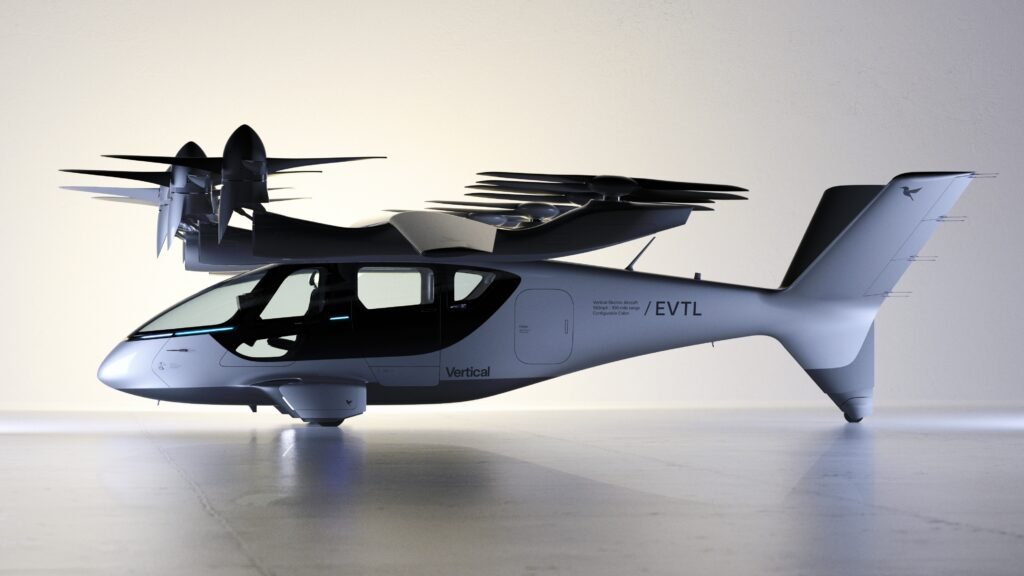
After years of testing with its VX4 prototype, Vertical unveiled Valo in December and has displayed the aircraft in London, New York City, Miami, and most recently Verticon in Atlanta.
The air taxi has a projected range of 100 miles all-electric, with capacity for up to four passengers at launch. However, Vertical says the cabin is large enough for it to one day accommodate six passengers, which would beat out most U.S. competitors. Valo will have a 1,200-pound payload and room for six checked and six carry-on bags. A planned hybrid-electric variant could fly closer to 300 nm with the same payload.
Electric battery packs will power Valo’s eight propellers, with four on the leading wing that tilt forward to support both hover and cruise flight. Controls comprise a simple joystick, Honeywell’s Anthem flight deck and digital fly-by-wire system, and three flight control computers.
Vertical has conducted vertical takeoff, hover, and wingborne flight testing with VX4 prototypes, including an airport-to-airport flight at the U.K.’s Royal International Air Tattoo. It began transition flight testing in November under CAA oversight and recently completed a wingborne flight during which one of the rear propellers was successfully tilted and restowed.
Vertical is targeting several certification milestones for Valo this year. Those include achieving piloted transitions from hover to forward flight, conducting public prototype demonstrations, advancing its hybrid-electric demonstrator, and producing the first full-scale Valo aircraft.
In addition, the firm aims to expand its battery production facility in the U.K., which began operations earlier this month. It plans to open a second facility this year, which could help it recoup investor contributions through battery sales. The company is continuing to lay the groundwork for a facility at Cotswold Airport (EGBP) that could churn out 15 aircraft per year.
So far, Vertical has shared potential air taxi route maps for New York and Florida. Other U.S. markets could be next.
