


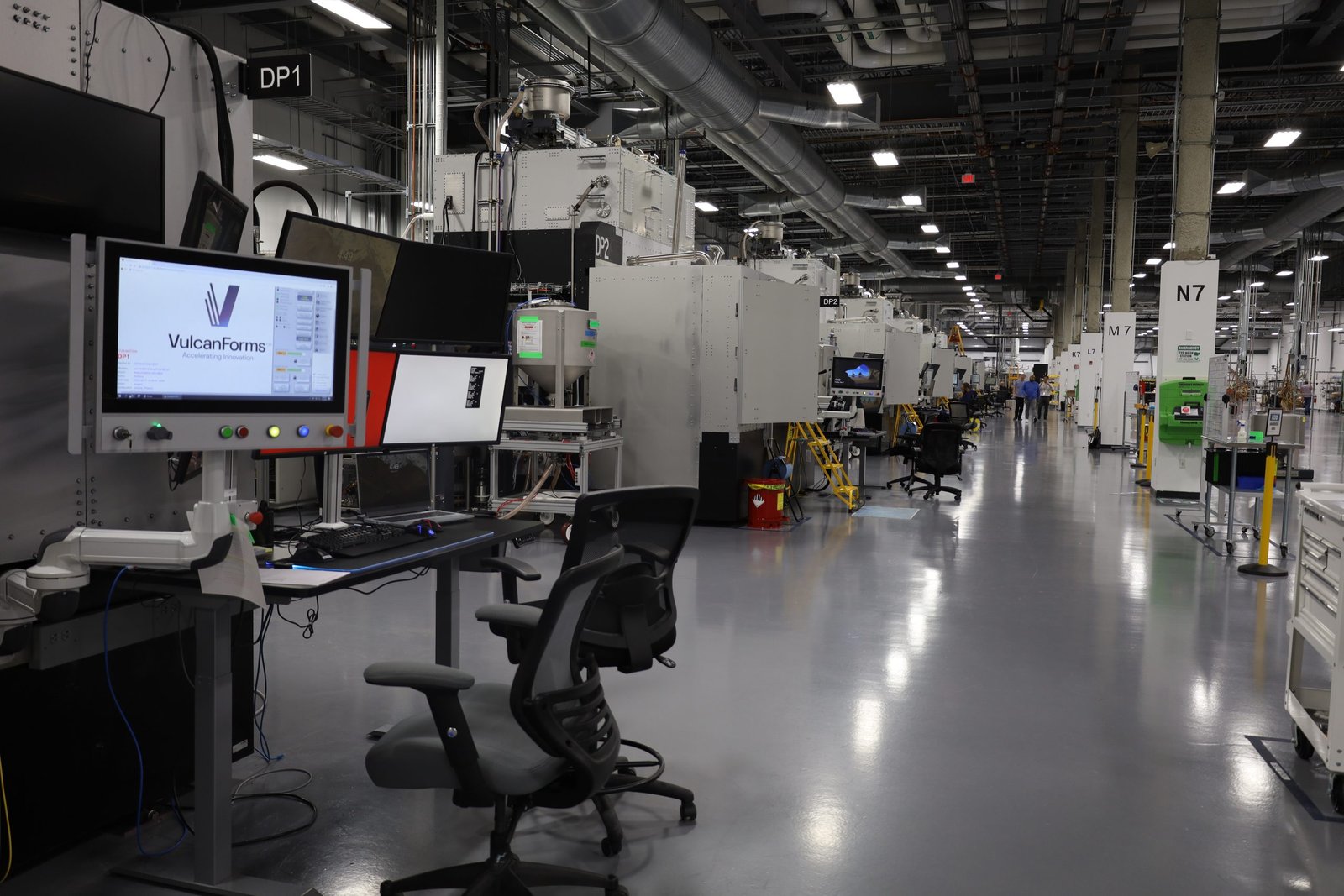
Digital manufacturing firm VulcanForms has secured $220 million in an oversubscribed financing round led by Eclipse and 1789 Capital, with participation from Washington Harbour, Fontinalis, IEQ Capital, and other investors. The funding will support expansion of the company’s integrated digital metal manufacturing operations as demand grows for domestic production of high-performance, mission-critical components.
The investment reflects increasing industrial pressure to reduce reliance on fragmented global manufacturing networks and to establish more controlled, production-scale capabilities within the United States.

Addressing Fragmented Metal Supply Chains Through Integration
Traditional metal manufacturing typically relies on multiple vendors, facilities, and production steps distributed across regions. Each transition introduces additional lead time, cost, and logistical risk, challenges that have intensified amid geopolitical uncertainty and trade disruption.
VulcanForms aims to consolidate these dispersed processes into unified digital factories that combine metal additive manufacturing, precision machining, automation, inspection, and proprietary software into a single workflow. By reducing handoffs between suppliers and compressing production into an integrated system, the company seeks to streamline manufacturing cycles, improve consistency, and deliver finished components at industrial scale. The newly raised capital will fund capacity expansion, continued technology development, and growth of its materials and research programs.
Scaling Production Across Critical Industrial Sectors
The company reported that it has transitioned from early development into scaled industrial production, securing commercial programs spanning aerospace, defense, medical devices, consumer products, and broader industrial applications. These contracts suggest growing interest from organizations seeking domestic suppliers capable of producing complex metal components at volume.
“American manufacturers need a domestic alternative that can compete with global production at scale with superior speed and precision,” said Kevin Kassekert, CEO of VulcanForms. “This financing enables us to meet surging demand and expand our role as a critical partner to companies rebuilding resilient domestic supply chains.”
Investors also emphasized the strategic implications of domestic manufacturing capacity. “1789 Capital is thrilled to support VulcanForms, a company revitalizing America’s industrial strength and sharply reducing our dependence on foreign suppliers,” said Omeed Malik, President of 1789 Capital. “By restoring high-skilled manufacturing jobs to American soil, VulcanForms is helping to drive the next great chapter of American prosperity.”

Limits and Remaining Challenges
Although VulcanForms’ integrated digital metal manufacturing platform boosts domestic production and lowers reliance on foreign supply chains, important challenges persist. Coordinating additive manufacturing, precision machining, automation, and inspection within a single workflow is complex, and sustaining consistent output at scale demands highly trained personnel. Access to critical materials, meeting certification standards, and completing qualification processes for high-performance components can slow production growth. The company also depends on suppliers for specialized equipment, raw materials, and skilled labor, leaving capacity vulnerable to disruptions despite the expanded operations.
U.S. Reshoring Advanced Manufacturing for Defense and Aerospace
In recent years, the United States has accelerated investment in domestic advanced manufacturing as fragile global supply chains, extended lead times, and geopolitical risk continue to constrain defense and aerospace production. Additive manufacturing is increasingly positioned as a strategic tool to localize production, enabling faster iteration, reduced logistics dependency, and improved control over mission-critical components. Rather than pursuing innovation for its own sake, these initiatives reflect a constraint-driven shift toward manufacturing ecosystems capable of sustaining operational readiness under disrupted supply conditions.
Companies across the industrial AM landscape are expanding U.S.-based production capacity to support this transition. Divergent Technologies has scaled its digitally driven manufacturing platform to produce complex aerospace and defense structures domestically, while Beehive Industries is manufacturing advanced propulsion systems for uncrewed aerial defense applications within the United States to strengthen industrial resilience. Similarly, the U.S. Department of War awarded $39.6 million under the Defense Production Act to three companies to expand domestic solid rocket motor production. These efforts strengthen U.S. defense supply chains and reduce reliance on foreign suppliers.
The 3D Printing Industry Awards are back. Make your nominations now.
Do you operate a 3D printing start-up? Reach readers, potential investors, and customers with the 3D Printing Industry Start-up of Year competition.
To stay up to date with the latest 3D printing news, don’t forget to subscribe to the 3D Printing Industry newsletter or follow us on Linkedin.
Featured image shows VulcanForms’ production facility. Photo via VulcanForms.
