


Sandwiched between the lochs of Nevis and Hourn (Gaelic for “heaven” and “hell,” respectively), Knoydart is a kind of geographic purgatory. This remote one-road knuckle of land on Scotland’s northwest coast, long known as the Rough Bounds, is defined by its savagely wild terrain. Accessible only by sea ferry or by a punishing multiday hike of no fewer than 16 miles, it sounds like a place of banishment. But when German billionaire and businessman Christoph Henkel laid eyes on this isolated, untamed landscape, he envisioned it as something else entirely: the ultimate respite from the stresses of modern society.
An avid outdoorsman, Henkel “grew up stalking in the Austrian Alps,” and his zeal for it eventually led him to Scotland, where he fell hard for the Highlands. When he learned the Delwart family of Belgium had put Kilchoan—their 13,000-plus-acre Knoydart estate—on the market in 2019, he made a trip to what’s considered the highland of the Highlands and scooped up the property.
Over the past five years, Henkel and his wife, Katrin, have rewilded the land, refurbished its cottages, and respectfully constructed new structures so they can invite people to hike, fish, bike, stalk, and disconnect in one of Britain’s last remaining wildernesses. The new Kilchoan will officially welcome its first guests in June.
Christoph and Katrin Henkel at Dunton Hot Springs, the hospitality venture in Colorado that started their obsession with rehabbing remote properties into luxury hotels.
Courtesy of Dunton Destinations
INTO THE WILD
Winter has many moods in Scotland, and I’m lucky Mother Nature is feeling tranquil when I land at Inverness Airport, the gateway to the Highlands, in January. Ryan Forbes, my driver, doubles as a tour guide, pointing out filming locations for Harry Potter and Outlander during the three-hour car ride to Mallaig, a blue-collar fishing village and ferry port that services the Knoydart Peninsula as well as the popular Isle of Skye and smaller isles of Eigg, Rum, Muck, and Canna.
A thick blanket of gray clouds threatens rain as I board the MV Western Isles, but the cobalt-blue sea remains mercifully calm for the 40-minute crossing. This 81-passenger wooden ferry has been shuttling people and supplies six miles between Mallaig and the off-grid village of Inverie for the past 60 years.
Mid-voyage, I still can’t make out any sign of human habitation. It appears as if we are sailing into a virgin bay hemmed in by hulking snow-capped peaks. But as we draw closer, a sprinkling of whitewashed cottages materializes in the hills, and what I estimate to be a quarter of the 120-member community has gathered on the stone dock anticipating our arrival, which includes about two dozen Amazon Prime deliveries and a bulk supply of whisky and cheese.

From left: The handful of cottages and communal spaces at Kilchoan estate were designed to echo the surrounding landscape; Hills of heather spill down to Loch Nevis and Inverie Bay.
Rebecca Reid/Courtesy of Dunton Destinations
Among the crowd is Iain Biggart, Kilchoan’s estate manager and head stalker, looking dapper in his three-piece tweed ghillie suit. The snowy-haired Scot waves me into the passenger seat of his Can-Am Traxter with a huge grin and navigates us through the blink-and-you’ll-miss-it town, famously anchored by mainland Britain’s most remote pub, the Old Forge.
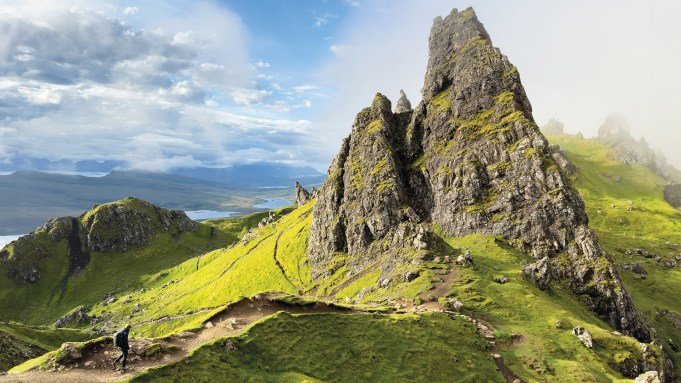
In less than 10 minutes, a wooden bridge deposits us on the doorstep of a cinematic landscape that unfurls into a seemingly endless patchwork of rolling hills and glens in hues of umber, cinnamon, and ochre, flanked by mountains standing sentinel on either side. It’s the type of view you can get lost in, no matter how many times you see it.
Once on property, Biggart swaps vehicles and escorts me in a shiny moss-green Land Rover to Rum, one of three two-bedroom (and a single three-bedroom) bothy-inspired cottages named for the surrounding isles. Its sandy-hued beachy interiors are a nod to its proximity to the sea. The Henkels tapped Tom Bartlett, cofounder of London-based design studio Waldo Works, to create spaces that would connect with the hugely changing landscape but also act as a refuge from it.
One of many spectacular views from Kilchoan estate.
Dunton Destinations
The accommodations, including the five-bedroom Farmhouse, are decorated in a mix of globally and locally sourced furnishings. There are Flexform armchairs from Italy, lamps from British ceramicist Adam Ross, and sofas upholstered in tweed from Bute. Textiles come from a historic mill in Selkirk, Scotland, while the futuristic-looking triphonic speakers are made by Syng, a California audio company that counts Henkel as an investor. Katrin, a former art dealer who sits on the board of trustees for the Tate and the Solomon R. Guggenheim Foundation, selected the 150 pieces of art—dating from the 18th century to present day and ranging from sculpture to painting to photography—displayed throughout the estate.
Homier than a hotel, Kilchoan provides fully equipped kitchens stocked with bottles of Knoydart Brewery I.P.A., local venison jerky, and cheeses. Add to that a selection of books—from newcomer Kat Hill’s Bothy to a reprint of Augustus Grimble’s 1886 Deer Stalking, a tutorial on the deep-rooted hunting tradition—and I almost feel like a personal guest of the Henkels’. As cozy and comfortable as my cottage is, the real magic happens when you get out in the hills. “People crave mind-altering experiences,” Henkel tells me. “Some people have to take Molly to have one. I come to Kilchoan and sit on a hill for three hours watching the clouds; no drugs needed. It’s so fucking glorious, it makes your head spin.”
Swiss couple Iwan and Manuela Wirth turned Braemar’s historic coaching inn the Fife Arms into a museum-worthy luxury hotel.
Courtesy of The Fife Arms
I understand what he means on my second morning, when Biggart picks me up just after sunrise for a tour around the sprawling grounds. He deposits me on the shores of the property’s lower loch to have a wander while he heads off to feed the resident herd of shaggy Highland cattle. For a good hour, I do nothing but admire the reflection of clouds floating across the mirrorlike surface of the water. The quiet is profound.
Silence here isn’t an absence, though. It’s a presence. With the noise of the world muted, everything feels amplified: the babble of a river flowing over stones, the rustle of the tussocks in the breeze, the soft bellow of a distant cow, the rhythmic thump of my own heartbeat.
The cofounder of Canyon Equity, a firm that specializes in developing high-end resorts in rare locations, Henkel has become a connoisseur of remarkably quiet landscapes. “I’m always looking for places that are incredibly still and silent,” he tells me. “I find them deeply inspiring.”
London-based design studio Waldo Works is behind the interiors at Kilchoan estate, including Eigg, one of three two-bedroom cottages named after the surrounding isles.
Rebecca Reid
In 1994, he purchased an 1880s mining camp–turned–ghost town in a secluded corner of southwest Colorado’s San Juan Mountains and, after a seven-year restoration, transformed its hand-hewn log cabins and Old West saloon into five-star destination Dunton Hot Springs. Shortly after, Canyon bought a patch of desert in Utah’s red-rock-canyon country and, in 2009, Henkel’s vision of a minimalist retreat ensconced in the sandstone landscape materialized as Amangiri, whose nightly room rates start at about $5,000.
Both hospitality ventures changed the very notion of quiet luxury. Dunton Hot Springs recently completed a multimillion-dollar renovation, largely led by Waldo Works, while Amangiri just put its first residence on the market for $33 million—proof that immersive nature experiences that don’t require roughing it are in peak demand, and the wilder the better.
Scotland has all of this in spades, but is sometimes overlooked for more exotic locales. “It has the adventure and big nature of New Zealand, but is also rich in tradition, history, and culture,” says Jules Maury, head of the invitation-only luxury-travel-concierge service Scott Dunn Private. It also has an incredible selection of passion-project hotels funded by billionaire investors that tap into the trend of “rewilding travel”—journeys back to the heart of nature, where ecosystems are being restored and landscapes regenerated to support local communities.
RESTORATION FROM THE ROOTS
Gazing out from my perch along the freshwater loch at Kilchoan estate, the surrounding land looks unspoiled. But what I’m viewing, Biggart later explains, is far from untrammeled terrain. “This is a man-made eco disaster in recovery,” he says. Centuries ago, the Highlands were home to one of the world’s most biodiverse forests. Lynx, bears, and wolves roamed amid the dense Scots pine, birch, and rowan. With the onset of agriculture, trees were removed to make room for sheep and cattle, which grazed out the natural vegetation. Predators disappeared, resulting in an explosion in deer, further degrading the woodlands and peatlands. Today, it is estimated that only 1 percent of the Caledonian forest remains.
The Highlands were a natural choice for Henkel’s next project. Much of the 68-year-old billionaire’s wealth is derived from his holdings in Henkel AG, the multinational consumer-goods and chemical company his grandfather established in 1876. After retiring from the family business in 2022, he shifted his focus to hospitality. “These places are gentle obsessions,” he explains. “I’ve put in my time sitting in offices. I love being in nature, and for my remaining years, I want to do more of it.”
Bertie’s Whisky Bar at the Fife Arms offers more than 500 bottles of mostly Scottish whiskies.
Courtesy of The Fife Arms
He is one of a handful of powerful, high-net-worth foreigners—so-called green lairds—who have invested capital in nature to restore the Highlands. In 2003, Brit Paul Lister, heir to the Mullard Furniture Industries fortune, acquired 23,000-acre Alladale and converted it into a lodge and wilderness reserve rooted in reforestation and reintroduction of endemic species, such as the water vole and mountain hare. Another is Anders Holch Povlsen, fashion tycoon and Denmark’s wealthiest man, who, alongside his wife, Anne, has acquired, over the past two decades, approximately 225,000 acres—about 1 percent of Scotland—across three estates in the Cairngorms, Loch Ness, and Sutherland, all newly incorporated into a venture called WildLand. The couple’s ambitious 200-year vision involves reviving the ecology through peat restoration, bracken rolling, and deer management, but also reenergizing rural communities by creating opportunities through tourism.
A Victorian suite at the Fife Arms.
Courtesy of The Fife Arms
WildLand’s portfolio of more than a dozen rehabbed historic buildings includes Aldourie, a 300-year-old baronial castle, and Hope, a 19th-century hunting lodge recently renovated by Cécile & Boyd, the South African design firm behind Singita’s most celebrated safari camps. (Povlsen is an investor in the Cape Town–based company.) Equally significant are WildLand’s social investments—neighborhood sites restored in consultation with the community—such as Burr’s of Tongue, a heritage bakery in Sutherland, and the Dores Inn, a beloved pub on the southern shores of Loch Ness that will reopen in 2027.
Three hours from Loch Ness, the 800-person village of Braemar in Aberdeenshire is best known for hosting the Gathering and for its proximity to Balmoral Castle. It has also been revived in recent years by Swiss couple Iwan and Manuela Wirth, of famed art gallery Hauser & Wirth, who transformed the old Fife Arms coaching inn. Reimagined in a maximalist style and decorated with 16,000 antiques, objects, and works of art including pieces by Pablo Picasso and Lucian Freud, the five-star boutique stay is one of Scotland’s most sought-after bookings. “Before the hotel, Braemar was essentially a ghost town,” says David Reynolds, my driver at the Fife Arms. “It’s provided the community with jobs, but also an opportunity to be part of something really exciting.”
Aldourie Castle, a 500-acre estate on the banks of Loch Ness, is at the center of the WildLand portfolio.
Courtesy of Dunton Destinations
Artfarm, the Wirths’ hospitality and development company, also owns the nearby Invercauld Arms hotel, which will be turned into a collection of self-catering apartments and a wellness center. And it recently acquired Braemar Kirk, a Gothic Revival church that will get a second life as a community center.
Locals’ trust is crucial to sustainable tourism in the Highlands, where absentee landowners have long been viewed with suspicion. The roots of that distrust run deep: During the Highland Clearances from about 1750 to 1860, roughly 70,000 tenants were forcibly evicted from their ancestral lands, and Knoydart’s population is said to have fallen from 1,000 to barely 600.
In 1948, seven residents, later known as the Seven Men of Knoydart, staged a failed land raid in a bid to break from the English lord who controlled the 55,000-acre peninsula. The breakthrough came in 1999, though, when locals succeeded where those men had not, purchasing 17,200 acres of estate land through the community-run Knoydart Foundation.
From left: The grounds of Aldourie Castle feature treasures such as private picnic spots, a lakefront sauna, and a stunning boathouse; Meals served at Aldourie Castle and other WildLand properties almost exclusively showcase locally grown and sourced ingredients.
Courtesy of Dunton Destinations
Since then, Inverie has become a model for progressive rural living. The organization subsidizes housing, manages the land, and, through Knoydart Renewables, supplies green energy to Inverie Bay. In 2002, the community once again joined forces to rescue the Old Forge pub, the social heart of town, where the hottest gossip centers around Henkel’s plans for the neighboring Kilchoan estate.
People crave mind-altering experiences. Some people have to take Molly to have one. I come to Kilchoan and sit on a hill for three hours watching the clouds.
Henkel sees his role as a steward, not an owner of the land. He openly voices his development plans and his commitment to decarbonize the property at town hall meetings. Completely fossil-fuel-free, Kilchoan is the number one customer of Knoydart Renewables, and has built a new water borehole and provided equipment and modern sewage-treatment plants for the area.
COMMUNING IN NATURE
Over 555 acres of native trees have already been replanted on the property by the Henkels, who have also restored old bridle paths. And with the assistance of Iain Biggart, the former chief stalker of the Knoydart Foundation who serves as a liaison between the Henkels and the community, deer numbers are down through selective management. My visit coincides with the tail end of hind season, and Biggart explains how clients must first prove they can take a clean shot in the shooting range before he takes them stalking. The antithesis of trophy hunting, this pursuit only targets old deer, and the meat is stored in the larder and either sold locally or used in the kitchens.
Knoydart is considered a trekking mecca. Kilchoan estate can facilitate guided hikes across the peninsula.
Sim Canetty-Clarke
Communal dinners, games of pool, and drams of rare whiskies will be served in the Long House—Kilchoan’s version of Dunton’s saloon, which is still under construction during my stay. A spa building houses a yoga studio, a fitness center, two massage rooms, a sauna, and a cold plunge. By year’s end, another one-bedroom cottage and four-bedroom home will be completed, and Henkel has a permit to rebuild a backcountry ruin about four miles away from the main complex. “I have no intention to make a grand mansion or flashy resort,” he tells me. “I want this to be a place [where] people can scatter, get lost, and then reconvene at the end of the day.”
The options to get out in nature are endless, from boat trips to see the puffin colony on neighboring Isle of Canna to e-bike rides around the hilly peninsula to fishing excursions for brown trout and salmon. Henkel is intentional about outsourcing as many activities as possible to local businesses. Biggart, in turn, sends me, just as he will future guests, into town for a venison burger at the Old Forge and a made-from-scratch oat cake with locally roasted coffee at the quaint Knoydart Pottery and Tearoom.
Craggy cliffs and crashing waves define the dramatic landscape of Sutherland in the northern Highlands.
David A.R. Williams
In town, I bump into Matt Humphrey, co-owner of Knoydart Brewery. When I ask him about Kilchoan, he proudly shares that his best-selling Heavenly Blonde will be served on tap in the Long House. Humphrey’s son works as a ghillie at Kilchoan, and he himself has joined Henkel stalking at the estate. “Knoydart would not survive without tourists,” he tells me. “More tourism brings more money to the community and creates more jobs and opportunities for our kids to stay here.”
My time at Kilchoan is a short three days. Even so, what I carry home isn’t just calm, but conviction that preservation in harmony with community can feel deeply transformative. I emerge better connected to the rhythms of nature and leave with a renewed faith in humanity.
Rooms at Kilchoan start at £1,100 (about $1,480) per night, double occupancy, all-inclusive.
Authors

Jen Murphy

