


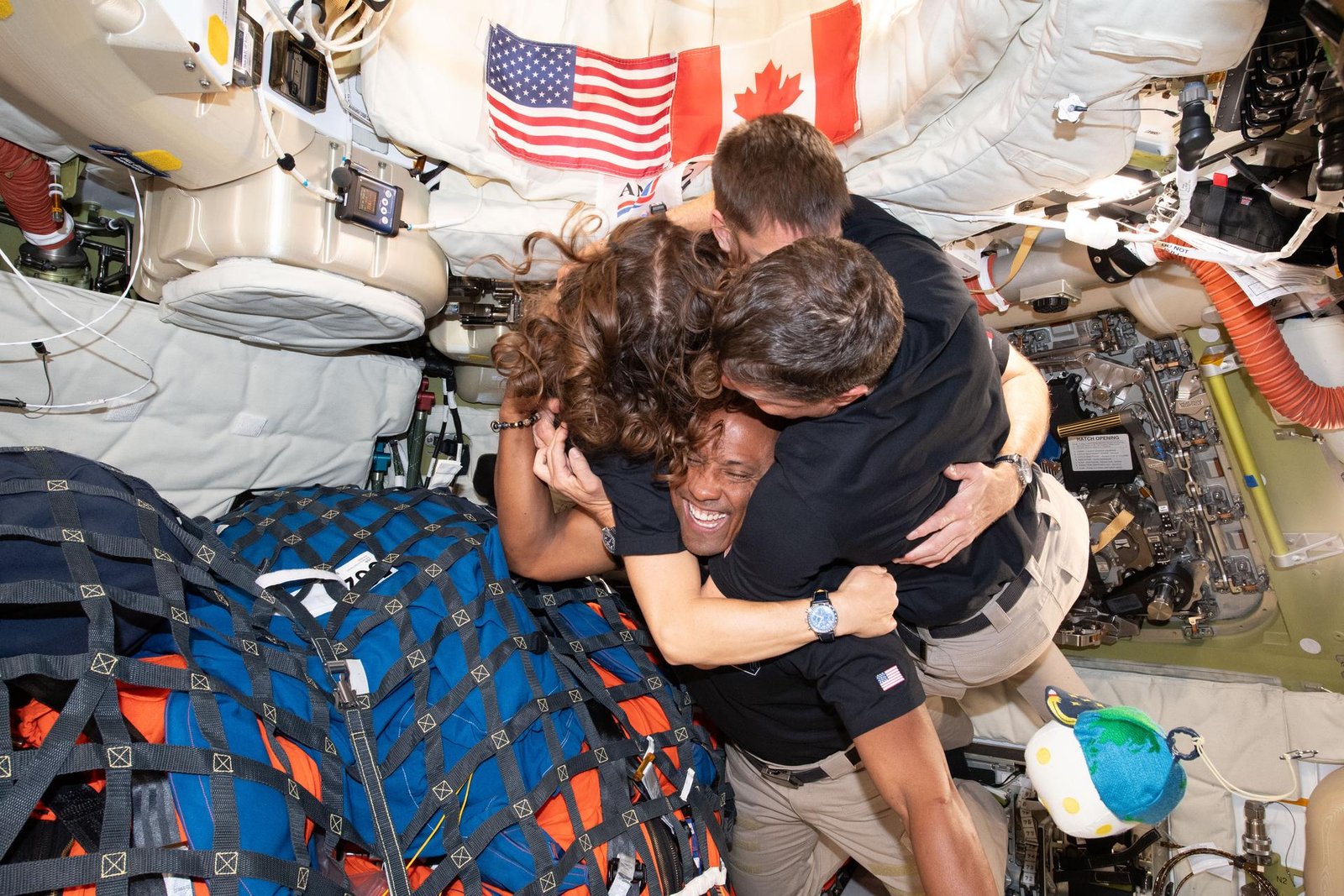
After slingshotting around the moon and traveling farther from Earth than any human has ever ventured, the four astronauts commanding NASA’s Artemis II mission are hours from splashing down in the Pacific Ocean off the coast of San Diego.
The mission’s final phase is also one of its most perilous. As of Thursday evening, NASA anticipates splashdown around 8:07 p.m. EDT on Friday. But before that, Integrity—the name of the Artemis II Orion crew capsule—will face a critical test of the heat shield that is designed to protect the astronauts as they hurtle through Earth’s atmosphere at nearly 24,000 mph. It will brave temperatures up to 5,000 degrees Fahrenheit, hot enough to melt steel.
The design of the heat shield is the same as the one that flew the uncrewed Artemis I mission in 2022. But some experts, including former NASA astronauts, believe it is not up for the task after unexpectedly cracking during that initial test flight. A few urged NASA to fly Artemis II without the crew, which trained three years for the historic mission.
During peak heating at about 200,000 feet in altitude, NASA mission control at Johnson Space Center in Houston will hold its breath as superheated plasma forms around the capsule, blocking communications for about six minutes.
When it emerges, Integrity will unfurl a series of parachutes to slow itself to a measly 17 mph. Airbags will flip the capsule upright if it lands upside down or on its side. Within two hours, the astronauts will be on MH-60 Seahawk helicopters en route to the USS John P. Murtha for post-mission medical evaluations. Then, they will fly to Johnson for more debriefing.
Starting 6:30 p.m. EDT Friday, NASA will televise Artemis II’s final moments on its NASA+ streaming platform, as well as on Netflix, Amazon Prime Video, Apple TV, HBO Max, Peacock, Roku, and Discovery+. Here’s what to look for during the mission’s critical home stretch.
Artemis II Comes Home
Artemis II has already cleared the mission phases that John Honeycutt, manager of NASA’s Space Launch System (SLS) rocket program, highlighted in March as the most treacherous— ascent, an Earth orbit raise maneuver, and the final translunar injection burn sending Integrity on a figure eight-shaped trajectory around the moon and back.
But atmospheric reentry also carries a degree of risk.
The Orion crew and service modules will separate about 40 minutes before splashdown and about 20 minutes before Integrity hits entry interface—the point it enters the upper atmosphere at about 400,000 feet. That will expose the heat shield, and reaction control thrusters will fire to swivel it into place.
Just before entry interface, Integrity will be traveling 30 times faster than the speed of sound, or fast enough to fly from New York City to Tokyo in about 20 minutes. The heat shield is coated in an outer layer of material called Avcoat, which is designed to char and wear away as it absorbs the extreme heat produced by its velocity.
The same material was used for the Apollo missions, though Orion’s large blocks of Avcoat contrast with Apollo’s honeycomb-like structure. But during Artemis I, trapped gases caused the heat shield to crack in more than 100 places and fling off large chunks of Avcoat.
NASA spent months investigating the incident and twice delayed Artemis II to assess risk. A special team even managed to validate computer predictions on Avcoat’s cracking behavior under real-world lab tests using the material.
Ultimately, the space agency decided it would be too costly and time consuming to replace the Artemis II heat shield, which had already been installed on Integrity. Its data showed that Orion’s internal temperature would have remained comfortable had Artemis I been crewed. A new, more permeable shield designed to release trapped gases will be installed for Artemis III.
Artemis II’s heat shield is actually less permeable than the one that flew previously. But engineers modified the mission’s reentry profile to protect the crew.
Artemis I used a skip entry to slow itself for a precise landing, dipping into the atmosphere before “skipping” back into space like a rock over water. Artemis II will use what NASA describes as a “lofted” entry, entering at a steeper angle to minimize the time Integrity is exposed to extreme temperatures.
Lori Glaze, deputy associate administrator of NASA’s Exploration Systems Development Mission Directorate, said in March that the Artemis II astronauts “all agreed that we’ve got a good heat shield.” But they had questions about being able to hit the precise entry interface that will cap the buildup of gases.
“The main thing that I want to do is I want to hit that…entry interface right down the middle and make sure that I bring the crew home safely,” Honeycutt said in March.
Experts do not ubiquitously share the astronauts’ confidence in the structure.
Ed Pope, a heat shield engineer, told Scientific American that the revised lofted entry profile “doesn’t mitigate the flaws in the design and manufacture of the original heat shield itself.”
Former astronaut Charlie Camarda, who flew on the first space shuttle after the Columbia disaster, spent months urging NASA to fly Artemis II without a crew. Camarda even expressed his concerns in an open letter to NASA Administrator Jared Isaacman. In March, he called the heat shield “deviant.”
Dan Rasky, who worked at NASA for three decades, shared Camarda’s concerns about flying with crew.
Danny Olivas, a former NASA astronaut who was part of the independent review team that investigated the Artemis I heat shield, also used the word “deviant” to describe it to CNN. Olivas said the structure will likely crack again. However, NASA convinced him that the crew would be safe even in a worst-case scenario.
Per Honeycutt, the risk threshold for Artemis II is somewhere between 1 in 50 and 1 in 2. NASA’s crew loss threshold is 1 in 40 for lunar missions and 1 in 30 for Artemis missions overall, better than the 1 in 10 figure for the Apollo missions.
Splashdown
Atmospheric reentry will be Artemis II’s biggest test on Friday. But teams have been preparing for splashdown for months and will have plenty more to do once the astronauts are back on Earth.
NASA’s recovery team has conducted 12 increasingly complex Underway Recovery Tests using Orion stand-ins that float on the ocean. The capsule can land with only two of its three main parachutes. But in the case of an anomaly—such as Orion landing off course or its hatch getting stuck—it has a set of preapproved recovery decision criteria (RDCs).
“We’re probably going to have about 50 of them where, if this happens, this is what we’ll do,” Liliana Villarreal, NASA’s Artemis II landing and recovery director, said on an episode of the space agency’s Curious Universe podcast.
In addition to the MH-60 Seahawks, the recovery effort involves small boats and open-water divers from the U.S. Navy. All assets will be in the water about two hours before splashdown, positioned about 2 miles away from the target area to avoid falling debris. Two helicopters have special equipment to track Orion’s location and observe its parachutes deploying.
Once Integrity is in the water, it will activate a cooling system that uses ammonia. Recovery crews will perform a “sniff test” to gauge the air quality before moving in.
“If everything’s good, everybody gets a thumbs up, [and it’s] all right, let’s go ahead and egress the crew,” Villarreal said.
The astronauts will exit onto an inflatable “front porch” to await their helicopter transport. Once the crew is recovered, teams will retrieve Orion by securing it to a winch and reeling it into the well deck of a massive vessel, like an enormous fish.
For the recovery team, it will certainly be the catch of the day.
