


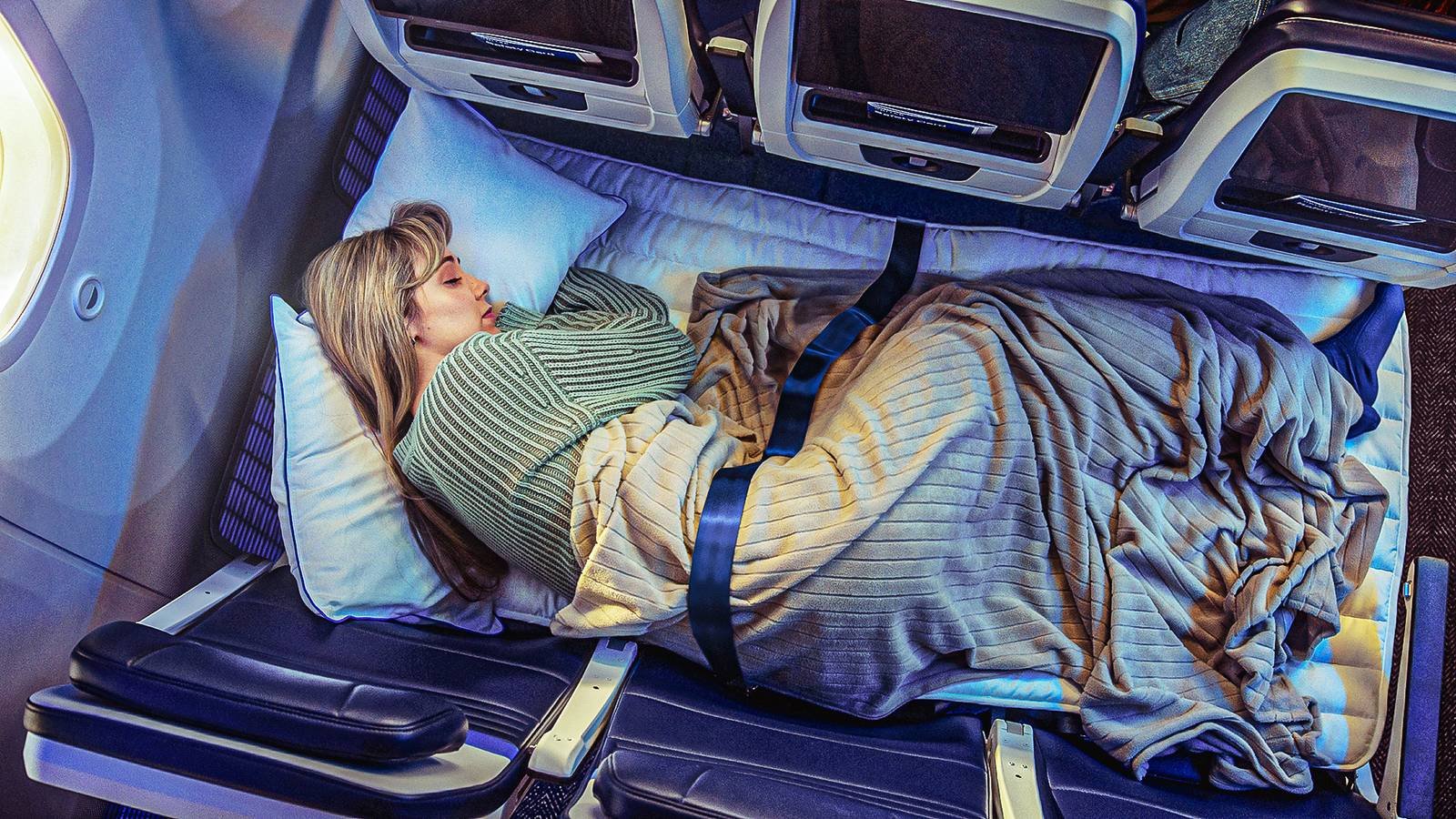
United Airlines’ new Relax Row looks set to become one of the most ambitious and interesting long-haul upsells in the industry because it is designed to sit somewhere between standard economy and premium economy while not really trying to replace either one. Announced initially on March 24, the product itself will debut in 2027 on  Boeing 787s and 777s, with United planning to install it on more than 200 widebodies by 2030. Each aircraft will have up to 12 Relax Row sections, giving the airline a way to sell extra comfort at scale without dedicating large amounts of cabin space to a new fare class.
The key question here is ultimately price. United has not announced it yet, but the clearest benchmark is Air New Zealand’s Skycouch, the closest like-for-like product in the market. Pricing reportedly shows that a two-person Skycouch upgrade from the US typically costs between $550 and $1,000 per person, while solo travelers can pay between $1,100 and $2,000, according to AFAR. This might allude that United will likely aim for a revenue sweet spot where Relax Row feels materially cheaper than Premium Plus, but expensive enough to generate strong ancillary revenue on long-haul routes. In practical terms, that likely means a price point in the low-to-mid hundreds per traveler for couples, and a meaningful increase in solo use.
United Relax Row: A New Kind Of Main Cabin Product

What United is launching is not a new cabin class, but rather a new way of selling space inside regular long-haul economy cabins. Rather, Relax Row will sit between United Economy and United Premium Plus on 787s and 777s, and it is designed around a block of three adjacent seats that can be turned into a couch-like surface after takeoff. The core feature is a set of adjustable leg rests that fold to 90 degrees, filling the gap between the seat and the floor so passengers can stretch out rather than remain upright in a conventional economy-class position.
This will therefore be an incredibly unique product. It is not catering to any traditional or established customer base, but rather seeking to fundamentally create a new kind of semi-value-oriented premium leisure traveler. In the years following the pandemic, it became quite clear to analysts that this is a lot to expect. For this unique product launch, United is clearly aiming it at three groups: couples, solo travelers willing to pay more for comfort, and families with small children who want room to rest without booking a premium cabin.
In this sense, Relax Row is thus best positioned as a monetized empty-row concept turned into an official airline product. It keeps travelers in the main cabin while offering a lie-flat option that standard economy typically does not. That positioning ultimately matters because it allows United to market a premium-feeling experience to a much wider slice of passengers than Polaris or Premium Plus ever could.
Bedding, Amenities, & Overall Fleet Scale

The much more revealing part of Relax Row is just how fully United appears to be turning it into a product. This is not simply three economy seats that are left unsold. Rather, it is United Airlines saying that customers who choose to book the option will receive a custom-fitted mattress pad, a specially sized blanket, extra pillows, and family-focused amenities such as a plush toy and children’s travel kit when kids are on the reservation.
Simple Flying’s coverage following the airline’s launch event for the new product noted that each row will retain its three seatback screens and offer abundant charging access, ultimately making the product itself feel much more deliberate and less improvised than the occasional luck into an empty row experience travelers already know. Just as important is the rollout plan itself.
Rather than treating it as a novelty on certain flagship services, United is now officially signaling that Relax Row will become a repeatable, network-wide upsell on long-haul flights. In practical terms, this means that it looks like a new ancillary revenue product built to bridge the gap between basic economy seating and the far higher cost of premium cabins.

Couches In Economy: United Airlines Brings Premium To All Cabins With New Long-Haul Perk
UA’s new Relax Row is rolling out in the main cabin this year.
Air New Zealand’s Economy Skycouch

The closest comparison here is undoubtedly Air New Zealand’s economy-class Skycouch, which has been the industry’s best-known version of a bed in economy for years. The New Zealand flag carrier has routinely described Skycouch as a row of economy seats that can be turned into a couch after takeoff, giving couples, families, and solo travelers extra room to stretch out on long-haul flights. The mechanics here are very similar to those offered by United.
The footrests fold to create a flatter lounging surface, the armrests can be adjusted to open up the space further, and bedding and pillows help convert the row from ordinary seating into something closer to an economy bed. Air New Zealand markets the product as flexible rather than luxurious, and it can serve as seating, a couch, a rest area, or even a play area for younger children.
Officially, the Skycouch is available in the forward economy cabin on the airline’s 777s and 787-9s. Furthermore, the carrier says all three seats are allocated to the same booking. The airline even provides infant-specific accessories such as the Skycouch Infant Harness, Belt, and Pod, which shows how heavily the product has been tailored toward families. In other words, United is not inventing this category purely from scratch. Rather, it is adapting the most proven economic couch model that is already on the market.
A Deeper Look At United’s Relax Row Product

The new United Relax Row will undoubtedly be a widebody product, not necessarily designed solely for its domestic narrowbody fleet. The airline says that the concept will debut in 2027 and be installed on Boeing 787s and 777s operating long-haul international flights. At the March 24 Elevated launch event in Los Angeles, Chief Commercial Officer Andrew Nocella said that the product would appear on all United 787s and on a very large number of the airline’s 777s.
“It’s gonna be on every single United 787 and a large number of our triple sevens, so we’re gonna get it at scale. And by 2030, 200 aircraft will have Relax Rows onboard.”
“They’ll be up to 12 couches per flight. The average will be about nine, but 12 will be our maximum. Again, it is important that we think about elevating the experience for all of our flyers, across all of our products, from small cities to big cities, and what we’ve done here today after years and years of investment, thought, and attention to detail, is we’ve actually, I think, brought that to life.”
This is the clearest indication yet of how United is thinking about deployment across its massive long-haul network. The official rollout target is even bigger.
It also suggests that Relax Row will be concentrated on the aircraft United is already using for transatlantic, transpacific, and other long-range missions, especially the 787 family and a substantial portion of its capable 777 fleet. Therefore, the short answer is simple. If one is looking for Relax Row, they should think of United’s Dreamliners first, followed by many of its long-haul 777s.

The Air New Zealand Aircraft That Feature A Cozy Skycouch In Economy
Find the best option for you to fly along Air New Zealand long-haul routes.
Was This A Good Financial Move For United Airlines?

There are certainly analysts who will argue that this is a smart financial move by United. Relax Row creates a new product tier from the cabin space United already has, rather than requiring a fully separate cabin with the heavy footprint and service costs that come with Premium Plus or Polaris.
The airline is also launching it in the part of the cabin where price-sensitive travelers still want more comfort. This certainly broadens the pool of potential buyers beyond the usual premium-cabin customer. That fits United’s recent revenue mix, as the carrier reported record 2025 revenue of $59.1 billion and a 7.8% adjusted pre-tax margin, all while continuing to emphasize premium and brand-led product investment. The risk that remains is execution.
If Relax Row is priced too low, United will be giving away space it could have sold normally. If it is priced too high, customers may simply book Premium Plus or ignore it altogether. There is also some operational complexity in bedding, inventory control, and ensuring enough demand on each route. Still, the core logic is strong, as the airline is incentivized to monetize unused or lower-yield economy space.
A Creative Way To Monetize

At the end of the day, United is doing more than just making the headlines with its upcoming release of Relax Row. This is an incredibly capable product, one that will undoubtedly have a major impact on the industry. However, it is not without its operational and execution risks.
The product itself is good in theory. There is a long-standing argument in commercial aviation management over how to monetize unsold seats. The challenge is that people are less likely to pay for a product they are not guaranteed, meaning United will struggle to get people to sign up for a waiting list for a Relax Row.
Relax Row seating could help United answer a relatively complex revenue question that few in the industry have really nailed down. On the other hand, it could be a gigantic investment that may not be worth the money for investors or analysts.
