


3D Systems has been awarded an additional $9 million under the U.S. Air Force-funded Large-Format Metal 3D Printer Advanced Technology Demonstrator program, GEN-II DMP-1000. The extension runs two more years and, in the company’s framing, covers the phase that completes the technology demonstration outright. Total project funding now stands at $27.4 million.
Work continues at 3D Systems’ San Diego, California and Rock Hill facilities, the two sites that have carried the program since 2023, with the effort focused on demonstrating large-scale, high-temperature, flight-relevant metal 3D printing. Completion is expected by September 27, 2027.
“This award increases total project funding to $27.4 million and reflects the U.S. Air Force’s continued confidence in our technology, its development path, and our teams,” said Dr. Michael Shepard, Vice President, Aerospace & Defense, 3D Systems. “It has been exciting to see the system come together, and we look forward to working with additional partners on new applications as the platform matures.”
Funded in stages, built over three years
The $9 million is the latest slice of a program the Air Force has released incrementally rather than in one block, and the three tranches together total $27.4 million.
It opened on 26 September 2023, when 3D Systems announced a $10.8 million Air Force contract to build a Large-format Metal 3D Printer Advanced Technology Demonstrator, a two-year effort to prove out the technologies needed to print large, high-temperature metal structures for hypersonic operating environments. Work was split between Rock Hill, South Carolina and San Diego, California, with completion set for 29 September 2025. The company positioned it as a continuation of additive manufacturing work it had been doing for the U.S. Department of Defense since 2019, and CEO Dr. Jeffrey Graves framed the goal as extending “the state of the art in metal additive manufacturing within the United States.”
The second slice came in August 2025, when 3D Systems received a $7.65 million two-year contract to advance the same demonstrator, by then carrying the GEN-IIDMP-1000 designation and a revised completion date of 27 September 2027. The stated target had also softened, from hypersonic environments to high-speed flight applications. Shepard, fronted the announcement, saying, “We’ve successfully demonstrated a number of innovative technologies under this program and it’s exciting to see those technologies mature both for this large-scale system as well as our commercially available printers,” he said.
The segment the company is betting on
The demonstrator sits inside the business line 3D Systems expects to grow fastest. The company has projected Aerospace & Defense as its fastest-growing industrial business, with over 20% growth in 2026 and more than $35 million coming from production systems and custom metal parts, the two revenue streams a qualified large-format platform would eventually feed.
Recent results give that projection something to stand on, if narrowly. Second quarter 2026 revenue of $94.6 million was down 0.3% year-over-year, or up 1.4% excluding divestitures, but printer sales rose more than 45%, led by the DMP 350 metal system and the SLA 825 polymer platform. Metal hardware, in other words, is the part of the portfolio currently converting, the same category the Air Force work is meant to extend upward in scale.
What is less settled is who oversees the finish. 3D Systems said that it has opened a search for its next president and chief executive, with Dr. Jeffrey Graves remaining in post until a successor is appointed, expected later this year, before consulting for six months. The funding is committed and the deadline is fixed at 2027; the demonstrator now has to be delivered across a change of management rather than by the team that started it.

Buying a machine that does not exist yet
3D Systems’ largest commercial metal system builds inside a 500mm cube, while hypersonic airframes need high-temperature structures printed whole at roughly twice that, and no vendor had commercial reason to build it alone.
The Air Force runs the same underwriting play across the additive supplier base: Continuous Composites holds a multi-year, two-phase contract to mature its Continuous Fiber 3D process for aerospace, while Elementum 3D and Divergent Technologies sit on EWAAC, the $46 billion vehicle that pre-qualifies capability providers instead of competing each requirement, the former on advanced alloys, the latter on AI-driven design and robotic assembly.
Separately, AFRL has been funding the surrounding problems. PADAM 2.0 put $6 million against refractory alloys, the high-temperature metals the demonstrator exists to print, held back by thin property data and process variability. Delta Qual 2.0, a separate $9 million effort funded by the Office of the Under Secretary of War’s Manufacturing Technology Office, targets qualification itself.
Qualification is the step between a working 3D printer and a flying part, and it belongs to the wider effort rather than this contract. What 3D Systems has to deliver by 2027 is the machine.
3D Printing Industry is inviting speakers for its 2026 Additive Manufacturing Applications (AMA) series, covering Energy, Healthcare, Automotive and Mobility, Aerospace, Space and Defense, and Software. Each online event focuses on real production deployments, qualification, and supply chain integration. Practitioners interested in contributing can complete the call for speakers form here.
To stay up to date with the latest 3D printing news, don’t forget to subscribe to the 3D Printing Industry newsletter or follow us on LinkedIn.
Explore the full Future of 3D Printing and Executive Survey series from 3D Printing Industry, featuring perspectives from CEOs, engineers, and industry leaders on the industrialization of additive manufacturing, 3D printing industry trends 2026, qualification, supply chains, and additive manufacturing industry analysis.
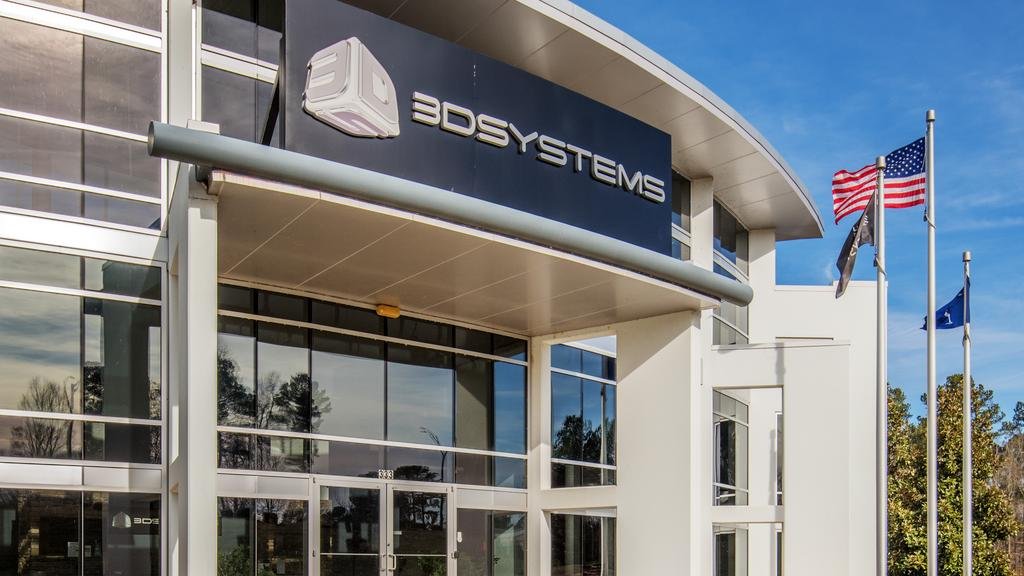
Featured image shows 3D Systems headquarters. Photo via 3D Systems.
