


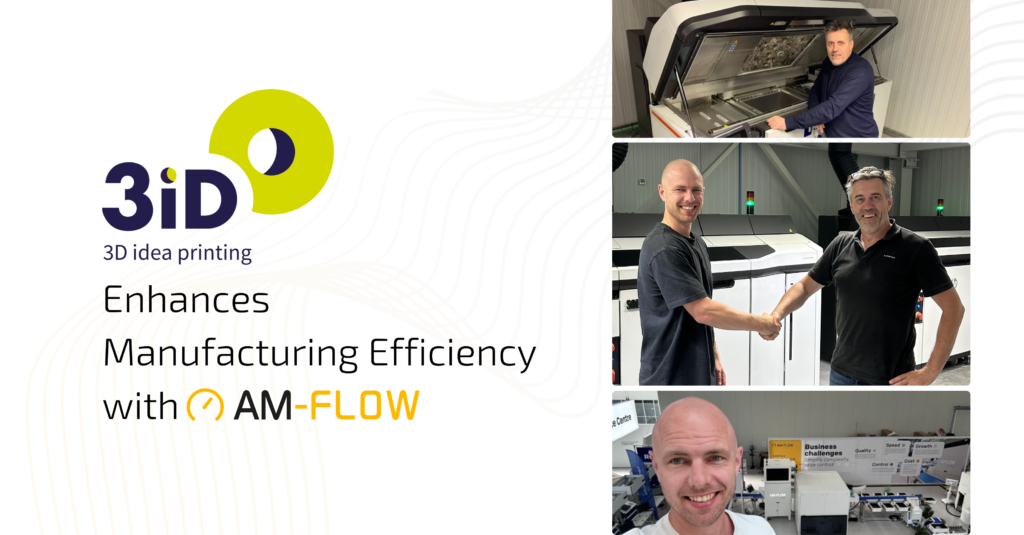
3iD Printing, a Belgian industrial 3D printing service provider, is installing an automated post-processing line supplied by Netherlands-based AM-Flow, integrating three systems, AM-Feed, AM-Vision and AM-Sort, to handle part feeding, identification and sorting without manual labeling.
Closing the Post-Processing Bottleneck
While 3D printing technology has advanced rapidly across the additive manufacturing industry, the steps that come after a part leaves the 3D printer have lagged behind. Identifying and sorting finished parts by hand remains one of the most labor-intensive stages of production, and as manufacturers scale up volume, that manual step increasingly caps how much a facility can actually ship. 3iD’s new line addresses this challenge, aiming to cut repetitive manual handling, reduce human error, and free operators for higher-value work.
The line runs as three handoffs. AM-Feed takes over first, pulling individual parts off the build plate one at a time and moving them down automated conveyors at a rate of up to 720 per hour. A LIDAR camera built into the unit keeps track of where each piece sits on the belt, starting and stopping the flow as needed to keep parts from piling up or colliding, work AM-Flow says can otherwise eat up to ten times longer when done by hand.
Next, AM-Vision takes over identification, reading each part’s geometry through machine vision and cross-referencing it against digital production records, no barcode, tag, or physical marking required. Sitting at the middle of the line, it then decides where the part goes next: straight on to sorting, or through an added quality check first. AM-Sort closes the loop, directing each finished piece to the right customer order, the next finishing step, or the loading dock, so every part carries a traceable record from the moment it’s printed to the moment it ships.
“Innovation has always been central to how we operate,” said Dave Vanhove, founder of 3iD. “As production volumes continue to grow, we are continuously looking for technologies that help us improve efficiency while maintaining the quality and flexibility our customers expect.”
A Shared Bet on Digital, Data-Driven Production
For AM-Flow, the 3iD installation extends a strategy the company has pursued since its founding in 2018: building a market-ready software and hardware stack that automates 3D printing post-processing end to end, using geometry-based part recognition rather than labels or tags.
“We are proud to support 3iD in optimizing its manufacturing workflow,” said Stefan Rink, CEO at AM-Flow. “Our technology is designed to help manufacturers eliminate manual bottlenecks and create scalable, data-driven production environments.”
For 3iD, which serves customers across a range of industries where flexibility, reliability and fast turnaround are competitive requirements, the move fits a broader push toward operational excellence and sustainable growth rather than a one-off equipment upgrade. Automating the identification and routing steps also gives the company a fuller “track and trace” record of each part’s path through production, a capability increasingly expected by customers in regulated or quality-sensitive industries.
Automating the Post-Processing Bottleneck
The 3iD deployment reflects a strategy at AM-Flow to close the gap between how fast a 3D printer can produce parts and how fast a factory can actually identify, sort and ship them.
3iD isn’t AM-Flow’s first service-bureau customer to take this route. Earlier in the company’s history, 3D printing service provider Oceanz partnered with AM-Flow to build a fully automated additive manufacturing production line, automating several post-processing steps that had previously relied on manual, analog handling and cutting the time spent on them substantially.
That pattern is playing out beyond AM-Flow’s own customer base, too. Previously, automated post-processing systems maker Additive Manufacturing Technologies (AMT) partnered with Prototal Industries to install vapor smoothing and depowdering equipment across Prototal’s facilities in Austria, Denmark, Italy, UK and Sweden, with more sites planned. Beyond the equipment rollout, Prototal is acting as a beta-testing partner for AMT, feeding back day-to-day operational data to help refine the systems, a similar dynamic to 3iD folding real production volume into AM-Flow’s own product development.
The through-line across these deployments is consistent: as service bureaus scale past prototyping into high-volume production, post-processing stops being a background task and becomes the constraint that determines how much a factory can actually deliver.
3D Printing Industry is inviting speakers for its 2026 Additive Manufacturing Applications (AMA) series, covering Energy, Healthcare, Automotive and Mobility, Aerospace, Space and Defense, and Software. Each online event focuses on real production deployments, qualification, and supply chain integration. Practitioners interested in contributing can complete the call for speakers form here.
To stay up to date with the latest 3D printing news, don’t forget to subscribe to the 3D Printing Industry newsletter or follow us on LinkedIn.
Explore the full Future of 3D Printing and Executive Survey series from 3D Printing Industry, featuring perspectives from CEOs, engineers, and industry leaders on the industrialization of additive manufacturing, 3D printing industry trends 2026, qualification, supply chains, and additive manufacturing industry analysis.
Featured image shows 3iD Printing Automates Post-Processing With AM-Flow’s Feed, Vision and Sort System. Image via 3iD Printing.
