


Let’s start with what is not in dispute.
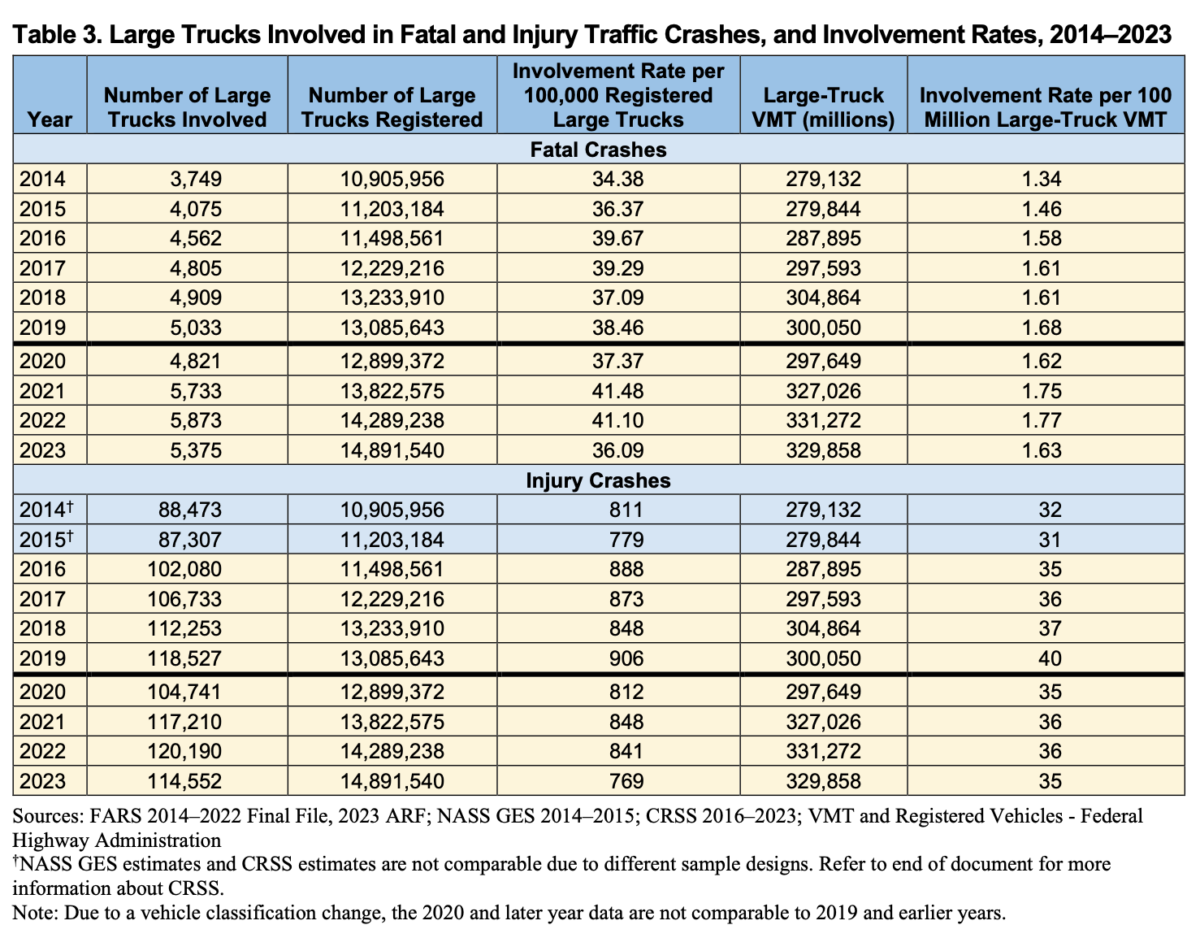
In 2023, 5,472 people were killed in traffic crashes involving large trucks, according to the National Highway Traffic Safety Administration’s Fatality Analysis Reporting System — the most reliable national crash database that exists. Seventy percent of those people — 3,837 of them — were not in the truck. They were in the other vehicle. They were pedestrians. They were cyclists. They were people who got up that morning and drove to work and did not make it home.
That number went down 8% from 2022. It is still 5,472 people. It is still one of the most serious highway safety challenges in the country. And the public debate about what is causing it — and what to do about it — has never been more politically charged, more emotionally driven, and, in important ways, less grounded in the actual data than it is right now.
This article is not a defense of any policy position. It is not an endorsement of open borders, and it is not an attack on immigration enforcement. It is an attempt to put the federal crash data in front of the people who operate in this industry every day — the drivers, the small carriers, the fleet operators — and ask the question that the loudest voices in this conversation are not asking: What does the data actually say?
What the NHTSA Data Shows About Why Large Trucks Crash
The NHTSA large trucks fact sheet for 2023 does not mention citizenship. It does not mention immigration status. It does not break down crashes by country of origin, visa type, or CDL category. What it does show is a detailed picture of who is involved in fatal truck crashes and what the driving records of those people look like.
Here is what the data shows about large truck drivers involved in fatal crashes in 2023:
Four percent had blood alcohol concentrations of .08 or higher at the time of the crash. That is the lowest rate of any vehicle type — passenger car drivers were at 24%, light truck drivers at 20%, motorcycle operators at 26%. Commercial truck drivers, as a group, are not a drunk driving problem.
Large truck drivers had the second highest percentage — 19.4% — of previously recorded traffic crashes among all vehicle types. They had the third highest rate of prior speeding convictions at 17.3%. And they had the lowest rate of prior license suspensions or revocations at 6.4% — lower than passenger car drivers at 12.2%, lower than light truck drivers at 9.8%, lower than motorcyclists at 16.4%.
What does that combination of data points actually tell us? It tells us that the commercial drivers involved in fatal crashes in 2023 were more likely than other vehicle types to have a prior crash on their record, had meaningful speeding conviction histories, but were less likely than almost any other driver group to have had a license suspended or revoked. They were, in most cases, licensed, operating with a valid CDL, and had a documented history of prior driving events that should have raised flags well before the fatal crash occurred.
The question that data invites — and that no one in the current political conversation is asking — is this: what was the safety system doing with those prior records?
What the Federal Causation Research Says
FMCSA’s own Large Truck Crash Causation Study — the most comprehensive federal analysis of why truck crashes happen — found that driver action or inaction was the critical reason in 88% of crashes involving large trucks. Not weather. Not road conditions. Not vehicle failure. Driver behavior.
The specific driver factors that research identified as most significant were: recognition errors — inattention, inadequate surveillance, distraction both inside and outside the vehicle; decision errors — driving too fast for conditions, misjudging the speed of other vehicles, following too closely; and performance errors — overcompensation, loss of vehicle control.
The same research found that speeding, fatigue, and distraction were the dominant behavioral factors. It found that brakes, tires, and cargo were the dominant mechanical factors. And it found something that rarely makes it into the current policy debate: 55% of trucks involved in crashes had at least one mechanical violation, and 30% had conditions serious enough to warrant immediate out-of-service status.
Thirty percent.
Brake violations were the most frequent mechanical issue. One in three trucks involved in fatal crashes had a mechanical problem serious enough that the federal standard said it should not be on the road. That is a maintenance and inspection failure. That is a carrier compliance failure. And that failure receives virtually no attention in the current political debate about large truck highway safety.
If the goal is saving lives on the highway, the federal government’s own research points directly at driver behavior — specifically speed, fatigue, and distraction — and mechanical deficiencies as the primary causation factors. Those are the things the data says are killing people. That is where an evidence-based safety conversation starts.
The Non-Domiciled CDL Narrative and What the Numbers Actually Show
Now to the conversation that is dominating social media, trucking Facebook groups, X, and the halls of Congress.
The claim, stated with varying levels of specificity across platforms, is that non-domiciled CDL holders — immigrant drivers, foreign-born truckers, people who obtained their licenses through systems different from the standard domestic CDL process — are a disproportionate and growing cause of highway carnage. The videos go viral. The comments fill with outrage. Legislation gets named after a child and moves through Congress in weeks.
So what does the crash data actually show about non-domiciled CDL holders?
Here is the answer that the federal government itself has acknowledged: we do not know. FMCSA does not track crash data by citizenship, immigration status, or CDL category. The Motor Carrier Management Information System — the primary federal crash database — does not break out crashes by whether the driver held a domestic or non-domiciled CDL. The foundational data point that would be needed to make the case that non-domiciled CDL holders are causing a disproportionate share of crashes does not exist in any federal database.
What FMCSA did cite when DOT Secretary Sean Duffy announced emergency restrictions on non-domiciled CDLs was five fatal crashes in the first half of 2025 that were identified as involving non-domiciled CDL holders. Five. Out of 1,600 fatal truck crashes reported through July 2025 — the same period when NHTSA was reporting an 8.2% decline in highway crash fatalities.
Five crashes out of 1,600 is 0.31%.
Now consider the denominator. FMCSA’s own data shows approximately 194,000 non-domiciled CDL holders — representing roughly 4% of the total CDL population of approximately 3.4 million. If non-domiciled CDL drivers crashed at the same rate as the general CDL population, the statistical expectation would be that they appear in approximately 4% of crashes — meaning something in the range of 59 of those 1,600 fatal crashes. Five crashes, against an expected baseline of 59, does not suggest a group that is overrepresented in fatal crashes. It suggests the opposite.
The question is not whether that specific math is airtight — it has limitations, because we are working with incomplete data on both sides. The question is whether five crashes in six months, in a population of 194,000 drivers who represent 4% of all CDL holders, constitutes sufficient evidence to justify emergency federal action framed explicitly around highway safety.
The FMCSA audit that accompanied the emergency rule did find something real and significant: compliance violations in the non-domiciled CDL issuance process. California alone was found to have issued 25% of its non-domiciled CDLs in ways that violated federal rules. That is a legitimate regulatory problem. States were not following existing federal law. The administrative compliance failure is documented.
But administrative compliance failure and highway safety failure are not the same thing. The audit found paperwork problems. It did not find a crash pattern. Those are different findings, and conflating them — describing a licensing compliance audit as a safety emergency — is worth examining carefully.
What Is Not Being Said Out Loud
Nearly 19% of U.S. truck drivers are foreign-born, according to Census data — a number that has more than doubled since 2000. If foreign-born drivers as a group were inherently more dangerous than domestic-born drivers, that overrepresentation in the workforce would be expected to show up in the crash data. Fatal truck crash counts have declined, not risen, during the same period that the foreign-born share of the trucking workforce grew.
That does not mean every driver with a non-domiciled CDL is equally qualified. There is documented fraud in the CDL training and testing system — not just for non-domiciled licenses, but across the domestic CDL pipeline as well. FMCSA has spent the past two years removing fraudulent and inadequate training providers from its Entry-Level Driver Training registry. The Clearinghouse has identified more than 202,000 CDL holders in prohibited status due to drug violations, with 159,000 of those having not even started the return-to-duty process. Those are domestic CDL holders. The compliance problems in the U.S. commercial driver licensing system are not limited to one population.
The data also raises a geographic question worth considering. The NHTSA report shows that 55% of fatal large truck crashes occurred in rural areas. The states with the highest rates of large truck involvement in fatal crashes — Wyoming at 22.5%, New Mexico at 19.6%, North Dakota at 18.4%, Idaho at 17.2% — are not the states with the highest concentrations of non-domiciled CDL holders or immigrant truck drivers. They are states with long-haul interstate corridors, challenging terrain, and extreme weather. The crash geography and the immigration geography do not align.
That is not a dispositive argument. It is a question that the data raises and that the current policy debate is not answering.
What Dalilah’s Law Actually Addresses — and What It Does Not
Dalilah Coleman’s injuries were real, devastating, and preventable. The system failures that allowed an individual to operate a commercial truck in circumstances that should have been caught are real. The case for closing regulatory gaps through statute is real. None of that is in dispute here.
What is worth examining is whether the legislation as written — particularly in its original form, which required recertification of all 3.5 million CDL holders in 180 days and extended eligibility restrictions to legal visa holders whose specific visa category is not on the qualifying list — is proportionate to the documented safety problem, or whether it addresses a different problem using safety as the frame.
The bill targets immigration status as the primary lens. The crash data points to driver behavior, speed, fatigue, distraction, and mechanical deficiency as the primary factors. Those are not the same lens.
A carrier operating with 30% of its trucks in mechanical conditions serious enough for out-of-service status is a highway safety problem. A truck driver with multiple prior speeding convictions who is still operating with a valid CDL is a highway safety problem. A training system that allowed fraudulent entry-level driver training providers to certify thousands of drivers — domestic and foreign-born alike — is a highway safety problem.
Those problems appear in the federal data. They receive a fraction of the legislative attention and social media outrage directed at a population whose crash rate, to the extent it can be measured at all, does not appear elevated relative to their share of the driving population.
The Harder Conversation
Social media is not a neutral platform for evaluating highway safety data. An algorithm built on engagement favors the dramatic over the measured, the outrage over the analysis, the specific horrible crash video over the population-level crash trend. One viral clip showing a crash involving a driver who is alleged to be an undocumented immigrant reaches millions of people in 24 hours. The NHTSA annual crash report, which documents 5,472 deaths and identifies speed, fatigue, and mechanical deficiency as the primary causation factors, receives a press release and a PDF.
That asymmetry is not an argument that the viral crash did not happen. It is an argument about what information is shaping the policy response, and whether that information is representative of the actual problem.
The people in this industry who operate on the highway every day deserve a highway safety conversation that starts with the data. That data says: 5,472 people died in 2023. The majority were not in the truck. The truck driver community has the lowest drunk driving rate of any vehicle type. Prior crash records and speeding histories were more predictive of involvement in fatal crashes than any demographic variable. Thirty percent of trucks involved in crashes had mechanical conditions that should have taken them off the road. Driver behavior — speed, fatigue, inattention — was the critical reason in 88% of crashes.
That is the safety conversation. It is harder to make viral. It does not map cleanly onto an immigration debate. It does not produce a satisfying legislative villain. But it is what the data says.
And the 5,472 people who did not make it home in 2023 deserved a conversation that started there.
The post 5,472 People Died in Large Truck Crashes in 2023. The Data Tells Us Why. And It Is Not the Story Being Told on Social Media. appeared first on FreightWaves.
