


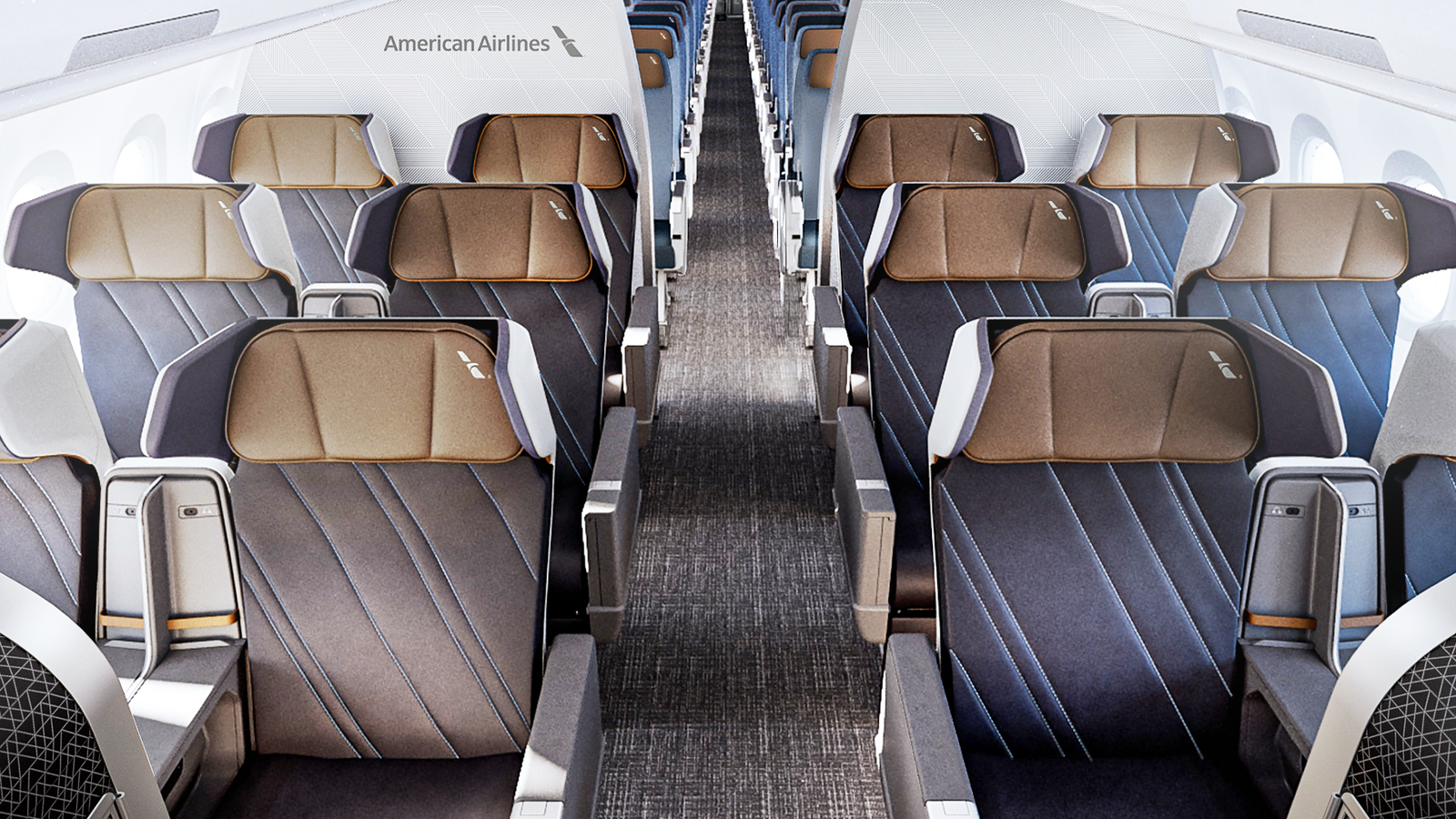
What do passengers expect from a modern airline cabin? Long-haul widebodies typically feature dedicated multi-cabin layouts, while short-haul regional hops stick to strict two-class narrowbodies. However, evolving passenger expectations and fleet-utilization strategies have disrupted that boundary. Across high-density regional and transcontinental corridors, a growing number of major carriers are selling international-grade premium economy seats on sectors lasting under six hours.
The trend provides an intriguing value proposition for travelers heading on three to five-hour flights. Rather than paying a substantial markup for short-haul business class or sacrificing personal space in a high-density economy cabin, flyers can find wider seats, additional legroom, and enhanced dining at a fraction of the cost. Still, as airlines deploy long-haul widebodies and long-range narrowbodies on regional trunk routes, availability often hinges on specific aircraft swaps and seasonal scheduling.
Cathay Pacific
Long-standing premium economy presence across key Asian routes
Cathay Pacific has long used its internationally configured widebody fleet to operate high-capacity regional routes across East and Southeast Asia. On major commercial trunks such as the 1,588-mile (2,555 km) corridor between  Hong Kong International Airport (HKG) and Singapore Changi Airport (SIN), a flight time averaging roughly four hours, Cathay Pacific routinely schedules Airbus A350-900 aircraft equipped with dedicated 28-seat premium economy cabins. Here, Cathay allows regional business travelers access fixed-shell privacy and upgraded meal services with no long-haul business class ticket prices.
As detailed in a cabin review by Point Hacks, Cathay Pacific’s A350 premium economy layout features a 2-4-2 arrangement providing 40 inches (102 cm) of seat pitch and 19 inches (48 cm) of seat width. The airline also schedules these widebodies on four to five-hour overnight red-eye flights to Japan, Singapore, and Indonesia. Furthermore, as reported by The Alviator, Cathay Pacific has integrated its newly redesigned Boeing 777-300ER premium economy cabins into short-haul regional rotations connecting Hong Kong to  Tokyo Haneda Airport (HND), New Chitose Airport (CTS), and
 Beijing Capital Airport (PEK).
However, when booking regional premium economy on Cathay Pacific, it is important to pay close attention to daily equipment schedules. The carrier regularly rotates regionally configured Airbus A330-300s and regional A350s onto these same intra-Asia routes, which lack a premium economy section entirely.
Air New Zealand
The smartest option for shorter international hops?

Air New Zealand frequently deploys its long-haul Boeing 787-9 Dreamliners across the trans-Tasman sea to connect  Auckland Airport (AKL) with key Australian hubs like
 Sydney Kingsford Smith Airport (SYD) and Melbourne Airport (MEL). Ranging from three to four hours, these short-haul international hops feature a dedicated 41 inches (104 cm) seat pitch in premium economy, delivering significantly more legroom than standard domestic offerings.
Analysis published by Simple Flying notes that Air New Zealand’s trans-Tasman premium economy is often the smartest buy for passengers, evaluating price versus comfort. Because the short flight duration makes a full lie-flat bed in Business Premier less essential, the generous recline, dedicated footrests, and premium dining in premium economy deliver most long-haul benefits at a much lower price.
As a result, Air New Zealand can maximize aircraft utilization between major long-haul rotations to North America and Asia. Offering international-grade seating on short daytime hops, the carrier fills mid-cabin capacity with high-yielding business and leisure travelers. What is important to keep in mind is that this regional widebody strategy is not unique to Oceania and is equally prominent across key trunk corridors in Southeast Asia.
Singapore Airlines
Short haul on the world’s largest airliner?

 Singapore Airlines regularly deploys long-haul widebodies across its regional network, connecting its Changi hub with high-density commercial markets across Asia. On the 1,588-mile (2,555 km) trunk route between Singapore and Hong Kong, a flight lasting roughly four hours, the carrier regularly sends its long-haul-configured A350-900 and 777-300ER aircraft. These airframes feature dedicated premium economy cabins offering 38 inches (97 cm) of seat pitch and up to 19.5 inches (50 cm) of seat width, providing a spacious middle-tier option for regional business travelers.
This route · Live
Watch – flights in real time
See every flight on this route today, with live altitude, speed and delays.
Follow this route
Singapore Airlines · Live
See the Singapore Airlines fleet in the air right now
Every Singapore Airlines flight on the map, with delays, diversions and holds flagged
live.
Track Singapore Airlines
· Live
See what’s happening at right now
Live arrivals, departures, holds and go-arounds at the airport in this story.
Open live
Right now
Follow the sky’s most interesting moments, live
Holds, diversions and rare aircraft, spotted as they happen. Free, no signup.
Open the tracker
As reported by Simple Flying, Singapore Airlines periodically increases capacity on this four-hour regional corridor by deploying its flagship Airbus A380 during peak travel seasons. Positioned as the shortest A380 route in the carrier’s global network, these double-decker superjumbos feature a dedicated main-deck premium economy cabin outfitted in a 2-4-2 layout. Passengers on these short-haul rotations are given full long-haul hardware amenities, including 13.3-inch (34 cm) HD seatback monitors, calf rests, and leather seating finishes.
However, booking a premium economy seat on Singapore Airlines’ short-haul routes also comes with frequent aircraft changes. The airline also operates medium-haul A350-900 variants across its regional network, which are configured in a two-class setup that lacks premium economy entirely. Generally, Asian carriers use widebodies to solve regional slot constraints, whereas major US legacy airlines form their fleet on a mix of repositioning widebodies and next-generation narrowbodies to bring premium economy to domestic transcontinental markets.
Delta Air Lines
Offering long-haul comfort on flights under six hours

In North America,  Delta Air Lines has introduced its international-grade Delta Premium Select cabin onto select domestic transcontinental corridors. Delta does not limit the product strictly to long-haul transoceanic flights and offers Premium Select on key hub-to-hub transcontinental rotations, such as New York John F. Kennedy International Airport (JFK) to
 Los Angeles International Airport (LAX) and
 San Francisco International Airport (SFO). On these 2,475-mile (3,983 km) transcontinental links, flight times vary directionally as eastbound flights from the West Coast regularly clock in under five hours and 30 minutes, while westbound sectors into winter headwinds can occasionally approach the six-hour mark.
According to a review published by Going, Delta Premium Select on domestic transcontinental routes provides a distinct upgrade over Delta Comfort+. With customized recline seats offering up to 38 in (97 cm) of pitch and 19 in (48 cm) of width, the cabin includes dedicated footrests, improved dining options, and priority boarding. Delta operates internationally configured widebodies, such as the Boeing 767-400ER and Airbus A330-900, on these premier domestic transcontinental routes, so travelers actually can get access to long-haul hardware on sub-six-hour sectors.
Delta Premium Select is sold on only select daily JFK–LAX rotations rather than every frequency, as noted by The Points Guy. The carrier mixes widebody operations with domestic narrowbodies that offer standard first class and Comfort+ seating instead. As North American carriers expand transcontinental premium offerings, the introduction of long-range narrowbodies like the Airbus A321XLR is set to make short-haul premium economy even more widespread.
United Airlines
A high cost, but one that yields major comfort upgrades

 United Airlines has expanded its dedicated international Premium Plus cabin onto high-density domestic transcontinental routes connecting its primary hub network. On key sub-six-hour transcontinental corridors, such as
 Newark Liberty International Airport (EWR) to San Francisco International Airport (SFO) and
 Chicago O’Hare International Airport(ORD) to Los Angeles International Airport (LAX), United regularly schedules internationally configured widebodies, including 777-200ERs and 787-10s. Deploying these widebody aircraft on domestic hub-to-hub legs brings long-haul hardware directly to transcontinental travelers.
As detailed in routing and pricing analysis from Autopilot, United’s Premium Plus cabin features a 2-4-2 layout on widebodies, offering 38 in (97 cm) of seat pitch and 19 in (48 cm) of seat width. Passengers receive plush leather recline seats, footrests, individual power outlets, and upgraded inflight entertainment screens. On competitive transcontinental routes, United’s Premium Plus tickets sit at a median price markup of $733 over standard economy, capturing high-yield corporate travelers whose companies restrict lie-flat business class bookings on sub-six-hour sectors.
United is further solidifying this domestic middle tier with the delivery of its A321XLR fleet. Configured with 12 dedicated Premium Plus seats in a 2-2 layout on narrowbody frames, the A321XLR allows United to offer consistent long-haul Premium Plus hardware on sub-six-hour transcontinental sectors without relying solely on widebody repositioning flights.
American Airlines
Leading the narrowbody premium revolution

 American Airlines is at the forefront of domestic transcontinental travel, deploying its purpose-built A321XLR fleet across premium sub-six-hour corridors. As detailed in operational analysis by Cirium, American has configured its A321XLR with a dedicated 12-seat premium economy cabin positioned between Flagship Suites and Main Cabin Extra. Scheduled on prime transcontinental routes such as New York (JFK) to San Francisco (SFO) and Boston (BOS) to Los Angeles (LAX), these five to six-hour sectors will see a move toward long-haul cabin hardware on single-aisle aircraft.
The 12-seat premium economy cabin on American’s A321XLR features a spacious 2-2 layout outfitted with Recaro seating platforms. Passengers enjoy 37 in (94 cm) of seat pitch, deep recline mechanisms, integrated leg and footrests, and 13.3-inch 4K touchscreen entertainment displays. Delivering true long-haul seating comfort, premium dining, and priority airport handling on sub-six-hour transcontinental flights, American provides a compelling middle-tier alternative for travelers seeking comfort without paying business class rates.
The introduction of dedicated premium economy cabins on short-haul and transcontinental sectors is equally being seen across the global aviation industry. Whether it be traveling on intra-Asia widebody routes or North American narrowbody transcontinental corridors, flyers no longer have to cross oceans to experience long-haul seating comfort. More and more airlines are now looking to expand custom-configured fleets like the A321XLR, so sub-six-hour premium economy will increasingly become the standard benchmark for regional premium flying.
