


The next time you pick up the checklist of your aircraft, remember this: It was created because of a horrible day in October 1935 when the Boeing Model 299 (XB-17), the prototype of the B-17, crashed during takeoff from Wright Field in Dayton, Ohio, in what was supposed to be a demonstration flight to earn a military contract.
The four-engine aircraft was the fastest and the most technologically advanced aircraft of the time. According to the official accident report, the aircraft lifted off, reached an altitude of approximately 300 feet, and then entered a stall. Two of the five crewmembers—including the pilot—were killed.
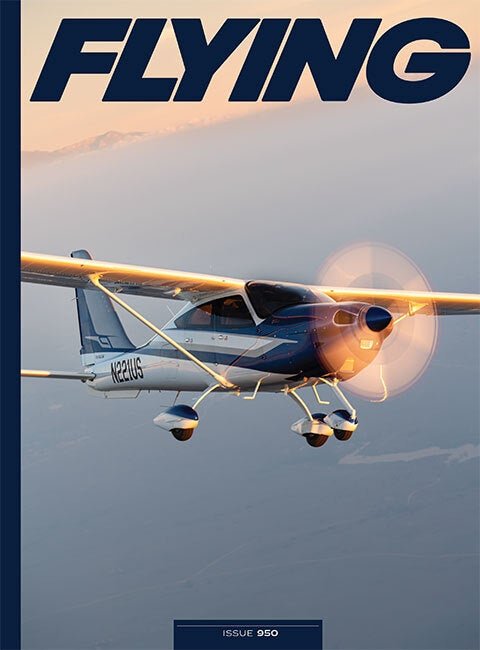
If you're not already a subscriber, what are you waiting for? Subscribe today to get the issue as soon as it is released in either Print or Digital formats.
Subscribe Now
A month later the Board of Officers assigned to investigate the crash determined that the pilot forgot to release a new control lock on the aircraft’s elevator that was designed to be disengaged by the pilot in the cockpit by depressing a locking handle. It was suggested that the pilot might have been overwhelmed and possibly distracted by the abundance of dials and gauges on the instrument panel—so he missed the control lock.
Boeing’s fix for this situation was to create a checklist for all phases of flight—engine start, taxi, takeoff, and landing. Other manufacturers followed suit, and the checklist became an integral part of aviation.
Checklists: The Backbone of Flight Safety
Today student pilots are taught checklist discipline starting with their first preflight inspection. It doesn’t matter if it is your first time doing the inspection or 100th—use the checklist during the walkaround. The more complicated the airplane, the bigger the checklist.
It lists preflight procedures, taxi, takeoff, cruise flight, descent, approach to landing (GUMPS check anyone?), go-around—also called a balked landing—normal landings, procedures for specialty takeoffs and landings, and emergencies. Learners are cautioned to memorize emergency procedures before their check ride.
- READ MORE: How Pilots Can Prepare for Unexpected Power Loss
- READ MORE: How to Winterize Your Flying
In a crewed environment, the checklist is run using “challenge and response”—the protocol where one pilot reads the checklist item as a question. For example, “Fuel pump on?” and the other pilot answers in the affirmative or negative. When flying with another pilot or an aviation-enthusiast passenger, challenge and response can add an extra level of involvement for the person not flying.
One of the most important things to remember is that the checklist is not a crutch but rather a means of making sure specific tasks—more often than not those connected to flight safety—are accomplished in a logical manner and that nothing is missed.
Some avionics suites, such as the Garmin G1000, have the checklist electronically built in. The print is often color-coded—white for normal operations, amber for caution, and red for emergencies.
There are third-party providers that create checklists—all can be found online—and in the training environment flight schools often create them by copying pages out of the pilot operating handbook for the aircraft, laminating them, and giving them the flight school logo and special procedures for that particular school, such as “place propeller in vertical position after flight to signify need for fuel.”
Sometimes they contain instructions on the setup and recovery for aircraft maneuvers. Using a checklist, it is possible to “chair fly.” To do this, you sit on the ground, checklist in hand, read it, and mentally fly the maneuvers. You can thank the military for this practice too. Aviation cadets are taught to put on all their flying gear and sit in a chair with a plunger between their knees and practice what they will be doing in the aircraft.
Is there such a thing as an FAA-approved checklist? According to an agency spokesperson, it “accepts aircraft checklists for Part 135 operations and approves checklists for Part 121 operations.”
It’s less restrictive under Part 61, as the “FAA does not require approval or acceptance of a checklist. As long as a pilot’s checklist matches the official manual [pilot operating handbook or airplane flight manual] and identifies the correct aircraft type, it is generally acceptable.”
It’s also legal for flight schools to add steps to their checklists, provided the additions do not conflict with the pilot operating handbook or airplane flight manual, according to the FAA.
“Overall, pilots must use a checklist in a manner consistent with the Airman Certification Standards and comply with FAA regulations, including FAR 91.9,” the agency said. “Using the manufacturer’s checklist helps ensure compliance.”
Checklist use is one of the items a pilot applicant is tested on during the check ride. You should be referring to it during the preflight, engine start, taxi, takeoff, cruise flight, descent, approach to landing, and go-arounds. You don’t want to be head down in the cockpit during the approach to land, which is why many pilots do an acronym-based flow such as GUMPS check (gas, undercarriage, mixture, propeller, pump, safety items) or a patterned-based flow like the T-check or backward question mark then refer to the checklist to make sure they got it all.
Checklists also have the speeds for operations such as normal and specialty takeoffs and landings, as well as emergency procedures. If you are interrupted as you run the checklist, I always recommend to back up three items.
We can also trace mechanical E6-B and kneeboards to the tools used by military pilots during World War II. The E6-B was often made of bakelite, and the kneeboard could be made of wood, a nonstrategic material.
After the war these devices were made from aluminum or plastic—and are still used today.
Call Signs: Another Military Tradition
In addition to checklist use, the adoption of pilot nicknames, also known as call signs, can be traced back to the military.
In the civilian world they are often bestowed after the first solo or when a certificate or rating is achieved. In the military, it can be more complicated and fraught with tradition and nuances. For example, the military call sign is usually printed in all caps. There are many ways to get a call sign—and they aren’t just for aviators.
Often it is derived from the person’s last name. Ed Hrivnak was a flight nurse and airdrop loadmaster in the U.S. Air Force.
“My call sign was ‘RIV’ for my last name, h-RIV-nak,” said Hrivnak, who is a pilot, with certificates earned through his experience in a sheriff’s department and fire department.
Jack Schoch, a private pilot and retired Navy man who served as an air intercept controller, controller supervisor, and at Top Gun school, has the call sign “Road Runner.” According to Schoch, in 1977, he was working with VF-74 Jolly Rogers off the carrier USS Forrestal when they asked what his call sign was. He said he didn’t have one, but when he rode his motorcycle, he was called Road Runner. The reply was: “That’s it. From now on, when you work VF-74, you will be the Road Runner.”
Sometimes it’s your association with someone else that generates your call sign, as was the case of Thomas Norton, a retired Navy captain. I met Norton when we worked for the same aviation publication. He was thin with white hair and a mustache and wore aviator-style glasses and his flight jacket, as he was a Vietnam-era Naval aviator. He spent years “training nuggets for carrier operations” and served two tours in Vietnam aboard the USS Ticonderoga. His call sign was “Mongoose.” The reason? He said his best friend and biggest competitor in the Navy flying A4s was a guy known as “Snake,” so by default he became Mongoose.
According to every military pilot interviewed for this article, call signs often trace back to a mistake a pilot made or are drawn from a serious situation that had a favorable outcome.
Washington state resident Erin Krizek, a retired Air Force lieutenant colonel, earned her call sign, “Kraken,” during what she describes as her “misadventures with depressurization over Mount Denali, Alaska.”
Krizek was piloting an E3 AWACS as part of a Red Flag exercise in which aircraft fly a total of 10 sorties designed to give soldiers experience similar to combat with live ordnance.
“One of our small eyebrow windows cracked at 31,000 feet,” Krizek said. “We ran a checklist and determined it was safer to land than continue, so we brought the plane back early. A couple weeks later, the No. 1 pilot window cracked—it was like we hit a bird at 31,000 feet.”
The crack was in the pressure pane of the multilayered window. It was not designed to hold in the pressure of the aircraft. The damage was like a spiderweb, Krizek recalled, and it was whistling.
Krizek put on her smoke goggles and oxygen mask in preparation for a window blowout and became the only one on that side of the cockpit. The copilot and flight engineer remained on the right side in case the left window blew out. Krizek slouched down low to avoid significant damage if the windscreen failed as she initiated a descent to 14,000 feet.
As they descended through that altitude, and the need for supplemental oxygen due to a lack of pressurization would not be an issue, the flight engineer depressurized the aircraft. At this point the impact-resistant outer pane broke, further intensifying the situation.
“Thankfully, it was the summer, so the air wasn’t too cold,” she said. “The impact-resistant outer pane was also spiderwebbed. It was terrifying, and my copilot mostly flew the approach in with me assisting on instruments.”
Krizek was given the call sign “Krak,” which evolved to “Kraken” during her call sign night. It is doubly important for Krizek, as Seattle’s NHL team founded in 2021 is the Kraken—and she’s a big fan.
Once you get a call sign, it sticks with you. A joke from my first day of college gave me the nickname of “Wolf,” as it was explained I had been raised by a pack of wolves until the age of 4. It became my college name. It would surface again many years later—we’re talking decades—when I joined the Seattle Women’s Field Hockey team as its goalie, although I hadn’t played in decades.
During the first practice, I let out a growl as a player charged me. The team captain remarked it was wolf-like, and therefore, Wolf was now my team name. A short time later I joined FLYING Magazine, and there was already someone named Meg on staff—this would be confusing. I was asked if I had a nickname. And that is how I became the Wolf at FLYING.
This column first appeared in the February Issue 967 of the FLYING print edition.
