


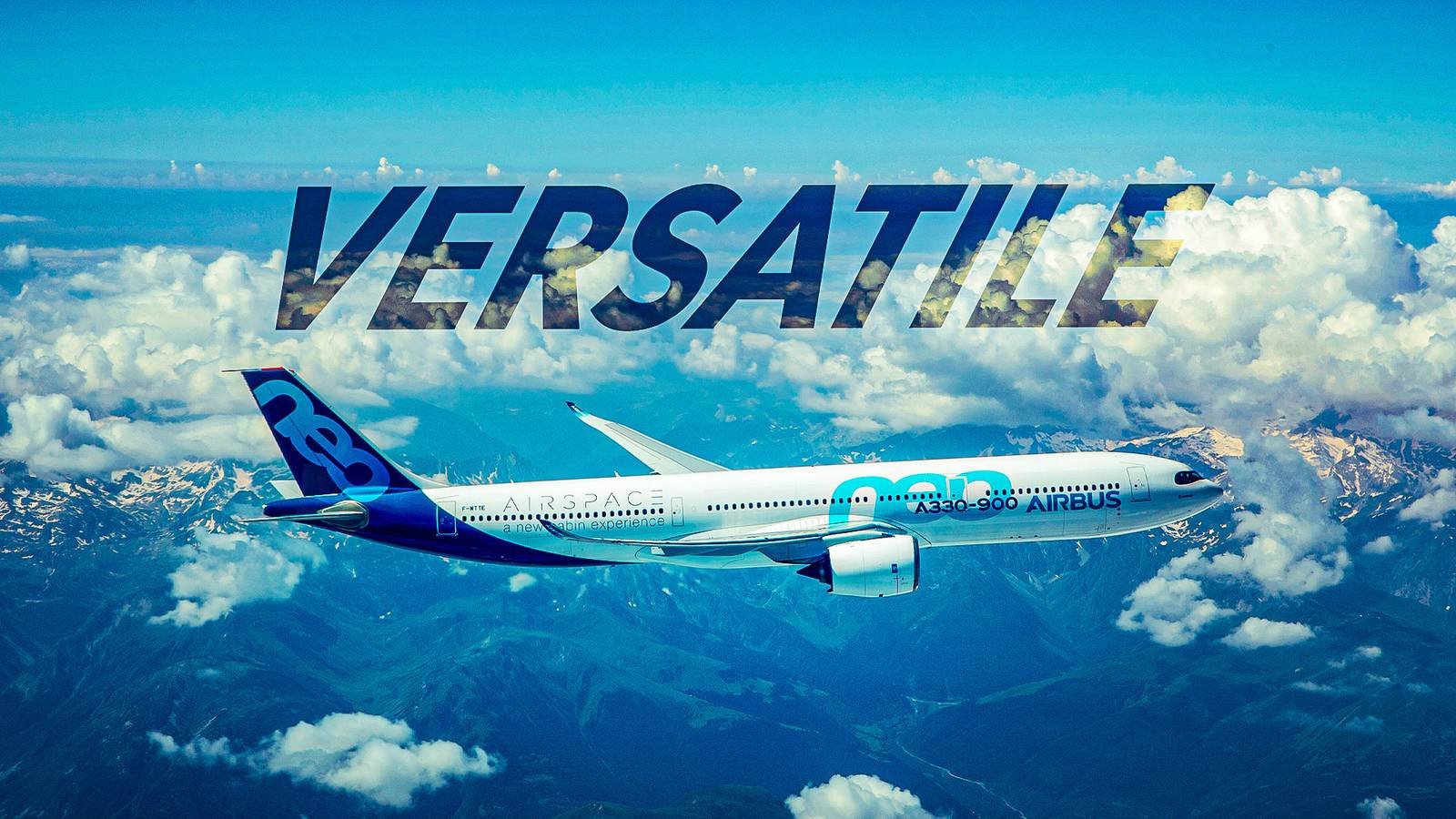
The Airbus A330neo occupies a distinctive position in the modern widebody market. Rather than pursuing record-breaking range or radical structural innovation, Airbus refined a proven airframe and integrated modern engines, aerodynamics, and systems to produce an aircraft optimized for a broad spectrum of airline operations. This approach reflects a deliberate strategy to prioritize operational flexibility, predictable economics, and long-term fleet adaptability over narrow performance specialization.
When Airbus describes the A330neo as “The Versatile Champion,” it is emphasizing a design philosophy rather than a marketing slogan. The term captures the aircraft’s ability to operate efficiently across short, medium, and long-haul routes while supporting diverse cabin layouts, payload profiles, and network structures. In an industry increasingly shaped by fluctuating demand and evolving route strategies, this breadth of capability has become a defining competitive advantage.
“The Versatile Champion” As Airbus Defines It
When Airbus calls the Airbus A330neo “The Versatile Champion,” it underscores the aircraft’s ability to operate across an unusually wide mission spectrum with a single platform. Airbus positions the A330neo as a widebody capable of handling short regional sectors, high-frequency medium-haul routes, and long-haul intercontinental services without structural or operational compromises. This flexibility allows airlines to deploy the same aircraft type across different network roles as demand shifts seasonally or structurally.
The aircraft’s certified performance envelope illustrates this adaptability. The A330-900 offers a typical range of approximately 7,350 nautical miles (13,250 km), while the A330-800 extends beyond 8,000 nautical miles (15,000 km), placing it firmly in long-haul and even ultra-long-haul territory. Both variants share a maximum takeoff weight of up to 553,000 lbs (251,000 kg), advanced composite winglets, and an optimized wing with improved twist for aerodynamic efficiency. The Rolls-Royce Trent 7000 engines also provide increased thrust margins and extended time on the wing, supporting operations from hot-and-high airports and challenging runway environments.
Beyond pure range, the A330neo benefits from cockpit commonality with earlier A330 models, reducing transition complexity for crews and enabling mixed-fleet flying. The aircraft incorporates the latest-generation Airspace cabin architecture, modern avionics, and enhanced maintenance diagnostics systems designed to improve operational reliability and dispatch performance. By branding it the “Versatile Champion,” Airbus emphasizes this blend of operational flexibility, infrastructure compatibility, and consistent economics across mission types rather than focusing solely on maximum-range capability.
Mission Flexibility And Utilization Efficiency

The A330neo’s ability to operate both short, medium, and long-duration flights is rooted in how its systems and structural margins were selected. Unlike aircraft optimized primarily for long-haul missions, it avoids excessive fuel volume, structural reinforcement, and systems redundancy that would add unnecessary weight on shorter routes. This directly improves utilization efficiency on medium-haul sectors.
High utilization is critical for widebody profitability. The A330neo can be scheduled on multiple short flights per day without incurring disproportionate maintenance or fuel penalties, then rotated onto longer overnight sectors. This flexibility allows airlines to keep aircraft flying more hours per day, spreading fixed costs across more revenue-generating cycles.
As a result, the aircraft often fits well into mixed schedules where demand varies significantly by time of day, route location, or season. This operational elasticity is one of the core reasons airlines view it as a reliable multirole platform rather than a niche or role-specific aircraft.

7 Ways Airbus Made The A330neo Different From The Original A330
The A330neo represents progress in seven key areas compared to the older A330ceo.
Medium-Haul Economics And Structural Trade-Offs

On medium-haul routes, the A330neo benefits from a structural design that balances weight and durability rather than minimizing mass at all costs. While composite-intensive aircraft achieve lower empty weights, they also carry design features intended for very long missions that offer limited benefit on shorter sectors. The A330neo’s aluminium-lithium structure avoids some of these penalties.
Fuel burn on medium-haul flights is influenced heavily by climb, descent, and reserve fuel requirements. Because the A330neo is not optimized for extreme ranges, it often carries less non-revenue fuel relative to its payload, improving effective efficiency on routes of 3,000 to 5,000 nautical miles. This can narrow or eliminate fuel burn gaps with newer designs in real-world operations.
Combined with higher seating capacity, these factors produce a competitive cost per seat rather than simply lower fuel burn per flight. For many airlines, this metric is more relevant to profitability, particularly in high-demand or price-sensitive markets.
Propulsion And Aerodynamic Design Choices

The exclusive use of the Rolls-Royce Trent 7000 reflects Airbus’ emphasis on delivering efficiency across a wide spectrum of operating conditions rather than optimizing the aircraft for a single mission. The Rolls-Royce Trent 7000 features a bypass ratio of approximately 10:1 and an overall pressure ratio above 50:1, incorporating composite fan blades and advanced hot-section materials derived from Rolls-Royce’s Trent XWB programme. These technologies enable around 11–12% lower fuel burn compared with the previous-generation Trent 700, while also achieving double-digit reductions in NOx emissions relative to ICAO CAEP/8 limits and a noise footprint up to ten EPNdB below regulatory requirements.
Equally important is how the engine’s thrust and efficiency characteristics are tuned. Rather than focusing solely on peak cruise performance for ultra-long-haul missions, the Trent 7000 maintains strong specific fuel consumption across climb, cruise, and descent phases. This matters because on medium-haul routes, these non-cruise segments represent a much larger share of total fuel burn. For the Airbus A330neo, this translates into consistent real-world efficiency whether the aircraft is flying a 2-hour regional sector or an intercontinental route approaching its maximum range.
Specification (Aviator Joe) | Airbus A330-800neo | Airbus A330-900neo |
|---|---|---|
Length | 193 feet (58.82 m) | 208 feet 10 inches (63.66 m) |
Wingspan | 210 feet (64.00 m) | 210 feet (64.00 m) |
Height | 57 feet 1 inch (17.39 m) | 55 feet 1 inch (16.79 m) |
Engines | 2 × Rolls-Royce Trent 7000 | 2 × Rolls-Royce Trent 7000 |
Thrust (per engine) | 72,000 lbf (320 kN) | 72,000 lbf (320 kN) |
Maximum Take-Off Weight (MTOW) | 533,500 lb (242,000 kg) | 533,500 lb (242,000 kg) |
Typical Range | 8,100 nmi (15,000 km) | 7,350 nmi (13,250 km) |
Cruise Speed | Mach 0.86 | Mach 0.86 |
Typical 3-class Capacity | 257 passengers | 287 passengers |
Cargo Volume (Lower Deck) | 4,800 ft³ (136 m³) | 5,750 ft³ (162.8 m³) |
Aerodynamically, the redesigned wing reinforces this multi-mission capability. The A330neo’s new composite wing increases the aspect ratio to roughly 11, significantly reducing induced drag and improving lift efficiency during climb and cruise. New-generation composite winglets, informed by A350 aerodynamic research, further reduce vortex drag and improve efficiency across a broad speed range. Together, these aerodynamic changes contribute roughly 4% fuel burn improvement on their own and are especially valuable on routes where the aircraft spends proportionally more time climbing, descending, or operating at non-optimal cruise altitudes, ensuring stable performance across varied weights, altitudes, and mission lengths.

An Ideal Market: Why The Airbus A330neo Is Uniquely Perfect For Asia-Pacific
The jet has impressive capabilities and versatility.
Cabin Density, Payload, And Revenue Potential

The A330neo’s cabin flexibility directly affects its revenue-generating potential. Airlines can configure the aircraft for long-haul comfort with premium seating and lie-flat beds or shift to high-density layouts exceeding 400 seats for leisure-focused routes. Arguably, the most famous application of this ability is Cebu Pacific. The Philippine low-cost carrier operates a fleet of A330-900s with a seating capacity of 459 in an all-economy 3-3-3 layout, utilizing slimline Recaro seats with a 30-31-inch pitch and 16.8-inch width. This adaptability allows the same aircraft type to serve very different business models.
Payload capability further strengthens this flexibility. The aircraft’s cargo volume enables meaningful belly freight carriage even on passenger-heavy flights, providing an additional revenue stream. On medium- and long-haul routes alike, cargo can significantly improve route economics, especially during periods of weaker passenger demand.
Because these configurations can be adjusted over time, the aircraft retains value as market conditions evolve. This long-term adaptability is a major consideration for fleet planners evaluating lifecycle cost rather than short-term performance metrics.
Market Positioning And Fleet Strategy Implications

In fleet planning terms, the Airbus A330neo occupies a strategic middle ground between large single-aisle aircraft and next-generation composite widebodies such as the Boeing 787 or Airbus A350. It offers intercontinental reach while remaining structurally and operationally closer to earlier-generation widebodies. This positioning enables airlines to upgauge from narrowbodies on high-demand routes or replace aging widebodies without committing to the higher capital expenditure and ultra-long-range specialization associated with newer all-composite platforms.
A key pillar of the A330neo’s appeal is its extensive commonality with the earlier A330ceo family and broader Airbus cockpit philosophy. Pilots can transition via a relatively short differences course rather than a full type rating, and maintenance crews benefit from shared systems architecture, ground support equipment compatibility, and established supply chains. The aircraft retains the same fuselage cross-section as earlier A330s while incorporating aerodynamic refinements. For airlines already operating Airbus fleets, this commonality can translate into reduced simulator time, simplified spares provisioning, and smoother integration into existing operational control systems.
Ultimately, the A330neo’s value proposition centers on consistency and flexibility, rather than technical extremes or record-breaking features. It does not chase the longest-range records or the lightest structural weight in its category; instead, it combines proven airframe architecture with targeted aerodynamic, systems, and propulsion upgrades to deliver broad mission capability. That balance allows airlines to deploy the aircraft across trunk routes, secondary long-haul markets, and seasonal capacity shifts with minimal network restructuring. In doing so, the A330neo serves as a resilient, adaptable platform designed to sustain competitive operating performance across diverse and evolving route strategies.
