


Ask anyone who has attended RAPID + TCT across multiple years what keeps them coming back, and the answers converge on the same thing: the calibre of conversation the event makes possible. Engineers talk to executives. Researchers talk to operators. People who rarely share a room find themselves sharing a problem.
The newly introduced Essential AM track in the 2026 conference is designed around that same principle. Spanning design for additive manufacturing (DfAM), post-processing, standards, repeatability, AI, and business case development, it is deliberately cross-sector rather than industry-specific.

Running from 13 to 16 April, the conference program is open to practitioners from any sector working through the harder questions, both before and after a successful build. The show floor and expo opens the following day, the 14th.
Attend RAPID + TCT this April in Boston as a guest of 3D Printing Industry! Claim your free Expo Pass or save 20% on a Conference Pass.
Ahead of the event, I asked three of the track’s speakers to discuss what past attendance at the conference has meant for their work, and what they are bringing to RAPID + TCT 2026 in Boston this year.
Cost-Driven Planning: Maximizing Profit in Additive Manufacturing – Huba Horompoly, Co-Founder and Managing Partner, Gravity Pull Systems

Horompoly has a particular way of describing what RAPID + TCT does well, as he explains, “RAPID + TCT is one of the few places where you can talk to everyone in the value chain in two days: machine OEMs, service bureaus, aerospace, medical primes, software vendors, and researchers. That environment forces you to connect the dots.”
For the Co-Founder, those dots kept pointing toward the distance between what an engineering team considers a success and what a production environment can actually sustain. Qualification requirements, post-processing bottlenecks, scheduling constraints, the unglamorous calculus of build vs. make decisions. None of it features heavily in the technical literature, but all of it determines whether a promising AM application ever scales.
That realisation shaped the architecture of Gravity Pull Systems directly. PAAM handles toolpath and parameter optimisation at the print level; SYNOPTIK takes the wider view, covering scheduling, material planning, post-processing capacity, and real-time replanning. The two platforms are built as a pair because, in Horompoly’s experience, improving one in isolation means the gains from the other are never fully realised.
His session in Boston will address a question the industry has been circling without quite resolving: why does cost keep surprising even experienced AM teams. He explains AM cost is not a single figure but a system with interdependencies that standard estimating models tend to flatten.
Yield assumptions, post-processing load, and realistic utilisation rates are the variables most commonly missing from early business cases, and most commonly responsible for the gap between projection and reality.
He adds, “The biggest step-change is usually not a single ‘magic parameter’ — it’s standardizing decision-making so every job doesn’t depend on tribal knowledge.”
The session is directly applicable to operations leaders, application engineers, program managers in aerospace and medical, and service bureaus. Horompoly will also address sustainability, working through the scenarios in which carbon and cost optimisation align and those in which they do not.
Fashion Meets Fabrication: Lessons from a Designer Collaboration – Sylvia Heisel, CEO, Sylvia Heisel

Heisel arrived at RAPID + TCT from a different direction. Her background is in fashion and design, and what she found when she started attending was a disconnect that surprised her in its scale.
She emphasizes, “I was, and still am, amazed that so few apparel companies attend to learn about AM and that the AM folks who would like to work with the fashion industry know so little about apparel supply chains. There is such a huge divide and a huge opportunity between these industries.”
What the conference gave her, across successive editions, was a more calibrated sense of what is genuinely possible. Conversations with practitioners in other sectors sharpened her thinking about where AM could realistically move the needle for fashion brands, and where the friction would be.
Her session, Fashion Meets Fabrication, is built around a lesson she has watched companies learn the hard way. “The apparel industry operates really differently from other design-centric industries. Success requires an understanding of how fashion brands function and what they consider a value. It is as much about fitting into their workflow as it is about delivering a great product,” she highlights.
Heisel notes that fashion brands operate on timelines, approval structures, and definitions of value that are largely invisible to those approaching the sector from a manufacturing or engineering background, and her session is aimed squarely at that audience.
She adds, “I am very sure that fashion presents a huge opportunity for AM. I hope delegates will leave questioning how they have approached working with the fashion industry and thinking about new opportunities.”
Beyond the Build: Standardizing Value in Additive Manufacturing – Stephanie Lake, CEO and Founder, Subcomponents Plus

Lake set up Subcomponents Plus to work on a problem that the AM industry has been struggling to formalise: how to measure whether an AM application has actually delivered. Previous attendance at RAPID + TCT fed into how she approaches that question.
She explains, “Instead of assuming a solution must be completely reinvented, I began looking for opportunities to reapply proven solutions across industries using different additive processes, materials, or manufacturing approaches.”
Her 2026 session will give delegates a structured way to make that evaluation across five areas: economic performance, production efficiency, repeatability and quality, supply chain resilience, and workforce impact. It also tackles the narratives she considers persistently overstated: that additive automatically reduces cost, that it eliminates rather than redistributes supply chain complexity, and that geometric complexity carries no downstream consequences.
She draws on research into presurgical planning to illustrate where measurable value does materialise: patient-specific models derived from CT scans reduced operative time by 18-60 minutes per case and anaesthesia exposure by 25-45 minutes, gains that carry even greater weight in rural healthcare settings where access to specialised planning resources are limited.
The goal for delegates is straightforward. Lake believes that the attendees “should be able to evaluate additive manufacturing projects using clearer metrics — understanding when additive manufacturing truly delivers economic and operational value, and when traditional manufacturing may still be the better solution.”
The CEO concludes, “The real breakthrough in additive manufacturing isn’t printing the part — it’s knowing when printing the part actually makes sense.”
Attend RAPID + TCT this April in Boston as a guest of 3D Printing Industry! Claim your free Expo Pass or save 20% on a Conference Pass.
3D Printing Industry is inviting speakers for its 2026 Additive Manufacturing Applications (AMA) series, covering Energy, Healthcare, Automotive and Mobility, Aerospace, Space and Defense, and Software. Each online event focuses on real production deployments, qualification, and supply chain integration. Practitioners interested in contributing can complete the call for speakers form here.
To stay up to date with the latest 3D printing news, don’t forget to subscribe to the 3D Printing Industry newsletter or follow us on LinkedIn.
Explore the full Future of 3D Printing and Executive Survey series from 3D Printing Industry, featuring perspectives from CEOs, engineers, and industry leaders on the industrialization of additive manufacturing, 3D printing industry trends 2026, qualification, supply chains, and additive manufacturing industry analysis.
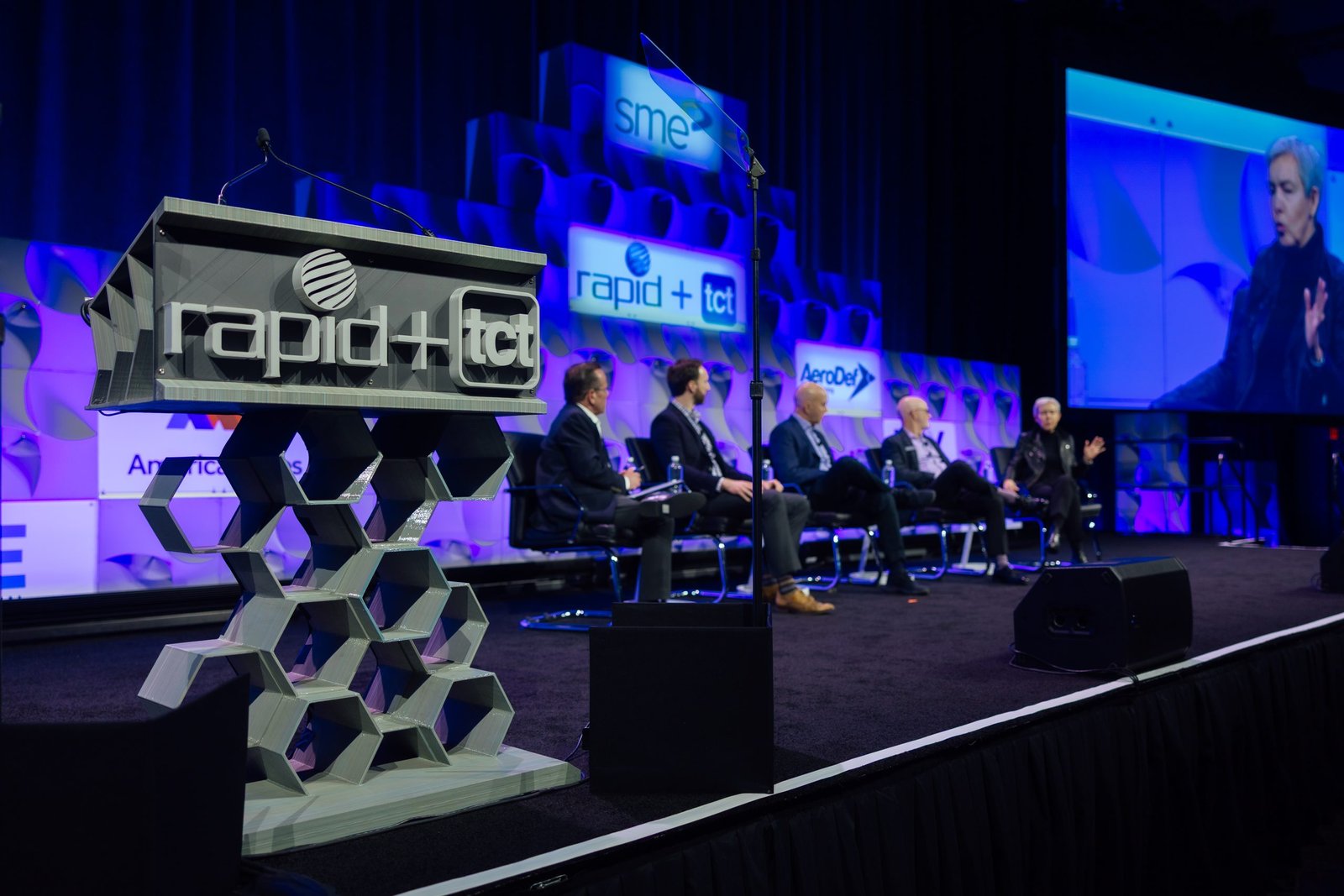
Featured image shows the daily Executive Perspectives Keynote Series kicks off each day before conference sessions begin. Hear from the industry luminaries charting the future of AM. Photo via SME.
