


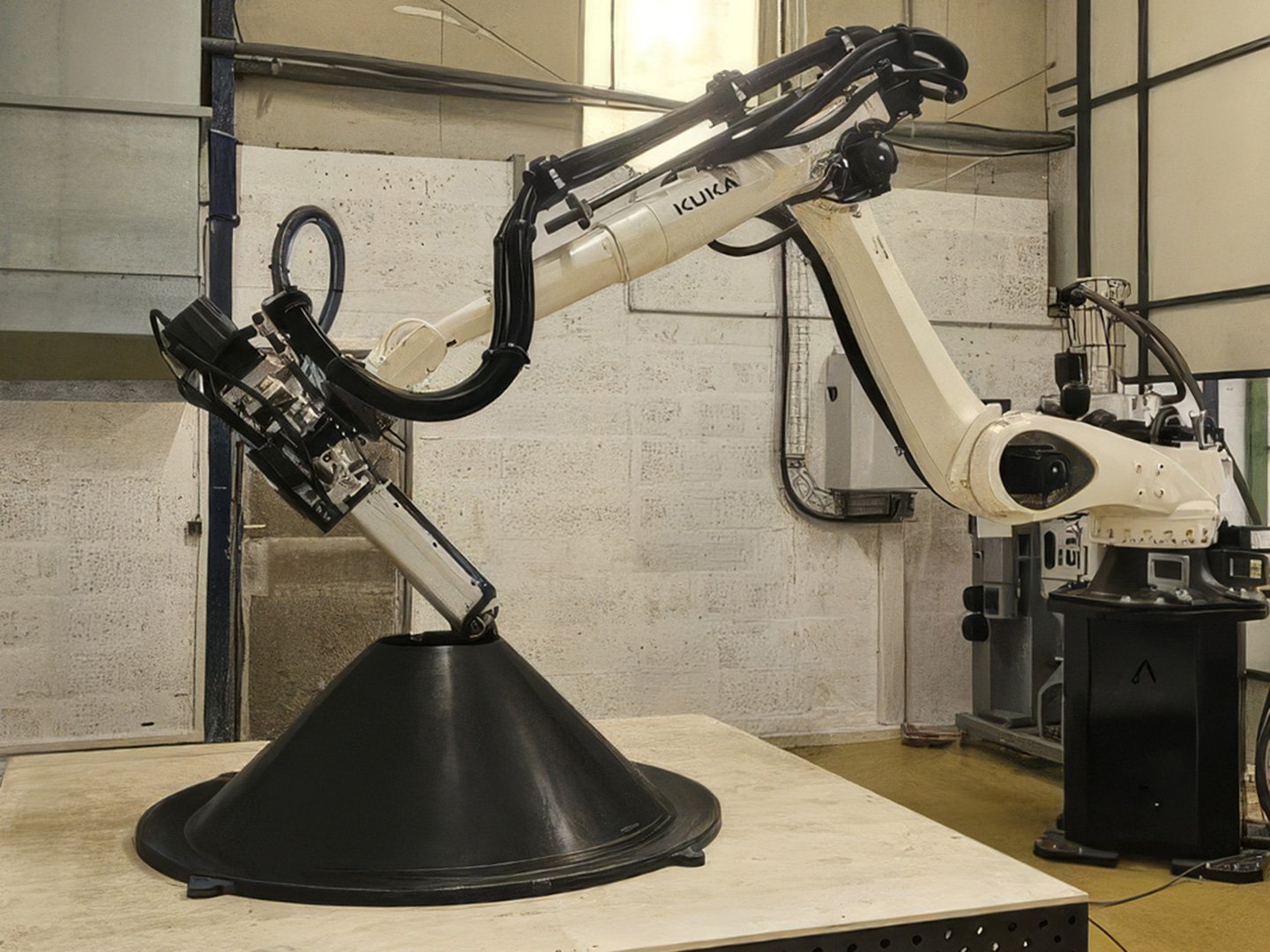
Italian 3D printer manufacturer Caracol has partnered with French manufacturer Formes et Volumes to produce a large-scale composite lamination tool for aerospace using robotic large-format additive manufacturing, combining fiber-reinforced thermoplastics and hybrid post-processing in a single integrated workflow.
Built on the Heron AM platform and already deployed in an active production environment, the project delivers a fully monolithic structure that cuts lead times by 50% and production costs by 30% compared to conventional tooling approaches.
Large-scale composite lamination tools have historically been among the most demanding components to produce in aerospace manufacturing. Traditional approaches rely on multi-part assemblies, extended CNC machining cycles, and tight tolerance stacking, challenges that become more pronounced as part geometry grows. Each additional component introduces new alignment risks, and lead times stretch accordingly, putting pressure on programs that increasingly require faster turnaround and leaner supply chains. Caracol’s Heron AM platform offers an alternative path.
A Lamination Tool Built for Active Production
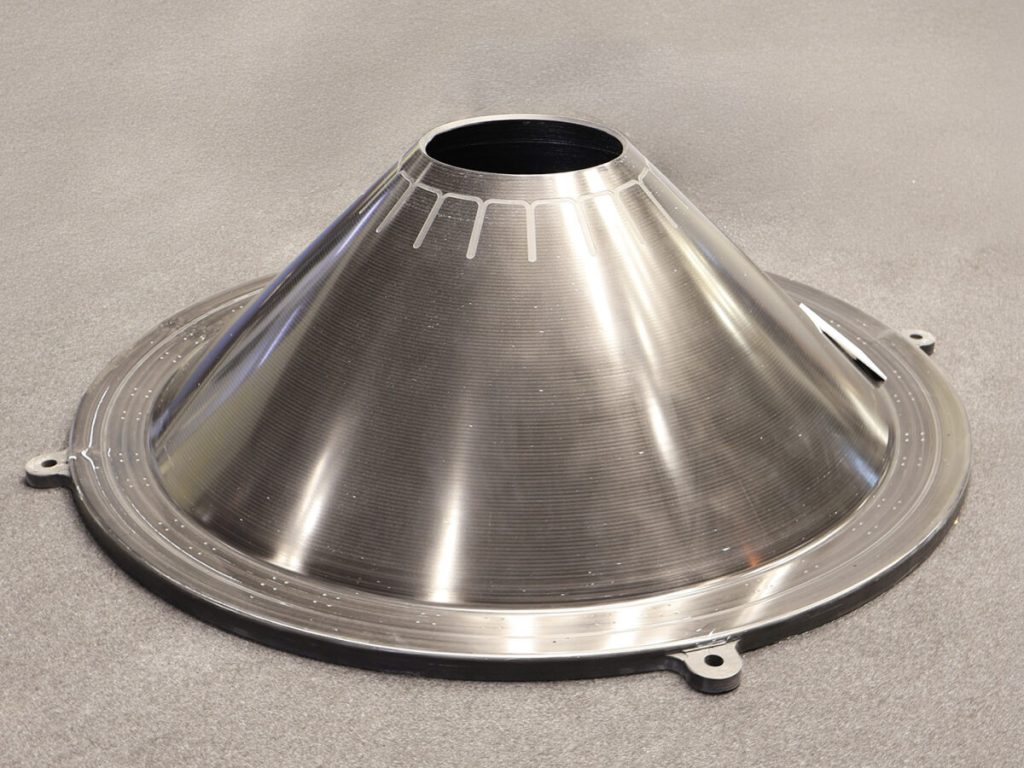
The component was built using the Heron AM system equipped with a high-flow extruder, purpose-built for robotic LFAM applications requiring high deposition rates and consistent mechanical output. The material selected was polycarbonate reinforced with 20% carbon fiber, chosen for its structural rigidity and low weight. The finished tool measures 2,200 × 2,200 × 600 mm, weighs 180 kg, and was printed in approximately 19 hours, a timeline that would be difficult to match through traditional fabrication at equivalent scale.
The production workflow is hybrid in nature: robotic LFAM establishes the core geometry, CNC machining brings the part to final dimensional tolerances and surface specification, and autoclave post-processing conditions the component for the thermal demands of composite lamination. The result is a fully monolithic structure with no assembly interfaces, removing a category of failure mode that conventional multi-part tooling cannot eliminate.
Measurable Gains Across the Production Chain
The shift to robotic LFAM produced results across multiple performance dimensions: lead time cut by half, production costs down 30%, and both material waste and part weight reduced by 50%.
Beyond the headline figures, the monolithic architecture offers structural advantages that compound over time. Without assembly joints, the tool maintains dimensional stability across repeated use cycles, a meaningful factor where tooling accuracy directly influences the quality of finished composite parts.
The digital design phase also becomes more flexible, allowing engineers to optimize internal geometry and mass distribution unconstrained by traditional manufacturing limits. The component is currently operational in an active industrial setting, providing real-world validation of both process reliability and part performance.
Aerospace Is Turning to Large-Format Additive Manufacturing
Caracol’s strategy centers on closing the gap between design freedom and production practicality in large-scale industrial tooling. Rather than positioning LFAM as a prototyping shortcut, the company has built its Heron AM platform around end-use deployment, integrating robotic deposition, hybrid CNC finishing, and autoclave-compatible materials into a single, repeatable workflow.
The need for this kind of solution is well documented. As part of the U.S. Air Force Research Laboratory‘s (AFRL) Low-Cost Attributable Technology program, Boeing and Thermwood applied large-scale additive manufacturing to produce autoclave tools for aerospace components, with the program’s manufacturing lead noting that additive composite tooling was being evaluated specifically to handle future manufacturing surge requirements and accommodate design changes at acceptable cost.
In a separate project, Ingersoll and Bell produced a 22-foot rotor blade mold in 75 hours using a hybrid large-format workflow, carbon fiber-filled ABS printed to near-net shape, then machined to final tolerances. The same fundamental approach Caracol has now deployed for Formes et Volumes in a production context.
Caracol’s own platform has demonstrated comparable efficiency gains beyond aerospace: its collaboration with Ferretti Group on the Pershing GTX116 yacht delivered a 50% reduction in lead time and 60% reduction in material waste, figures that closely mirror what the Formes et Volumes project achieved under more demanding production conditions.
What these projects make clear is that aerospace composite tooling is no longer a test case for large-format additive manufacturing, it is becoming one of its most mature and economically defensible applications.
3D Printing Industry is inviting speakers for its 2026 Additive Manufacturing Applications (AMA) series, covering Energy, Healthcare, Automotive and Mobility, Aerospace, Space and Defense, and Software. Each online event focuses on real production deployments, qualification, and supply chain integration. Practitioners interested in contributing can complete the call for speakers form here.
To stay up to date with the latest 3D printing news, don’t forget to subscribe to the 3D Printing Industry newsletter or follow us on LinkedIn.
Explore the full Future of 3D Printing and Executive Survey series from 3D Printing Industry, featuring perspectives from CEOs, engineers, and industry leaders on the industrialization of additive manufacturing, 3D printing industry trends 2026, qualification, supply chains, and additive manufacturing industry analysis.
Featured image shows Caracol and Formes et Volumes produce monolithic aerospace lamination tool via robotic LFAM. Photo via Caracol.
