


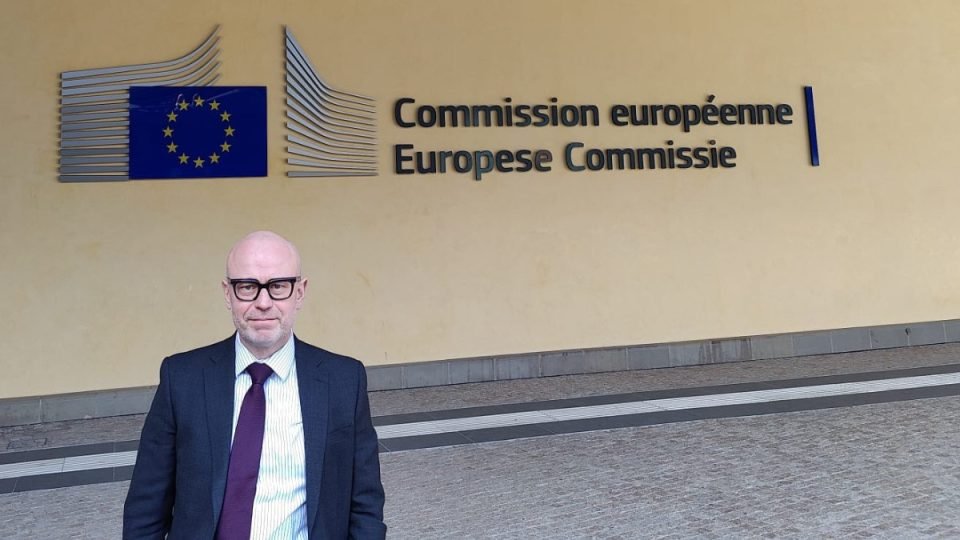
Pawel Jarza from the Policy and Compliance team of the British International Freight Association (BIFA) has met with representatives of the European Commission in Brussels to discuss the operation of the Windsor Framework and its impact on the movement of goods between Great Britain and Northern Ireland.
The Windsor Framework, which dates to 2023, offered a new set of arrangements to restore the smooth flow of trade within the UK internal market in a post-Brexit operating environment.
Jarza’s meeting formed part of ongoing engagement between industry and policymakers to assess how the post-Brexit trading arrangements are functioning in practice and to identify areas where processes might be improved for freight forwarders and their customers.
Jarza highlighted the operational realities faced by members of BIFA – the UK freight forwarder association – when moving goods across the Irish Sea.
While the Windsor Framework has simplified certain procedures, such as removing the requirement for export declarations on goods moving from Great Britain to Northern Ireland, freight forwarders continue to navigate a complex trading environment, BIFA considers.
Key challenges discussed included the need to operate between two tariff regimes and to determine whether goods are considered ‘at risk’ of entering the EU market.
Further requirements, including safety and security declarations and the implementation of systems such as Import Control System 2 (ICS2), also contribute to the complexity of border processes, it was noted.
Discussions also covered issues surrounding the movement of small parcels and lower-value consignments, where the detailed provisions of the Framework can create practical difficulties for operators.
Need for further dialogue
BIFA used the meeting, the association said, to relay feedback from its members and to emphasise the importance of continued dialogue between industry and regulators to ensure the Framework works as effectively as possible.
Jarza highlighted: “Freight forwarders operate at this border every day and have first-hand knowledge of what works and what does not.
“If members encounter systemic issues, it is important that they let us know so we can raise these with government departments and the European Commission, and where possible propose practical solutions.”
Progress on AI
Last month (February), BIFA confirmed that it had formed a new artificial intelligence (AI) and technology working group in response to growing interest from the trade association’s members in the opportunities and challenges presented by AI.
The trade association said the new working group will examine AI specifically from a freight forwarder’s perspective.
