


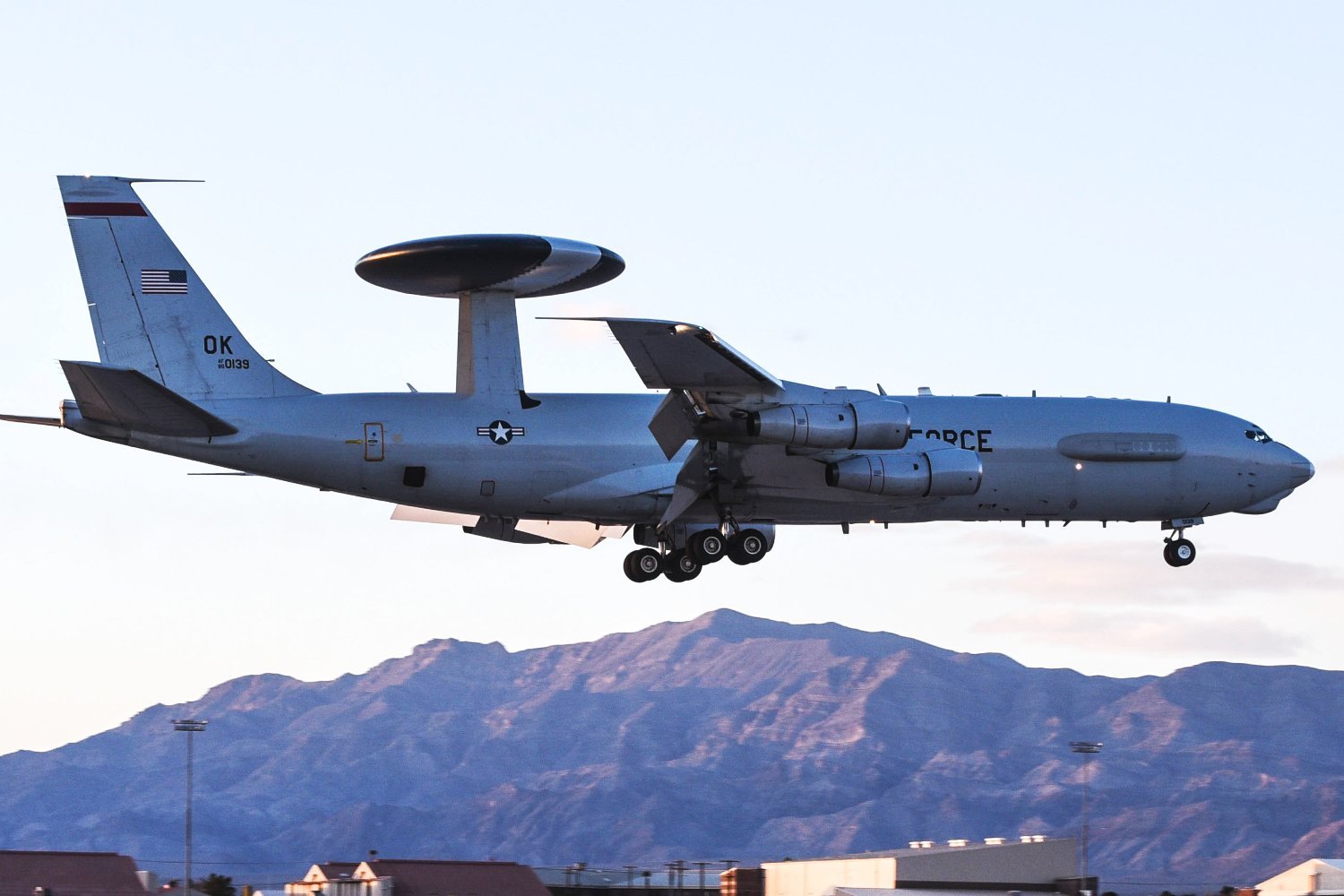
Images circulating on social media appear to show a U.S. Air Force Boeing E-3 Sentry airborne early warning aircraft heavily damaged or destroyed following an Iranian missile and drone attack on Prince Sultan Air Base in Saudi Arabia on March 27, though U.S. officials have not confirmed the extent of the losses.
The Pentagon and U.S. Central Command have declined to comment on the incident, which reportedly left more than 10 service members injured and damaged multiple aircraft, including aerial refueling tankers, according to people familiar with the matter cited by Air & Space Forces Magazine.
Photographs widely shared online show what appears to be E-3 serial 81-0005 with its rear fuselage burned out and debris scattered around the airframe. While the authenticity of the images has not been independently verified, multiple angles and consistent visual details — including markings and airfield features — suggest they are likely genuine.
Follow us: WhatsApp | BlueSky | Google News | Instagram | LinkedIn | Facebook
Separate reporting indicates that at least one E-3 stationed at the base sustained severe damage, potentially beyond repair. If confirmed, this would mark a significant loss for the U.S. Air Force, which operates a shrinking fleet of the aging airborne warning and control system aircraft.
The attack reportedly involved a mix of long-range one-way attack drones and ballistic missiles targeting the base, a key hub for U.S. air operations in the region. Satellite imagery prior to recent restrictions on commercial data availability showed high-value aircraft dispersed across taxiways and apron areas, a tactic intended to reduce vulnerability to such strikes.
Even without a direct hit, analysts note that fragmentation and secondary fires from nearby impacts can be sufficient to destroy large aircraft on the ground. Previous reports also indicated that several tanker aircraft were damaged in earlier strikes on the same installation.
Pictures show the total loss of 81-0005, an E-3G “Sentry” Airborne Early Warning and Control (AEW&C) Aircraft with the U.S. Air Force’s 552nd Air Control Wing based out of Tinker Air Force Base, Oklahoma, following yesterday’s Iranian ballistic missile and drone attack on Prince… pic.twitter.com/NNnILybnrU
— OSINTdefender (@sentdefender) March 29, 2026
The potential loss of an E-3 carries operational implications. The aircraft plays a central role in managing air operations, providing surveillance, command and control, and real-time battlespace awareness. The U.S. had deployed six E-3s to the Middle East ahead of the conflict.
With only 16 E-3s remaining in service — and fewer available at any given time due to maintenance constraints — the destruction of even a single aircraft could affect coverage and coordination of air operations. Experts warn that gaps in airborne early warning could reduce the effectiveness of strike missions and complicate airspace management.
The incident also highlights longstanding concerns about the vulnerability of aircraft on the ground. Despite repeated warnings, investment in hardened shelters and protective infrastructure at forward bases has lagged behind the evolving threat posed by precision-guided weapons and drones.
If the destruction of the E-3 is confirmed, it would represent one of the most significant setbacks suffered by the U.S. Air Force in many years.
