


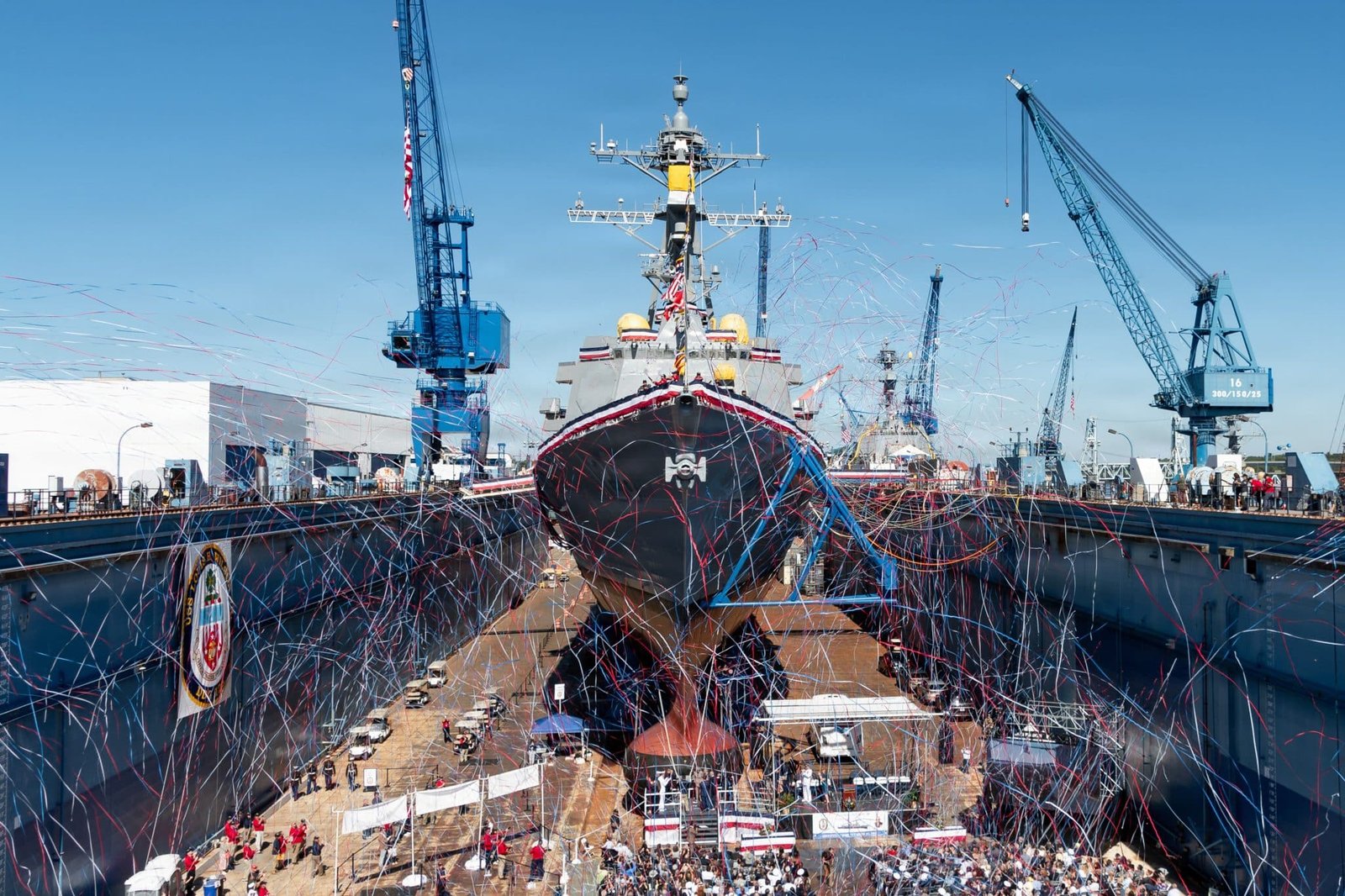
Under the U.S. Navy’s released shipbuilding plan as apart of the Future Year Defense Program (FYDP), the U.S. Navy’s surface force will receive a major reshuffle in it’s structure, targeted towards fielding continually advanced surface ship based capabilities and increasing industrial output.
Under the U.S. Navy’s prerogative, the surface force will be receiving a total of $77.8 billion dollars in investment from FY 2027 to FY 2031, with $7.6 billion dollars allotted in FY 2027 alone. The overall goal of the wave of monetary resources pushed into the surface fleet is to “expand and modernize” the U.S. Navy’s current surface force via the procurement of 14 new hulls. The FYDP also invests $6.7 billion across the surface ship industrial base, further revitalizing the U.S. defense shipbuilding sector.
These new vessels are to be split into a “high-low” split, with the higher end constituted by the Guided Missile Battleship and more Arleigh Burke-class Flight III guided missile destroyers (DDG-51s). The Navy states that the FF(X) Frigate with augmentation from a suite of unmanned systems will take over smaller/asymmetric threats in order to provide solutions tailored to the low end of this split and to free up higher tier combatants to conduct higher intensity, peer on peer engagements.
Going Nuclear

The Navy expressed that the new class of guided missile battleships was born from a multitude needs that previous surface combatant offerings could not shoulder all at once. Subsequently, the Navy introduced the BBG to handle multiple mission sets including high volume and time sensitive fires, anti-air warfare, and nuclear deterrence in one platform without compromise.
“Deterrence is our highest duty, and deterrence begins with credible combat power. The future Battleship is the high end of the high-low mix our Joint Force needs— survivable, hard-hitting, and built for the scale of the fight. It brings resilient command and control, deep magazines, diverse weapons, and long reach in one platform.”
– Admiral Samuel Paparo, Commander, US Indo-Pacific Command.
Formerly designated as BBG(X), the Battleship now includes a a nuclear power plant, which earns the vessel the new designation of BBGN (Guided Missile Battleship-Nuclear). The transition to a nuclear power plant reflects the intended usage for high powered energy weapons, advanced electronic warfare suites, and the need to push a 40k+ ton vessel at required speeds. The Nuclear power plant also adds additional future proofing for more energy intensive systems, another stated goal in the Navy’s plan.
The battleship program soaks up most of the FYDP’s funding, with $43.526 billion allotted towards the procurement of the first three hulls split into $1 billion for FY 2027, $16.970 billion for FY 2028, $1 billion for FY 2029, $13.028 billion for FY 2030, and $11.528 billion for FY 2031. Following the beginning of it’s procurement cycle in FY 2028, the Navy will receive the first battleship in 2036, with a projected total of at least 11 BBGNs in service by 2055.
The Battleship’s production will utilize methods including AI enabled design tools, industrial base integration, and a rushed engineering process to try to trim the delivery timeline down as much as possible. Additionally, fragmentation of production is to enable larger sects of the industrial base to produce components and then ship them to assembly, allowed via a modular design.
A Proven Design
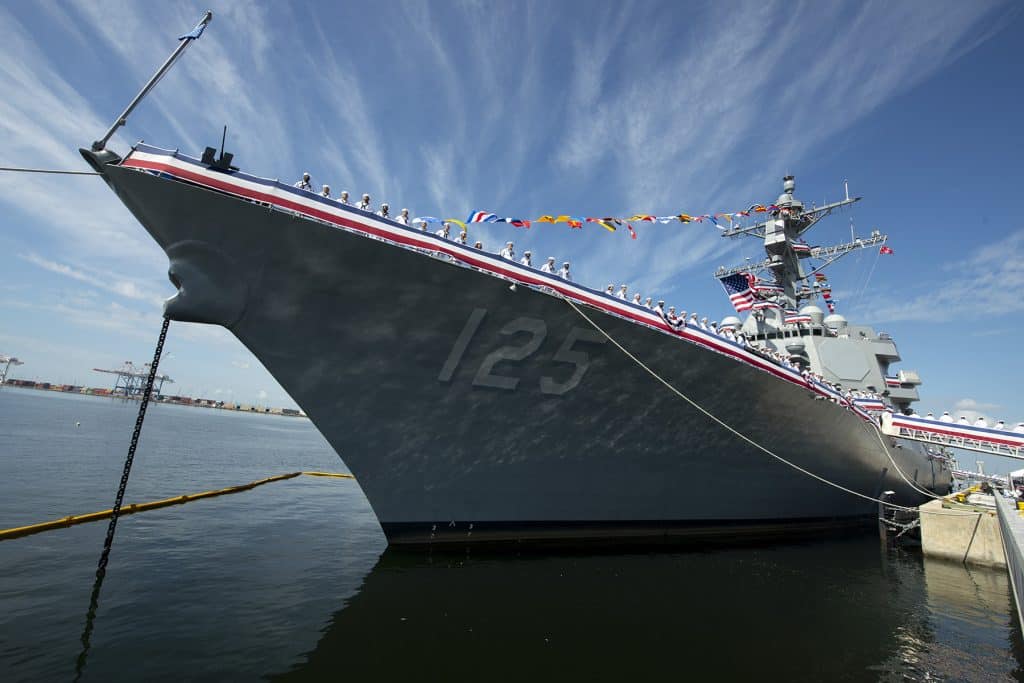
The Arleigh Burke-class’s Flight III iteration on the vaunted guided missile destroyer’s design rounds off the other half of the high end in the high-low force design, with the class maintaining it’s role as the most numerous multi-role surface combatant. Following the introduction of the battleship and FF(X), DDG-51s are to be redirected towards an increasingly high end/escort heavy role, functioning primarily alongside capital ships with an increased emphasis on Air and Missile Defense, Strike, and Anti-submarine warfare as a part of Carrier Strike Group or Surface Action Group.
As the Arleigh-Burke maintains it’s status as a cornerstone of the American fleet, serial production will continue to preserve industrial capacity and fleet size. Production is to rise to a an average of 2 per year with the Navy desiring to improve productivity and a reduction in the DDG-51 production backlog. Additionally, the Navy will purchase two DDG-51s every year starting in FY 2030 (up from the current 1 per year), with 7 DDG-51s purchased under the FYDP for $25.332 billion dollars.
Under the stated plan, Flight I DDG-51s will begin to exit service in FY 2031, with the Ticonderoga-class cruisers completely decommissioned by FY 2030. The absence of these vessels creates a serious crunch on the numbers of large surface combatants in service before FF(X) and BBGN enter service. Total CG/DDG numbers will crater to 71 (from 82 currently) in 2035-2036 following a continual decline caused by a spiked amounts of retirements. This situation creates a critical need for FLT-III DDG-51s, especially given their abilities to act as battle group air defense commanders.
The Low-End
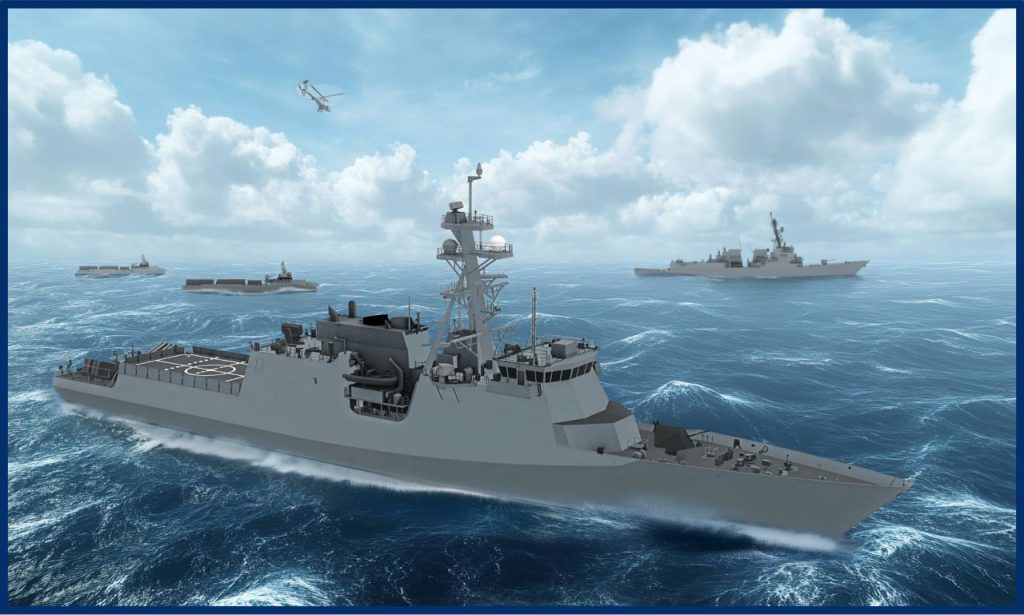
FF(X) will represent the lower end of the high-low mix, with increased emphasis on handling asymmetric or non-peer adversaries through manned-unmanned teaming with USVs and stated duties such as, “convoy escort, anti-submarine warfare, surface warfare, homeland defense, maritime interdiction, and counter-drug operations.” However, the shipbuilding plan emphasizes multi-role flexibility, increasingly mentioning Anti-Submarine Warfare (ASW) based tasking. ASW based missions are amongst a frigate’s more traditional roles as smaller, yet capable escort ships to augment more anti-air warfare/strike oriented vessels.
For FF(X)’s part, the shipbuilding plan explicitly mentions the Frigate’s capability to carry containerized sonar arrays and an MH-60R, the Navy’s primary multi-role helicopter often tasked with assisting in ASW through it’s dipping sonar, deployable sonobuoys, and ability to drop MK-46/54 torpedoes. However, the frigate lacks an innate sonar array (either towed or hull-mounted) and VLS system to launch stand-off anti-submarine weapons, limiting it’s capability to change between mission sets on the fly, a flaw potentially mitigated by a modified Flight 2 design.
The Navy will purchase the first two FF(X)s in 2027 and 2029 respectively, followed by 2 more in 2031 (for a total of 4 under the FYDP) and a planned sustained future rate of procurement set a 3 per fiscal year. The Navy plans for the first two FF(X) articles to be delivered to the U.S. Navy in 2030 and 2033, tailed by 5 delivered in 2036 and 3 per year every year post-2036. In total, 66 FF(X) hulls are planned to be delivered to the Navy by the end of the plan’s measured years in 2056.
Other Programs
The DDG-1000 program, which seeks to augment the Zumwalt-class of guided missile destroyers with Conventional Prompt Strike Hypersonic missiles in lieu of their Advanced Gun Systems, places work on the Zumwalt herself as largely complete. Zumwalt is to conduct the first afloat test-fire of CPS in 2027, with the U.S. Navy assessing the DDG-1000’s conversions to hypersonic as a technological bridge for hypersonic strike systems installed on the battleship.
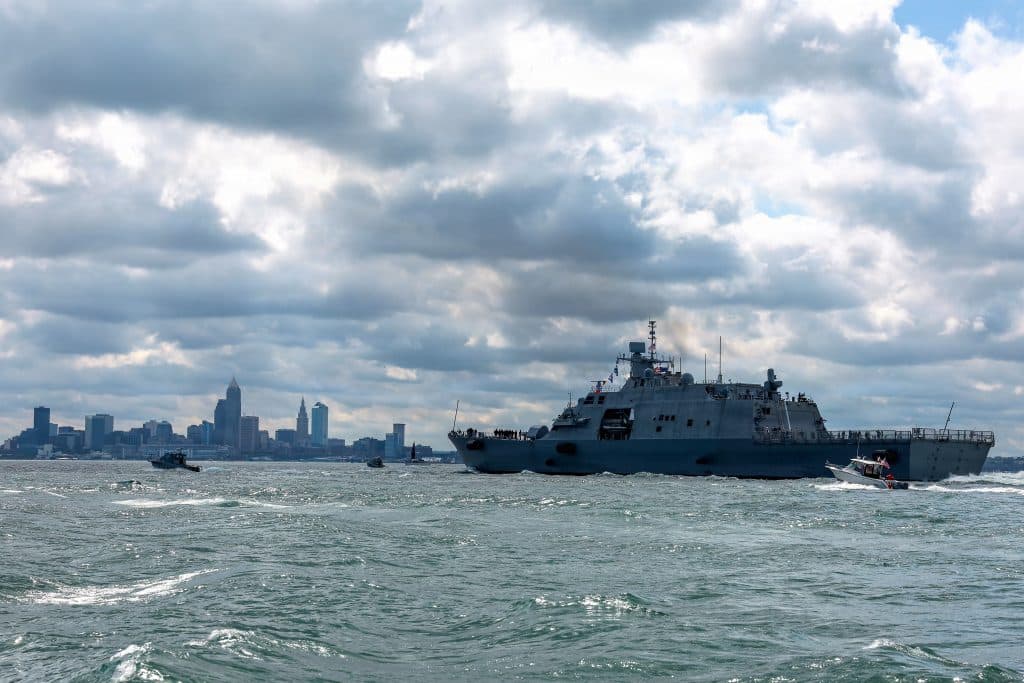
The Littoral Combat Ship program completed delivery of it’s final hull in 2025, with the Navy focusing on transitioning towards sustainment to keep the ships in service to provide critical capabilities such as mine-countermeasures. Additionally, LCSs have provided an experimental baseline in regards to deployment of unmanned systems and Naval special warfare assets for potential wider usage in the future.
The U.S. Navy only mentioned the now cancelled FFG-62 within the battle force retirement plan table, placed in a row with numbers combined with LCS and mine countermeasure vessels. The Navy’s plan stipulates that by 2054, no FFGs, LCSs, and MCMs will be in active service.
