


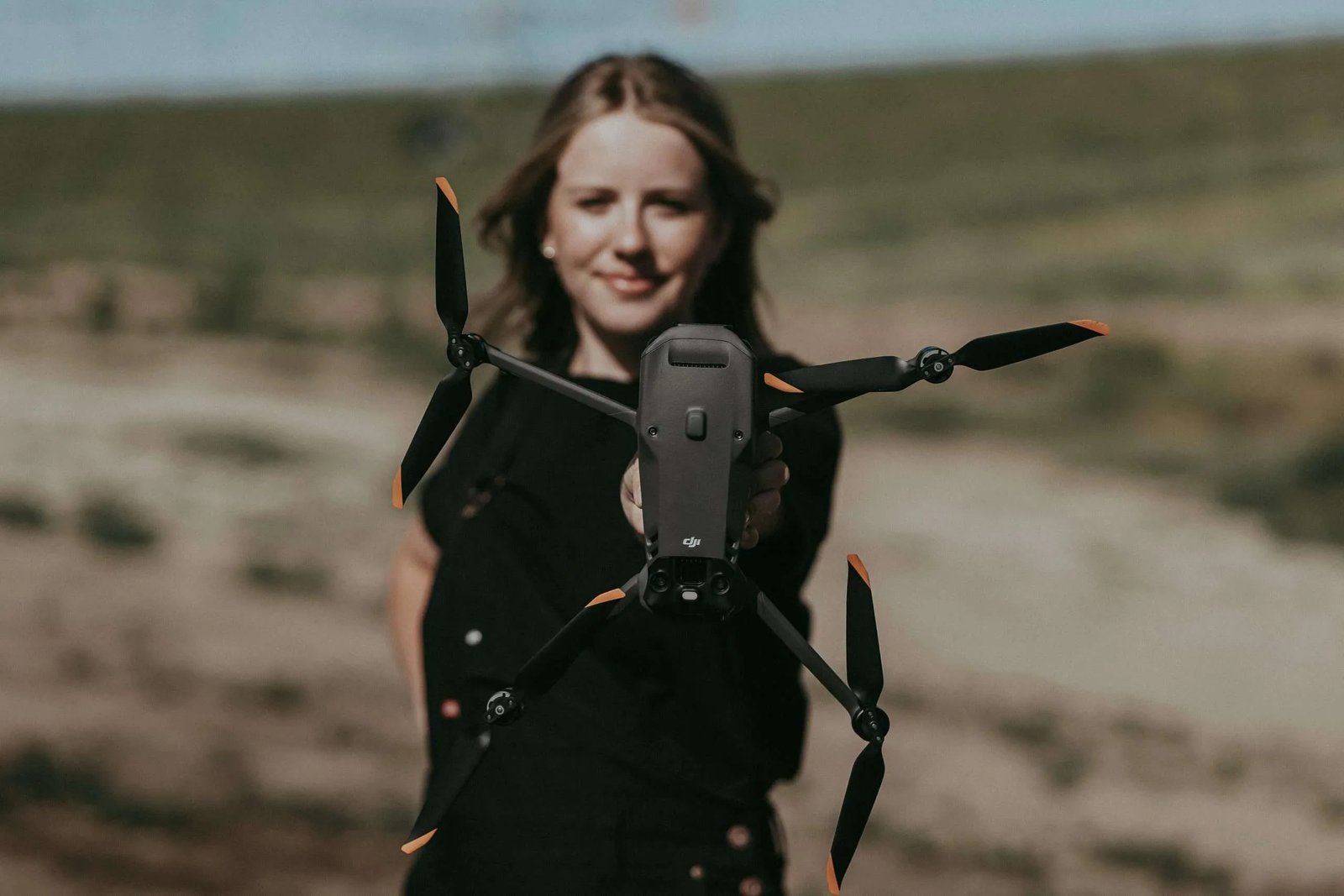
Sadie Kolsen was studying plant science when she spotted a pair of pilots flying a massive agricultural sprayer over an Idaho field — and knew, immediately, that her life had changed. Today she’s a Revenue Development Specialist at Vision Aerial, an American-made drone company based in Bozeman, Montana. She shared her story in this exclusive interview with TheDroneGirl.com.
Do you know an awesome drone girl I should profile? Contact me here.
During her internship with Valley Agronomics, Sadie Kolsen heard that there were “these guys with HUGE drones” flying for one of their growers. She zipped over to the field, watched two pilots run a DJI Agras T40 across Idaho farmland, and quietly handed one of them her contact information before he could walk away. She expected nothing to come of it. Six months later, her phone rang.
That cold outreach launched a career that has since taken her from precision agriculture operations in Idaho to industrial drone demonstrations across the oil and gas, search and rescue and construction industries. Along the way, she’s become a vocal advocate for American-made drone technology at a pivotal moment for the domestic industry.
I sat down with Kolsen to talk about how a plant science degree prepared her for industrial drone work, what heavy-lift flying actually demands and why she keeps a quote about discomfort close at hand.
Editor’s note: This interview has been edited for length and clarity.

The Drone Girl: For readers who are meeting you for the first time, how do you describe what you do?
Sadie Kolsen: I’m a Revenue Development Specialist at Vision Aerial, an American-made drone company based out of Bozeman, Montana. I’m a trainer, product specialist and one of the lead pilots on our team. I’m frequently on the road doing trainings and demonstrations across the U.S. in oil and gas, search and rescue and construction, to name a few.
The Drone Girl: That’s a pretty wide range of industries. How did someone who studied plant science end up there?
Sadie Kolsen: It really caught me by surprise! I started my degree in microbiology, which turned into plant science pretty quickly. My main interest was precision agriculture — learning how to use technology to grow more with less. During my internship with Valley Agronomics, I was told one day that there were “these guys with HUGE drones” flying for one of our growers. Who wouldn’t want to see that? So I zipped over to the field and met the two pilots, Brandon Hadley and Cody Wadsworth. They had just started flying the DJI Agras T40 and spraying fields across Idaho and Utah. I could have watched that drone for hours without hesitation.
The Drone Girl: What did you do after they landed?
Sadie Kolsen: I gave Brandon my contact info and told him to let me know if he ever needed any help. I fully expected him to throw it straight in the trash. But six months later, in the dead of winter, I got a call asking if I’d join the Airfield Ag team. Best day ever.
The Drone Girl: What was your drone experience at that point?
Sadie Kolsen: I had flown a DJI Mini 2 once, in my front yard, one week before they handed me the controls of the Agras.
The Drone Girl: Wow, that’s wild. I would have assumed people would want you to have years of experience flying smaller drones.
Sadie Kolsen: I was shaking in my boots. But there’s no better way to learn than trial by fire. Despite the sweaty hands, I absolutely loved not only piloting, but seeing the impact these drones have for a grower.


The Drone Girl: A lot of Drone Girl readers are comfortable on Mavics or Matrice platforms. What’s the biggest adjustment when you move into heavy-lift or agricultural aircraft?
Sadie Kolsen: Confidence. When flying large platforms like the Agras, you need to be confident in your decision making, because a small gust of wind or a moment of hesitation can cause major problems. When landing on a trailer, you’re standing 10 feet away from a human blender. Any hesitation when the drone is a foot off the ground leaves room for a gust of wind to drift it right toward you. Intentional, methodical, confident piloting makes all the difference. Take your time, stay calm and stay in control.
The Drone Girl: How did your agriculture background shape the way you approach field operations?
Sadie Kolsen: The ag community has a strong sense of respect and trust, where a handshake still means something. I carry that same focus and discipline into every field situation, and it naturally builds quality relationships. I haven’t met more humble and devoted people than those out in the field. There is always something to learn from them.
The Drone Girl: Walk me through the path from Airfield Ag to where you are now.
Sadie Kolsen: At Airfield Ag I helped with marketing, sales and piloting everything from the Agras to the Mavic 3M, and learned how to run NDVI analysis and variable rate application. I can’t say enough great things about Brandon and Cody — they trusted me, an 18-year-old at the time, with a big dream and a passion for drones, and gave me the space to build real experience.
Then during a scholarship trip to San Antonio with the American Society of Agronomy, I was introduced to Resonon, a hyperspectral imaging company based in Bozeman, Montana. I got really interested in their systems and started thinking about how great it would be to fly drones in Bozeman. So I threw out a lucky search in Google for “drone company in Bozeman Montana” and struck gold when Vision Aerial came up. They weren’t hiring at the time, but I sent my resume anyway — and the timing turned out to be perfect.
The Drone Girl: That’s the second time a cold outreach worked out for you.
Sadie Kolsen: It really is! Don’t hesitate to reach out to people. There are so many out there who can point you in the right direction.
The Drone Girl: You work closely with American-made drone systems. What are the biggest advantages when manufacturing, engineering and field operations stay closely connected?
Sadie Kolsen: When everything stays closely connected, you develop a full understanding of your platform and the reasoning behind every design choice. One of my favorite things about in-house training at Vision Aerial is that you get to meet the person who designed your drone, the person who assembled it, and see the machines that milled out the parts. You get the full picture of how it came to be. You always have someone to call if you need help, and you know exactly where your parts are coming from. You really get to know the faces behind the product, and you’re genuinely valued as an individual customer.


The Drone Girl: Vision Aerial just debuted the Vulcan line at GeoWeek 2026. Where do you see the biggest opportunities for drones in precision agriculture over the next few years?
Sadie Kolsen: The biggest thing that needs to happen is education for growers on the benefits of integrating drones and precision agriculture systems into their operations. We’re losing over 2,000 acres of farmland a day, and making the most of what we have left is crucial. When growers understand how drones can benefit their yields, backed by credible research, it stops being a nifty new gadget and becomes an essential tool.
The Drone Girl: For someone early in their drone career who wants to work with advanced systems, what’s one step they can take right now?
Sadie Kolsen: Be comfortable with being uncomfortable. One of my favorite quotes is “comfort is a slow death.” Growth isn’t comfortable. Every opportunity that felt impossible and daunting beforehand has led me closer to the person I want to be by the end of my career. If it were easy, everyone would do it. Jump into new experiences, ask questions and keep the mindset of being willing to learn.
Follow Sadie Kolsen on LinkedIn or learn more about Vision Aerial’s industrial drone platforms at visionaerial.com.
Do you know an awesome drone girl I should profile? Contact me here.
Related
Discover more from The Drone Girl
Subscribe to get the latest posts sent to your email.
