


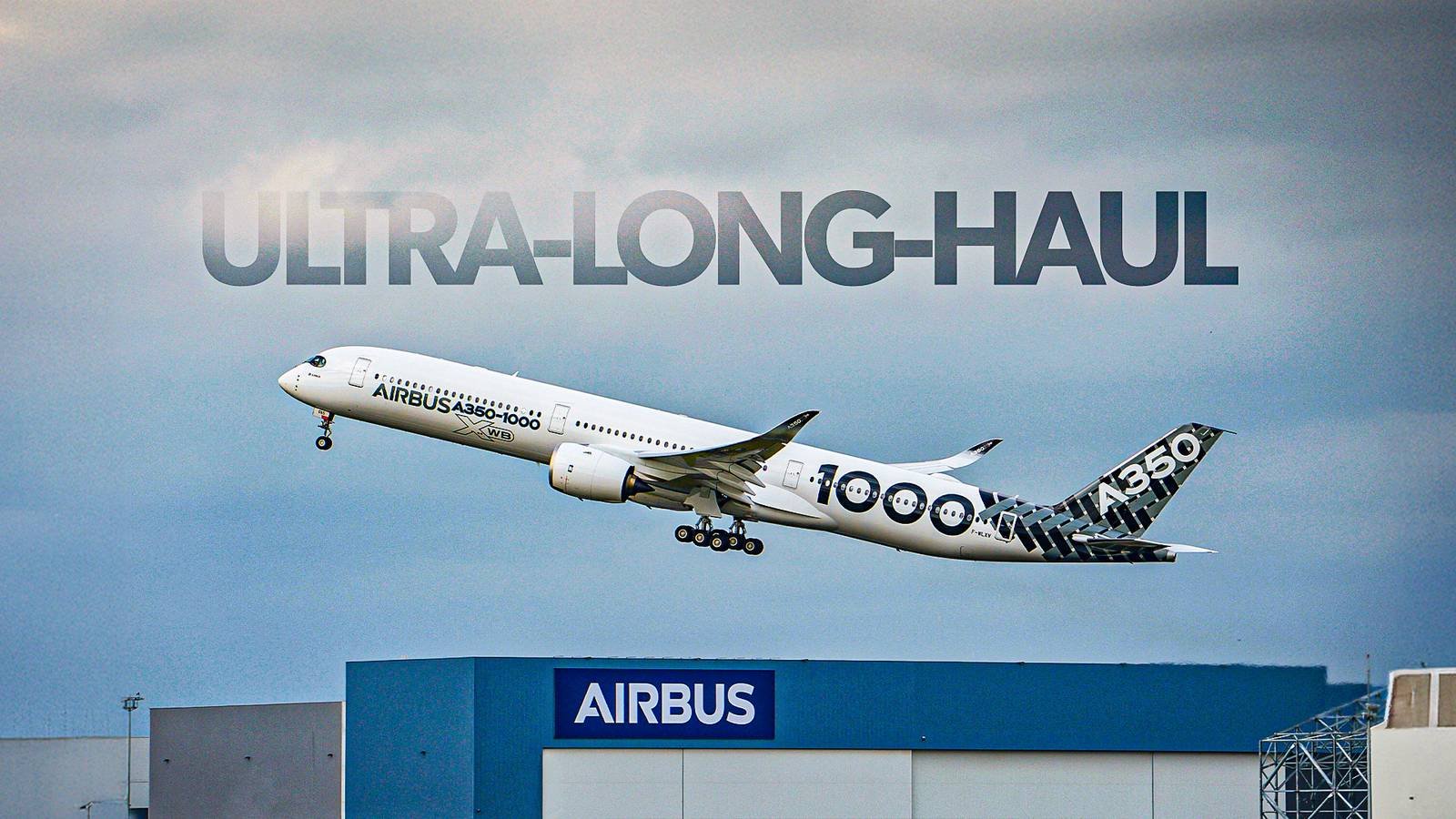
Ultra-long-haul flying was once a unique niche served for just a handful of marquee routes, but the incredible capabilities and operating economics of the Airbus A350 are proving that such long-range services can actually be quite a lucrative business model. What makes the aircraft so important is not just that it can fly exceptionally far, but rather that it can do so with the economics, reliability, and overall passenger comfort that airlines now need on missions that can stretch well beyond the 16-hour threshold.
The Airbus A350 family was designed initially as a clean-sheet long-haul platform, and that ultimately matters, according to Aircraft Insider. The plane combines advanced materials, efficient Rolls-Royce Trent XWB engines, and aerodynamic refinements in a way that gives carriers the range to attempt routes once considered unrealistic while still keeping trip economics fundamentally under control.
This is ultimately why the aircraft has become central to the next phase of long-haul network planning. Airlines are not just using it to replace older jets. Rather, they are using it to fundamentally rethink what nonstop service can actually look like. From Singapore’s longest flights to North America to Qantas’ planned Project Sunrise missions from Australia to London and New York, the A350 has become the aircraft that best aligns airline ambition with operational reality. In an era where every pound of weight, every ton of fuel, and every hour of passenger endurance matters, the A350 increasingly looks like the default answer for ultra-long-haul growth of all kinds.
A High-Level Overview Of The Airbus A350
At a very high level, the Airbus A350 is the manufacturer’s flagship long-range twin-engine widebody aircraft family, one designed to sit at the top end of the market for intercontinental flying of all kinds. The two main passenger variants are the A350-900 and the longer A350-1000. In typical three-class layouts, Airbus lists the -900 at roughly 300 to 350 seats with an impressive maximum range, all while the -1000 grows to around 350 to 410 seats and can fly a bit further for some of the most taxing missions.
For even the most extreme missions that the aircraft was designed to handle, the A350-900ULR pushes range even further, allowing flights of around 19 hours or more. Ultimately, what makes this family so fundamentally attractive to airlines is that all of these aircraft share a common pilot qualification, giving carriers flexibility across their vast, complex, and dynamic operational networks without the added costs of more training complexity. From a technical perspective, the jet is built around a lightweight clean-sheet airframe made with 70% advanced materials, paired with Trent XWB engines and a highly optimized wing.
From a commercial perspective, that ultimately translates into what Airbus believes is around 25% lower fuel burn or operating cost compared with previous-generation competitors. For passengers of all kinds, the A350 has also become associated with modern long-haul comfort, including a quieter cabin, lower cabin altitude, improved humidity, and an interior designed specifically for extremely long journeys. In simple terms, it is an aircraft built to make faraway city pairs feel economically and physically feasible.
Looking Back At The A350’s Operational History

Let’s continue by discussing the Airbus A350’s impressive operational history, analyzing just how quickly it moved from an ambitious program in and of itself into the backbone of modern long-haul fleets. Airbus officially launched the program in 2006 as a clean-sheet design aimed at redefining long-haul air travel, and the A350-900 made its first flight in 2013 before entering commercial service in January 2015 with  Qatar Airways.
That was ultimately the beginning of a rapid expansion phase. The much larger A350-1000 ultimately followed in 2018, again with Qatar serving as the principal launch operator. This gave airlines a higher-capacity variant for denser intercontinental markets. Later that same year, Airbus delivered the first A350-900ULR to Singapore Airlines, which used the plane to launch nonstop Singapore to New York flights in October 2018, cementing the plane’s reputation as the ultimate benchmark for ultra-long-range passenger service. Since then, the aircraft has spread well beyond a few flagship operators.
Airbus says that the family now serves more than 1,300 routes worldwide and has grown to 28 operators, all while its November 2025 facts-and-figures data said that the global fleet had surpassed two million revenue flights and carried more than 530 million passengers. The next chapter is already forming, as Qantas says its first Project Sunrise A350s will arrive at the end of 2026 for future services from Sydney to London and from Sydney to New York. This arc from launch to global long-haul workhorse is why the A350 today defines this market category.

Airbus A350-900 Vs A350-1000: Features Compared
Comparing and contrasting the modern widebody variants.
Which Carriers Ultimately Ordered The Airbus A350?

The easiest way to frame an answer to this question is that the A350 went from being a niche flagship order to a truly global widebody program. Airbus’s January 2026 customer list, reflecting figures at the end of December 2025, highlighted 1,529 firm orders for the type from 67 customers. The biggest airline buyer was Turkish Airlines with 110 of the type, followed by Qatar Airways with 76, Emirates with 73, Singapore Airlines with 72, Lufthansa with 65, IndiGo with 60, and  Delta Air Lines with 55.
Japan Airlines has 52 of the type, Air India ordered 50, the Air France-KLM Group ordered 50, and United Airlines also has an outstanding order for 45 of the type. The customer base is massive, and it spans across pretty much every major long-haul region, including a number of Gulf carriers like Qatar Airways, Emirates, and Etihad Airways. Meanwhile, Asian operators include Singapore Airlines, Cathay Pacific, Japan Airlines, EVA Air, Korean Air, and China Airlines. European groups such as Lufthansa, Air France, British Airways, Iberia, Finnair, SAS, and Turkish Airlines are also all key pieces of the program.
North American major customers include Delta, United, and now Air Canada, which added a landmark order for eight A350-1000 models in February 2026. The order book also extends beyond passenger airlines to cargo and leasing customers, including Air China Cargo, Lufthansa Technik, AerCap, Air Lease Corporation, AviLease, and BOC Aviation. That breadth matters because it shows that the A350 is no longer a specialist aircraft but rather a mainstream long-haul platform.
Why Does The Aircraft Offer Appealing Operating Economics?

The Airbus A350’s economics work especially well on long-haul routes because nearly every major cost lever improves once a flight begins to get longer. Airbus says that the family delivers a 25% advantage in terms of overall fuel burn, operating costs, and carbon emissions over previous-generation aircraft, helped by a structure made with 70% advanced materials, low operating empty weight per seat, efficient Rolls-Royce Trent XWB engines, and aerodynamic refinement.
Airbus also says that the A350-1000 can offer roughly 15% to 25% lower seat-mile cost than competing products, something which is critical on 14-to-18-hour sectors where fuel is by far the dominant expense. On top of all that, Airbus says that the A350 can cut airframe maintenance costs by up to 25% over 15 years, improving availability and lowering aircraft lifecycle costs.
These are the unique kinds of operating economics that are strengthened by the plane’s long-range operating flexibility. Regulators have approved the A350-900 for Extended-Range Twin-Engine Operational Performance Standards (ETOPS) of up to 370 minutes, allowing airlines to fly more direct routings over oceans and remote regions rather than accepting longer detours. In practical terms, that means airlines can open nonstop city pairs that older four-engine aircraft serve less efficiently, all while making existing long-haul routes cheaper to operate per-seat, per-trip, and over the full life of the aircraft itself.

Sister Variants Examined: The Major Differences Between The Airbus A350-900 & -1000
These two aircraft differ in some key ways.
Just How Far Can The Aircraft Really Fly?

The Airbus A350’s range story is one of the key reasons that the plane has become so central to long-haul planning. In the plane’s baseline passenger form, the A350-900 is rated for up to 8,500 nautical miles (15,742 km), which already places it among the most capable twin-engine widebody aircraft in service and makes it suitable for almost any conventional intercontinental route. The larger A350-1000 trades a little flexibility for more capacity, but Airbus still markets it as capable of flying up to 9,100 nautical miles (16,853 km).
A350 Variant: | Maximum Range: |
|---|---|
A350-900 | 8,500 nautical miles (15,742 km) |
A350-1000 | 9,100 nautical miles (16,853 km) |
A350-900ULR | 9,700 nautical miles (17,964 km) |
This gives airlines a rare, unique mix of high seat count and genuine ultra-long-haul reach. The specialist variant also exists, as the A350-900ULR pushes the platform to 9,700 nautical miles (17,964 km). That version was ultimately designed for missions that sit at the absolute edge of commercial passenger flying. It is also the aircraft behind routes like Singapore to New York.
The jet’s range allows it to fly routes that stretch beyond 18 hours. What makes the family so compelling is that these are not separate aircraft designed for unrelated missions but rather closely linked variants that let airlines scale range and capacity according to network needs. In practical terms, the -900 suits mainstream long-haul flying and the -1000 adds more seats without giving up reach, all while the ULR turns the A350 into a globe-spanning aircraft.
What Is Our Bottom Line?

At the end of the day, the A350 is a jet offering impressive long-range capabilities, and it has slowly become a key backbone of long-haul intercontinental aviation. The plane’s ultra-efficient cruise capabilities and endurance mean that it can serve routes no aircraft has ever been able to before.
The jet’s twin-engine setup means that it can fly just as far as previous-generation long-haul jets but with exceptional efficiency, making it a favorite and next-generation flagship for airlines all across the globe. Even in markets where the 777 has historically been the dominant player, the A350 is beginning to carve out market share for itself.
Now the execution question turns back to Airbus. If the manufacturer can continue delivering for operators, it will have no challenge being able to keep this program at the top of the market. If delivery delays or quality issues emerge, it could hamstring a program that currently sits in an exceptionally strong market position.
