


Covenant Logistics Group executives struck a more optimistic tone on Friday’s earnings call, pointing to tightening truckload capacity, rising rate discussions and improving demand trends despite a weaker-than-expected first quarter.
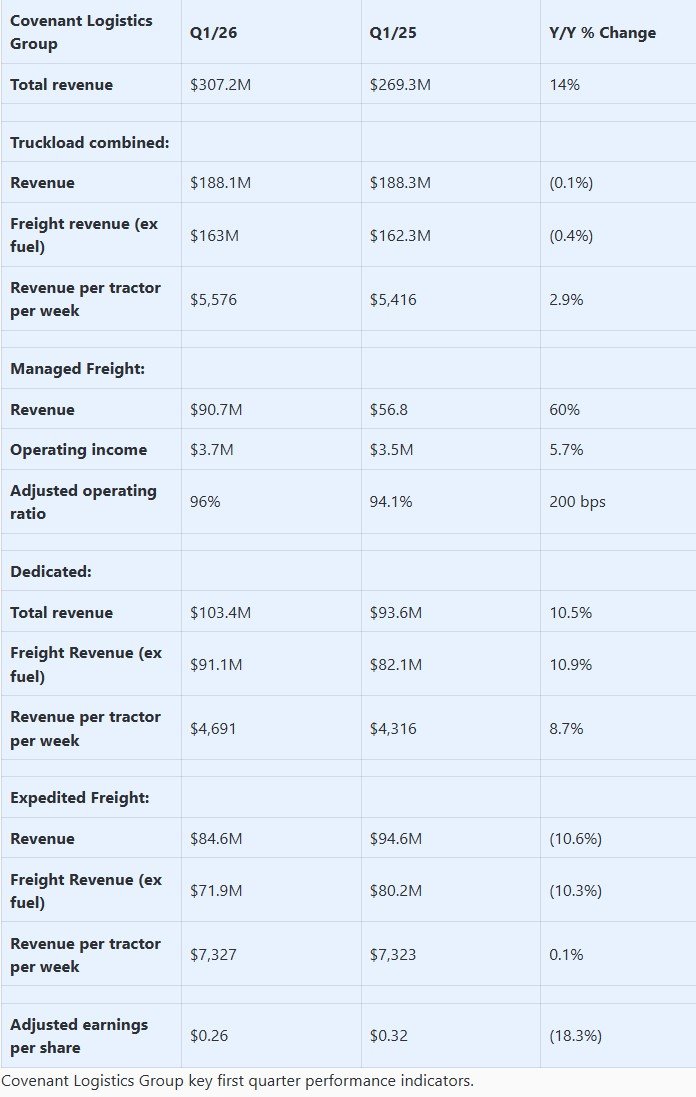
The Chattanooga, Tennessee-based carrier reported first-quarter earnings earlier this week that missed expectations, with net income falling to $4.4 million, or $0.17 per share, as winter weather and fuel costs weighed on results.
But CEO David Parker said conditions improved meaningfully as the quarter progressed — and are continuing into Q2.
“We believe [conditions] will continue to improve throughout the year,” Parker said, citing a strengthening pipeline of committed truckload capacity and growing customer demand.
Covenant Logistics Group (NYSE: CVLG) provides truckload, expedited, dedicated, and logistics services across the U.S.
Capacity tightening, driver market shifting
A key theme from the call was tightening industry capacity — particularly among qualified drivers — after a prolonged downcycle.
“For the first time in 40 months drivers are starting to get tight out there,” Parker said, noting that driver pay discussions are reemerging across large customer accounts.
Executives said the combination of reduced fleet capacity and improving industrial demand is setting the stage for rate increases, though rising driver wages could offset some of that upside.
Parker added that the company is already seeing stronger engagement from shippers seeking dedicated capacity.
“We’re seeing more people want to talk about dedicated capacity almost since ’21 or ’22,” he said.
Dedicated, managed freight driving growth
Management emphasized that Covenant’s dedicated and managed freight segments are positioned to benefit first as the freight cycle turns.
Dedicated operations continue to expand, supported by specialized equipment and long-term contracts, while Managed Freight revenue surged nearly 60% year over year in Q1 following late-2025 acquisitions.
However, executives acknowledged that margin pressure remains in the near term, particularly in expedited trucking, which underperformed during the quarter due to lower utilization.
Pricing power returning — with caveats
While rate momentum is building, Parker cautioned that cost inflation — especially driver wages — will absorb part of the gains.
“Driver [costs are] 30% to 40% of total costs… what you get from the customer may not net the same as before,” he said.
That dynamic could temper margin expansion even as pricing improves, particularly if wage inflation accelerates alongside tightening labor supply.
Equipment strategy, tariffs in focus
Executives also addressed equipment costs and supply chain uncertainty, noting that pricing for new trucks remains elevated heading into 2027 due in part to regulatory and tariff-related pressures.
The company is taking a cautious approach to fleet expansion, focusing instead on optimizing utilization and shedding underperforming assets — a strategy that helped reduce net debt by $51 million during the quarter.
Parker said Covenant is actively engaging in Washington on issues including CDL standards and tort reform, both of which could impact capacity and operating costs across the trucking industry.
“We’re working on CDL schools… making sure they’re producing qualified drivers,” Parker said, adding that legal and regulatory reforms could also help address capacity constraints.
The post Covenant sees tightening capacity, rate momentum building in 2026 appeared first on FreightWaves.
