


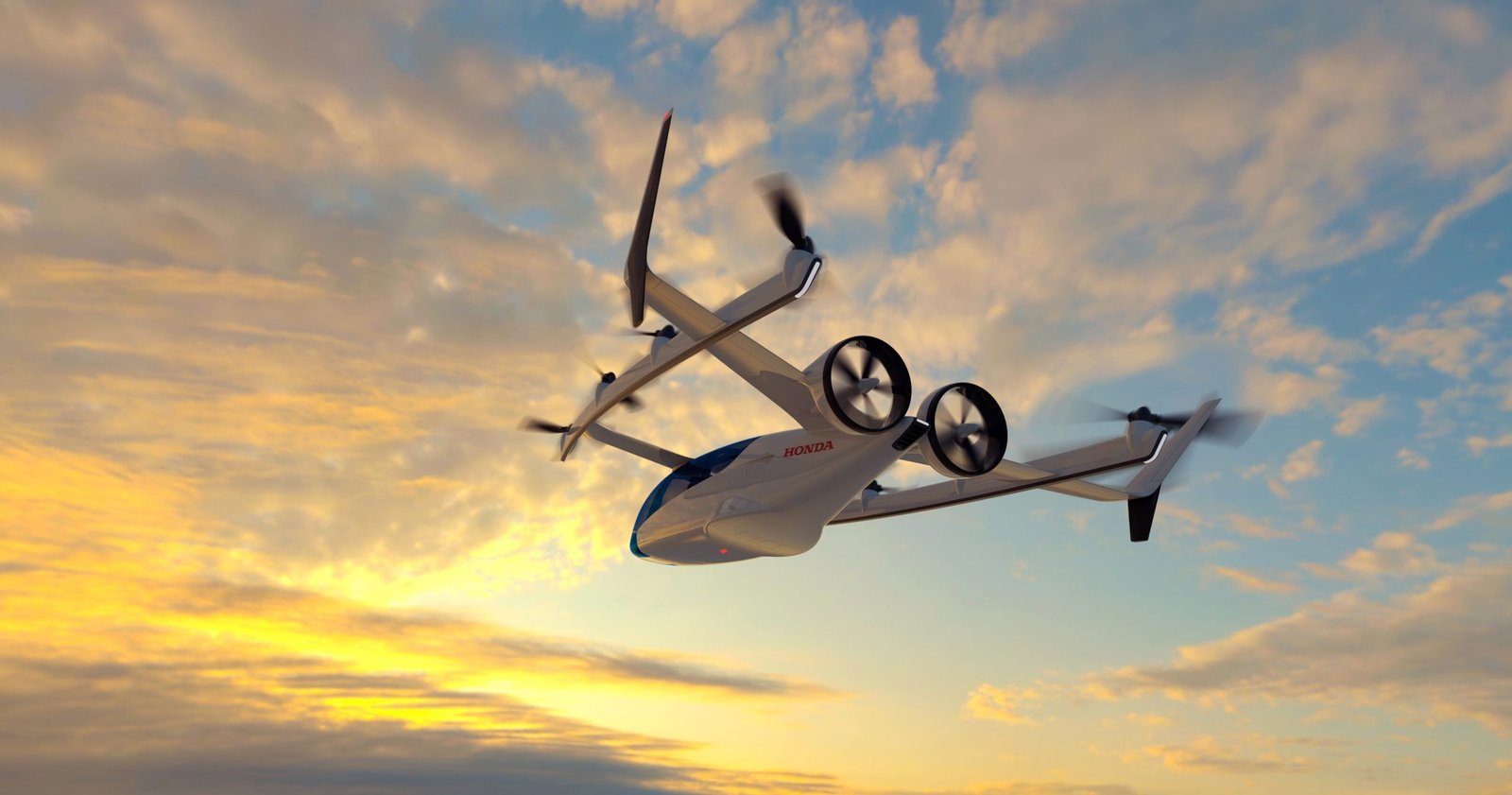
The aircraft’s “inherent design limitations of battery storage” necessitated FAA exemptions prior to test flights.
The Federal Aviation Administration has approved Honda Research Institute to begin flight testing its full-scale unmanned electric vertical take-off and landing (eVTOL) aircraft – a model having 15min of flight endurance.
The agency’s 4 June approval is specific to the “fully electric” F1 model and follows Honda’s 1 April first flight of a hybrid-electric variant of the design.
The FAA in December disclosed that Honda, which has for several years been developing air taxis, requested regulatory exemptions for the all-electric F1 because the aircraft cannot meet FAA flight-time reserve requirements. The rules prohibit operators from taking off in fixed-wing aircraft without enough fuel to fly 30min after reaching an intended landing spot. Rotorcraft must have a 20min flight reserve.
The FAA’s January notice did not specify the all-electric F1’s flight endurance but its 4 June approval does.
“The F1 battery is designed for a standard mission of no more than 15min, including vertical take-off and landing operations,” the approval says. “The installed batteries on the F1 provide a maximum endurance of approximately 15min total flight time.
“The F1 aircraft’s maximum endurance… is due to inherent design limitations of battery storage, which is an industry-wide challenge for electric aircraft development,” the agency adds.
The FAA’s approval allows Honda to operate the all-electric F1 for research and development purposes under an experimental-category certification, and only during the day. The aircraft’s maximum take-off weight must not exceed 3,175kg (7,000lb) and it must remain within the ground operator’s sight, the FAA says.
Also, the aircraft must have sufficient battery power to provide 2min of reserve flight time.
The FAA notes that the aircraft’s “nominal voltage for standard flight operations is between 800V of direct current (VDC) and 675VDC. Below 675VDC, the aircraft still has enough energy remaining to perform abnormal and emergency operations”.
The FAA provides several more details about the all-electric F1. It has “redundant flight control computers” and a “flight termination system” designed to cut power and deploy a “ballistic parachute” if control is lost. Honda intends to fly the all-electric F1 from a private airfield and over private land.
The company runs the programme though its California-based Honda Research Institute innovation arm.
The Air Line Pilots Association had opposed Honda’s all-electric F1 exemption request, saying the FAA should complete more research before approving operations of aircraft with minimal energy reserves.
The FAA declined, noting existing regulations were not written for eVTOL aircraft and that Honda’s plan will ensure safe flight.
Honda on 1 April completed the first flight – lasting 90sec from San Luis Obispo in California – of a hybrid air taxi powered by “a gas turbine generator and battery”.
That aircraft, with eight lifting props mounted to overhead booms and two pusher props, has 216nm (400km) of range, it says.
Subscribe to gain access to all news
Already have a subscription? Log in.
Choose your subscription
Considering a corporate subscription? Contact us to find out more.
