


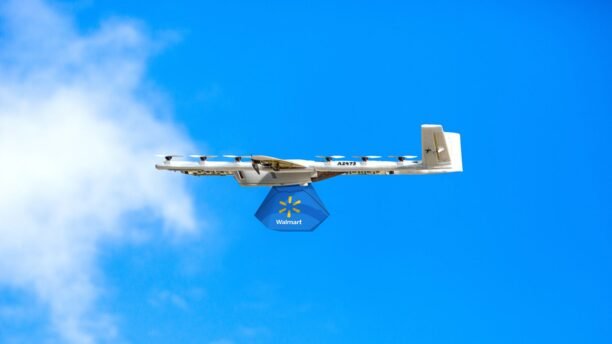
County denies Walmart bid to start drone deliveries
By DRONELIFE Features Editor Jim Magill
A board of Georgia county officials have denied a Walmart application to install a fenced area for delivery drones at a store location in suburban Atlanta as part of the retail giant’s expansion of UAV delivery service into the metropolitan area.
At a hearing on April 21, the Cobb County Board of Commissions denied a Walmart rezoning petition that would have allowed the company to erect a fenced-in area on the parking lot of its Johnson Ferry Road store that would have accommodated 18 delivery drones.
About 50 people showed up at the hearing to protest the siting of a drone takeoff and landing area in the largely residential neighborhood. Commissioners emphasized that their decision was based on a land-use restriction in that particular neighborhood and did not represent their opposition to drone delivery in general for the county.
Commission Chairwoman Lisa Cupid said the board would likely consider numerous issues involving the expansion of drone delivery services in the county in the future and decide them on a case-by-case basis. “Cobb County is evolving. Cobb County will continue to evolve,” she said at the hearing.
In response to the board’s decision, Walmart issued the following statement: “We remain excited about expanding drone delivery in Metro Atlanta with Wing, especially given the strong response we’ve seen from customers already using the service. We care deeply about the neighborhoods we serve and remain focused on bringing safe, fast and convenient drone delivery to more communities.”
Residents who spoke in opposition to the proposed drone site also said their objections were aimed at the particular planned site and not to drone delivery in general. “Today’s decision is not about drone technology. It’s about land use and whether this specific Walmart site is an appropriate location for a commercial drone port and fenced operational compound,” said David Rumrill, a local resident and member of the East Cobb Civic Association board or directors.
Walmart director of public affairs Glen Wilkins said drone delivery is the next step in the retail company’s efforts to respond to customers’ needs for faster and more efficient service.
“As we start looking at a newer generation, they’re looking for even quicker delivery times. Drone delivery is that new opportunity that we’re working on,” he said.
Walmart, in cooperation with its partner, UAV service provider Wing, expanded its drone delivery service into the metro Atlanta region late last year, opening at six store locations in December. Since then, the retail company has initiated drone delivery at six more store locations, bringing the service to more than 120,000 residential homes in the region.
Catherine Lovett, Wing Aviation’s manager of local policy and community affairs, told the Board of Commissions that the UAV operator has received a favorable community response to the other Walmart locations where it operates in the metro Atlanta region.
“For all of those locations, the reception has been very positive,” she said.
Under the Walmart drone delivery model, a team of Part 107-certified pilots oversees the operations of the fleet of autonomous drones. The drone itself, which has a round-trip range of six miles, weighs about 11 pounds, and is capable of delivering a payload of about 2.3 pounds.
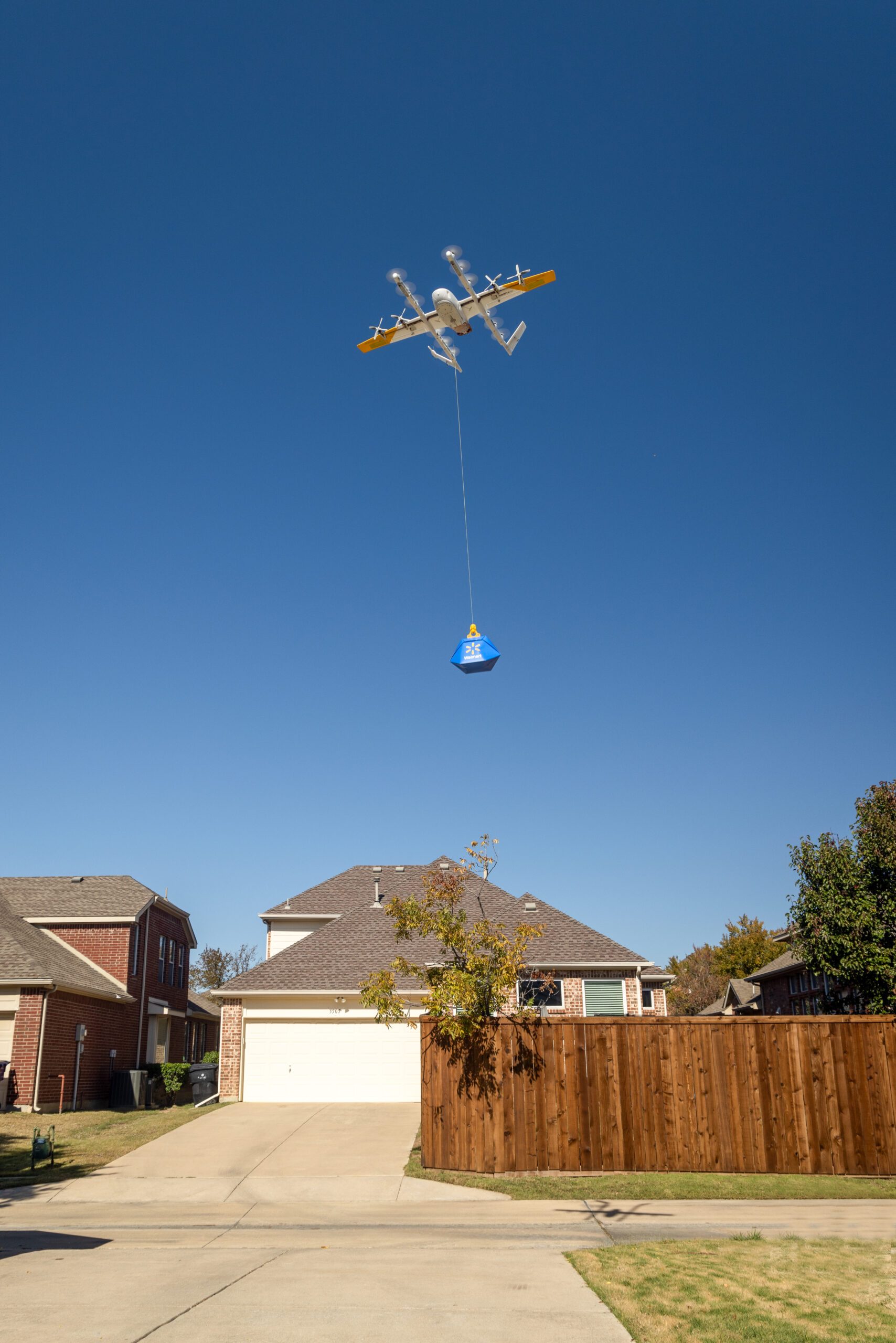
After Walmart receives an order for the service, the selected items are placed in a special delivery package, which is secured in the body of the aircraft. The drone ascends to a cruising altitude, typically between 165 and 200 feet, before switching to vertical flight mode to fly toward its destination at a speed of up to 60 mph.
Once it reaches its delivery destination, the drone will hover at an altitude of about 25 feet. The customer, who is tracking their order in the app, knows when to come outside to receive it. The aircraft lowers the package down to the ground on a tether, unhooks it safely and returns to its home base.
In the hearing, Lovett tried to assuage the concern of residents opposed to the proposed drone delivery location. She noted that the drones’ cameras are designed to assist in navigation and obstacle avoidance and cannot be used to look down on residents in their yards.
“Our focus as a company is on package delivery, not photography nor surveillance,” she said.
She also addressed potential noise complaints, which are commonly raised in association with the introduction of new drone operations in a community.
When the drone reaches its cruising altitude, the sound from its rotors registers at 43 decibels, a volume lower than that of her voice amplified by a microphone, Lovett said. The drone gets louder whenever it descends to 25 feet to deliver a package.
“That’s when the hover propellers on the top of the aircraft kick in, and the sound does increase. During that sound profile, you’ll note that it’s about 62 decibels, which is still quieter than a delivery truck,” Lovett said.
Read more:
 Jim Magill is a Houston-based writer with almost a quarter-century of experience covering technical and economic developments in the oil and gas industry. After retiring in December 2019 as a senior editor with S&P Global Platts, Jim began writing about emerging technologies, such as artificial intelligence, robots and drones, and the ways in which they’re contributing to our society. In addition to DroneLife, Jim is a contributor to Forbes.com and his work has appeared in the Houston Chronicle, U.S. News & World Report, and Unmanned Systems, a publication of the Association for Unmanned Vehicle Systems International.
