


One of the biggest knocks against the viability of food drone delivery is its economics—with payloads limited by their weight, drones must be cheap to build and operate to make a trip worth the cost.
Most are limited to about 5 pounds of chicken wings, ice cream, eggs, or other restaurant and grocery store staples. But drone delivery operators are starting to think bigger—and heavier.
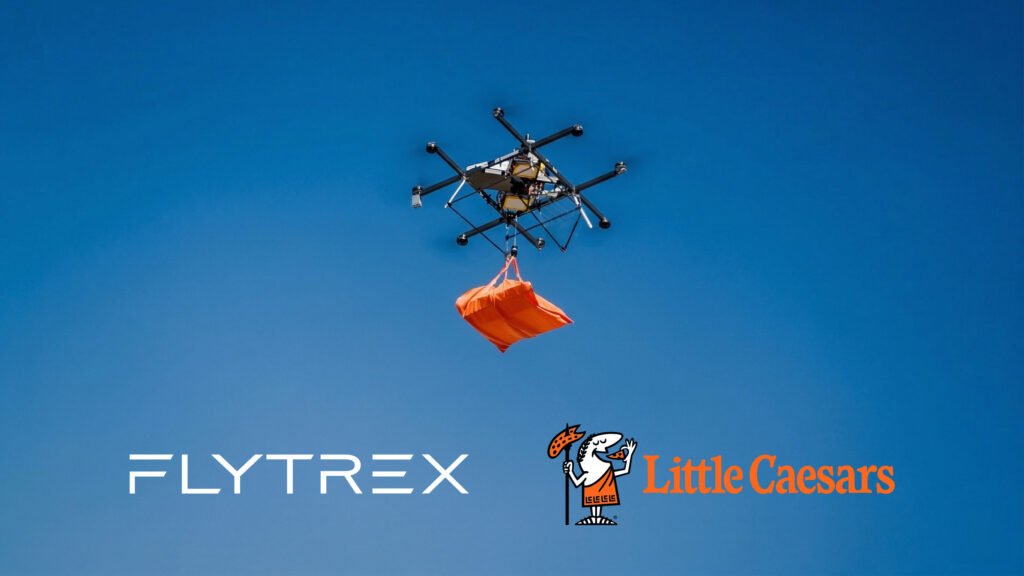
Flytrex, which has operations in the U.S. and Israel, on Thursday unveiled its Sky2, which it says is the first on-demand delivery drone that can carry two large pizzas, bread bites, and sodas in a single trip—enough to feed an entire family. The Sky2’s 8.8-pound payload matches that of Irish company Manna’s flagship drone, which per its website carries up to 4 kilograms.
Per reporting from The Guardian, Manna’s aircraft have capacity to carry four 15-inch pizzas, though CEO Bobby Healy acknowledged that “volume is harder than weight” when it comes to drone delivery. Like Flytrex, Manna has operations in Texas.
Outside of Manna and Flytrex, Zipline’s P2 has the highest payload (8 pounds) among delivery drones operating in the U.S. Amazon Prime Air’s MK30, Dexa’s DE-2020, and Wing’s flagship model each carry 5 pounds. Matternet’s M2 maxes out at about 4.4 pounds.
“Flytrex is laser-focused on making on-demand food delivery by drone a reality for everyday families,” said Amit Regev, CEO and co-founder of Flytrex. “A big part of advancing this market is making sure people can get the food they actually want, when they want it.”
Flytrex’s previous drone model carried up to 6.6 pounds. On average, the company claims the new drone—an autonomous octocopter—will complete deliveries within 4.5 minutes of takeoff. The drone is rolling out through a partnership with Little Caesar’s, beginning with a single store in Wylie, Texas. Customers will place orders through the Flytrex app.
Orders will be collected from outside of restaurants. In the air, the drone uses an AI-based flight logic system to keep itself on course. Upon arriving at the customer’s locations, it uses a tether to lower cargo gently to the ground. Other delivery drones use parachutes or simply drop orders while hovering a few feet in the air.
The Sky2 also improves Flytrex’s delivery radius from 2.5 to 4 miles, meaning it can now reach more customers. The company’s partnership with Uber Eats gives it another avenue to put its new drone into service.
Why Delivery Drones Don’t Carry More
Some manufacturers are developing large cargo uncrewed aircraft systems (UAS) designed to move heavier loads over longer distances. Elroy Air’s Chaparral, for instance, is designed for 300 pounds of cargo over 300 miles.
Food drone delivery is a starkly different use case, since time is often more of a factor. These services are typically restricted to a single city or neighborhood, and FAA regulations limit them further.
The most consequential regulation for drone delivery centers on beyond visual line of sight (BVLOS) operations. Because the FAA requires Part 135 drone operators like Flytrex to keep an eye on the aircraft in the sky, their range is limited, and they often turn to smaller, lighter models that lack the capacity of the Sky2.
Flytrex received an FAA exemption for BVLOS operations in August. Other operators have done the same. But those permissions, often limited to a certain geographical area, are not easy to extend to new cities or aircraft.
With the FAA’s proposed Part 108 rule presenting a framework for routine BVLOS operations, delivery drones could fly farther, creating economic incentives for manufacturers to build larger, more capable aircraft.
Food delivery drones were already getting bigger—Wing’s 5-pound payload doubles that of its previous model, for example. As more regulations take shape, expect that trend to continue.
