


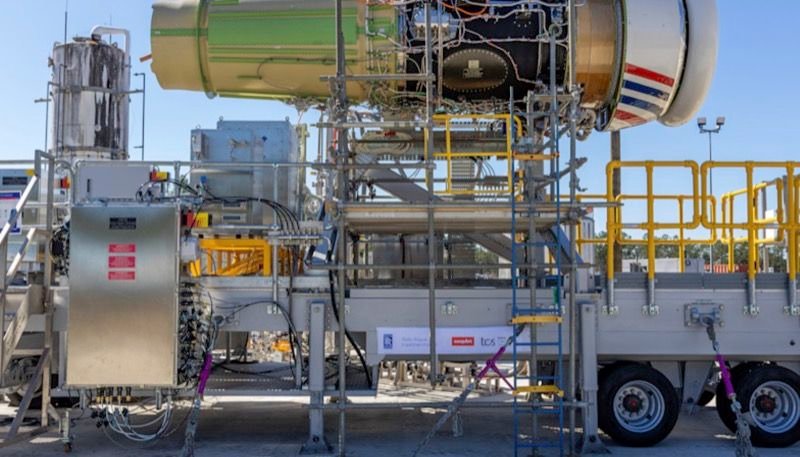
A modified Rolls-Royce Pearl 15 engine has reached full take-off power while running on 100% gaseous hydrogen during ground testing at NASA’s Stennis Space Center, Mississippi.
The test campaign demonstrated that the modified business jet engine, which according to easyJet and Rolls-Royce could be scaled up to power a narrowbody aircraft, can safely operate on hydrogen across a fully simulated flight cycle covering start-up, take-off, cruise and landing. The four-year program has also explored fault scenarios and a range of operating conditions.
The use of hydrogen to replace jet fuel can be achieved either by combusting hydrogen in engines like the ones in use today, or by using hydrogen in fuel cells to produce electricity that powers a propulsion system.
The Pearl 15 produces a maximum certified thrust of 15,250lb (67.8kN) and powers Bombardier’s Global 5500 and Global 6500 business jets. Reaching full take-off power on hydrogen is the first time a modern aero engine of this class has been demonstrated under those conditions across a complete cycle, the partners said.
The Stennis campaign represents the culmination of an incremental campaign that began with early concept testing of a Rolls-Royce AE2100 engine on 100% green hydrogen at MoD Boscombe Down in the UK in 2022. The technology was subsequently scaled through component and system rig tests in the UK and Europe, including the development of a full-scale hydrogen test facility at the Health and Safety Executive (HSE) and cryogenic liquid hydrogen pump testing at Solihull, before integration into a hydrogen-fuelled demonstrator engine.
Earlier work also adapted the engine to replace traditional jet fuel with hydrogen, with the combustion program considering both carbon and non-CO2 impacts.
Adam Newman, chief engineer of the hydrogen demonstrator program at Rolls-Royce, said, “This program has given us the clearest understanding in the industry of how hydrogen behaves in a modern aero gas turbine. Through a collaborative, staged testing approach, we have validated combustion, fuel and control system technologies, and demonstrated the safe use of hydrogen through design, commissioning, maintenance and testing.”
Newman added that insights from the campaign, many of which are fuel agnostic, would be applied to future Rolls-Royce programmes including the UltraFan large turbofan demonstrator.
David Morgan, chief operating officer at easyJet, said, “Demonstrating 100% hydrogen operation at scale marks an important step towards easyJet’s net zero ambition, supporting the long-term transition to more sustainable aviation.”
Rolls-Royce’s hydrogen research has received support from the government-funded Aerospace Technology Institute’s HyEST, RACHEL and LH2GT programmes, Germany’s LUFO 6 WOTAN programme, and the CAVENDISH programme backed by InnovateUK and the European Union’s Clean Aviation joint undertaking.
Tata Consultancy Services provided engineering capacity across the workstreams, while the HSE Science and Research Centre in Buxton, Derbyshire built and tested the pressurised hydrogen infrastructure used in the campaign.
