


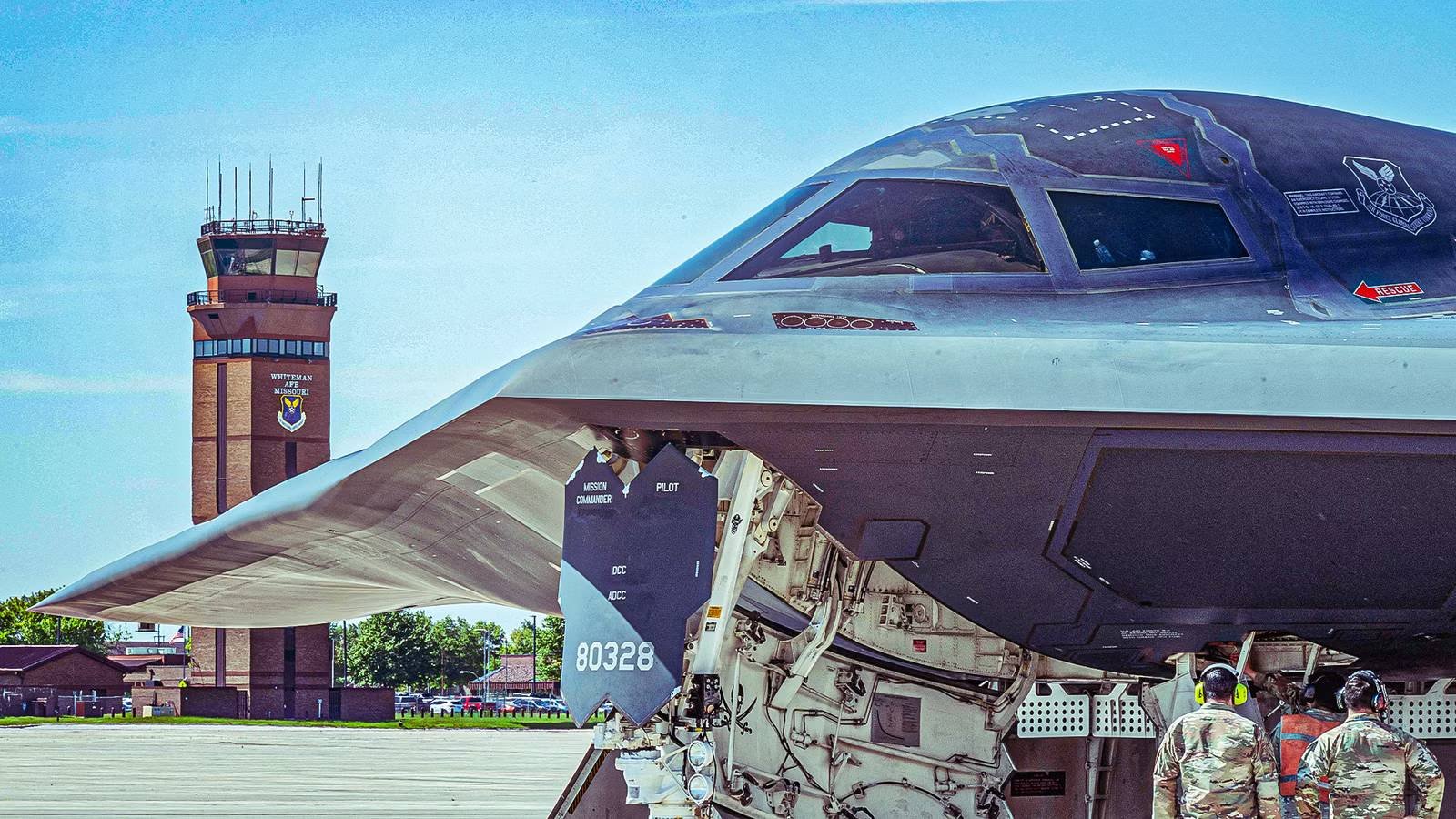
The Northrop Grumman B-2 Spirit was the world’s first 5th-generation bomber and the first stealth bomber that was a true strategic strike platform with global reach and world-class payload. The B-2, endearingly known as the Flying Dorito, was also the first flying wing to ever achieve serial production and put a tailless aircraft into operational service. Not only was it the culmination of Jack Northrop’s dreams, but the plane also went on to become one of the most effective platforms in the history of the US Air Force.
The first and most obvious way the B-2 achieves stealth is its coating of Radar-Absorbent Material, specifically Carbonyl Iron Powder, which converts electromagnetic radar waves into heat rather than reflecting them. The tailless design eliminates vertical surfaces and sharp right angles that typically reflect radar energy directly back to the source. The smooth, curved surfaces scatter radar waves away from the receiver.
Radar Absorbent Material: The Heavy Toll Of Exceptional Stealth Technology
The B-2 Spirit defeats radar through a layered approach that combines extreme geometric precision, advanced material science, and active signal manipulation. Its primary goal is to reduce its Radar Cross-Section. The B-2 has the smallest RCS of any stealth aircraft in the world at 0.0001 square meters.
The B-2’s flying wing design is the most significant factor in its ability to evade radar by redirecting electromagnetic waves away from the source. Radar waves tend to trap and bounce back in the 90-degree corners between an aircraft’s body and its tail fins. By removing the tail and vertical stabilizers entirely, the B-2 eliminates these major reflection points.
In order for the Spirit to be as stealthy as possible, all leading and trailing edges are aligned at the same angles. That includes panel doors and hatches as well. This concentrates radar reflections into very narrow spikes that are difficult for radar systems to distinguish from background noise unless they are at one specific angle relative to the aircraft. It even has a special rotary weapons launcher inside its internal bay in order to keep all the ordnance concealed. The rotating munition rack spins to position the proper weapon as selected by the air crew and drops it at the push of a button, with the doors opening and closing only for the exact amount of time necessary.
The RAM is applied in layers with varying electrical properties. This gradient is designed to make the outer surface as reflectively similar to air as possible, allowing waves to enter the material where they are trapped and canceled through destructive interference. A specialized material called Butter is used to seal gaps between panels, ensuring surface continuity and preventing chinks in its stealth.
The Untouchability Of Northrop Grumman’s Flying Wing

If a B-2 Spirit is flying through civilian airspace with the transponder turned off, in a combat configured stealth profile, the aircraft is virtually invisible to civilian radar. It appears no larger than a bird flying through the sky. When it comes to military grade fire control radar, the B-2 RAM and radar-defeating geometry are its most important stealth features. These effectively neutralize the ability of ‘weapons quality’ targeting radar to lock on and direct a surface-to-air missile accurately against the Spirit.
Decoding of RAM and alternate high-frequency material on the outside of the jet is so precise that it absorbs the entire range of radar wavelengths, thanks to its special application. Evading early warning radar is a different battle for the B-2. The much lower frequency used by these systems can sometimes detect the B-2’s general location, but are unable to develop a weapons-quality targeting solution. That means that these systems alone cannot guide a missile to the target.
Maintaining the B-2 Spirit is often described as a ‘fight against entropy’ because its stealth effectiveness is entirely dependent on a surface that is physically unnatural and incredibly fragile. For every single hour the B-2 spends in the air, it requires approximately 50 to 120 hours of maintenance on the ground. Its coating absorbs water, which is so sensitive that it requires the flame to be housed in special hangars with precise climate-controlled conditions.
Here’s Why Air Forces Are Expanding Their Stealth Fighter Programs
The global race for the ultimate stealth jet.
The Inner Workings Behind The B-2 Spirit’s Extreme Stealth

The B-2 is a marvel of flying by wire technology and performs marathon missions over 40 hours long that enable it to penetrate the deepest airspace and deliver surgical strikes to the most critical targets, but all that would be meaningless without its stealth technology. To reduce the labor-intensive task of taping every seam, the Air Force uses AHFM. This specialized coating is sprayed onto the aircraft by four independently controlled robots to ensure a perfectly uniform thickness and consistency.
The B-2 is actually a quadjet, even though it is difficult to tell from its profile, it carries a heavy payload of 40,000 pounds of munitions, one of the most diverse magazines of munitions in military aviation. Maintainers must deal with unique dangers, such as blade seals, which are thin metal strips on weapon bay doors that become razor-sharp over time and can easily cut unsuspecting crew members.
Airmen must regularly wash the B-2 to remove salt, bugs, and other contaminants that can cause corrosion or break down the low-observable materials. Ground crews perform a massive amount of touch labor after almost every flight to restore the aircraft’s stealth signature. Every nine years, each B-2 undergoes a massive overhaul at Northrop Grumman’s facility in Palmdale, California.
Heavy maintenance in the depot used to take 470 days, but recent improvements in the process have reduced it to 379 days. During programmed depot maintenance, the entire outer surface is restored, with all major moving parts, like landing gear, receiving service, and software and hardware upgrades completed as well. The new software factory, Spirit Realm, has also contributed to the time savings by making digital upgrades much more efficient.

This Is How Powerful The B-2 Spirit Bomber Is
The B-2 is famous for its stealth, but how much punch does it pack? Let’s find out.
Evading Infrared Threats: How The B-2 Stays Cool

Unlike the angularity of the Lockheed F-117 Nighthawk, the B-2 uses smooth, calculated curves that minimize the hotspots where radar waves typically bounce back. Highly reflective metal parts, such as engine fans and weapons, are housed deep inside the composite body. Engines use S-shaped intake ducts to block a direct radar line-of-sight to the spinning compressor blades. This design also lends itself well to concealing the heat generated by the power plants.
The skin of the Flying Dorito is a sandwich of composite materials that combine different qualities to achieve thermal stability as well as electronic silence. The B-2 protects against heat-seeking surface-to-air missiles and infrared search and track systems by managing its thermal emissions through several methods. The edges of the plane have special coatings that are different from the other surfaces because they are heated the most by the friction of the B-2 flying through the air.
When it comes to the larger fuselage, the iron ball RAM paint helps blend the aircraft into the ambient temperature of the surrounding sky by converting radar waves into heat. Near the rear, specialized carbon tiles and a titanium/carbon-fiber surface are used on the V-Trough exhaust decks. These materials are highly heat-resistant and act as a buffer, allowing the exhaust to cool before it is even seen by sensors below the plane.
The B-2 also uses specialized topcoats to blend its temperature with the cold, high-altitude background air. To avoid visual and LIDAR detection, the B-2 also uses a LIDAR sensor to detect the formation of contrails, allowing pilots to change altitude to eliminate them. To protect against optical and IR detection during daylight, the B-2 is painted with an anti-reflective matte finish. This finish prevents glints, or sudden reflections of sunlight that can be picked up by optical trackers.
Hot exhaust is mixed with cooler ambient air before being expelled over V-Trough carbon tiles on the upper surface of the wing. This uses the aircraft’s body as a shield to block the heat from ground-based IR sensors. The General Electric F118-GE-100 turbofans lack afterburners, preventing the massive heat plumes and supersonic booms that would trigger IR and acoustic sensors.

Why The Pentagon Is Worried About International Stealth Fighter Development
The new 5th-generation arms race.
The Battle On The Electromagnetic Spectrum

The B-2 Spirit also has an advanced electronic warfare suite that allows it to use active signal management electronic warfare. The plane can capture incoming radar pulses and manipulate the data to rebroadcast it in an altered form. These new emissions become ghost targets that obscure the true position of the aircraft. Instead of simply disappearing, the B-2 actually redirects adversary radar systems in the wrong direction.
The plane’s own actor radar uses frequency hopping and spread spectrum technology to make its signals indistinguishable from the background radiation, preventing clutter from appearing on the radar scope when an enemy attempts to detect it. This blends the B-2 into cosmic radiation that is in the background of all radar-based systems.
Should the Flying Dorito fall on bad luck and be detected by an enemy radar search, or if there is a high chance based on the systems’ sensors, the defensive management system alerts the pilots. This ‘invisible shield’ means the B-2 is more than just a passive ghost flying through the electronic battle space. It is an active participant in electronic warfare and can deceive, jam, and outmaneuver enemy systems.
