


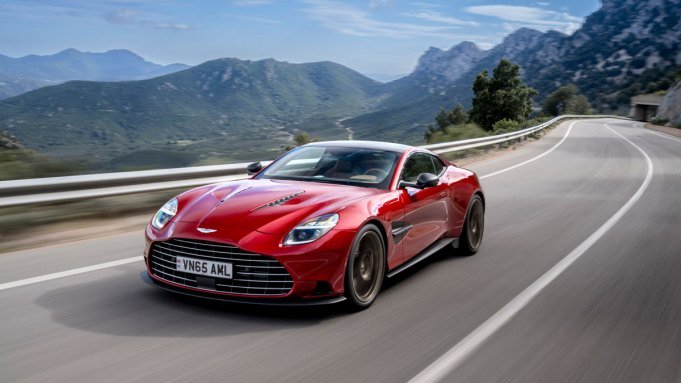
Life is coming at Aston Martin even faster than one of its sports cars.
Things haven’t gone to plan since the British automaker was first listed on the stock market in 2016, according to The Telegraph. They have reportedly gotten so bad that the automaker behind our 2026 car of the year, the Vanquish, may be in need of saving.
Things were looking up when Aston Martin went public in 2018. Sure, James Bond’s favorite marque had already gone out of business seven times, but it was also on a run of profitable quarters and had some important new models on the way, including its first SUV and EV. There was hope within the company that it was ready to leave the sports car niche behind and graduate to being a full-on lifestyle brand, like Ferrari or Porsche.
The Aston Martin DBX SUV has proven to be a success for the company
Aston Martin
What a difference eight years can make. The DBX SUV may have come out, and even been a hit, but nothing else has gone as predicted. Aston Martin’s value has plummeted over that time, falling from 4.3 billion Pounds, or roughly $5.76 billion, at the time of its public offering to 430 million pounds, or $576 million, today. That means around 90 percent of the company’s value has been wiped out. To make matters worse, the British newspaper reports that late last month the company sought emergency funding for the eighth time since going public, a little over two months after it had announced plans to lay off a fifth of its workforce.
The injection of funding, which The Telegraph puts at 50 million pounds, or $67 million, came from Canadian businessman Lawrence Stroll, who is also the chairman of the Aston Martin Aramco-Honda F1 team. No one has put more money into the automaker in recent years than Stroll, whose Yew Tree consortium owns a 31 percent stake in the brand, but the paper reports there are growing questions about whether he will continue to do so. Stroll has said he remains committed to the company, which he already bailed out once before, but if he doesn’t, its future looks even cloudier.
It’s not time to start planning Aston Martin’s funeral just yet, but its days as a British-run automaker may be nearing an end. After the Yew Tree consortium, Aston Martin’s biggest stakeholder is China’s Geely, followed by the Saudi Public Investment Fund, and Mercedes-Benz. Geely, which owns Volvo, currently has a 14 percent stake in Aston Martin and has been accused, by Stroll, of having tried to buy the brand “on the cheap” in 2022. The conglomerate already owns a British sports car maker, Lotus, so why not add another, even more storied, one to its portfolio?

