


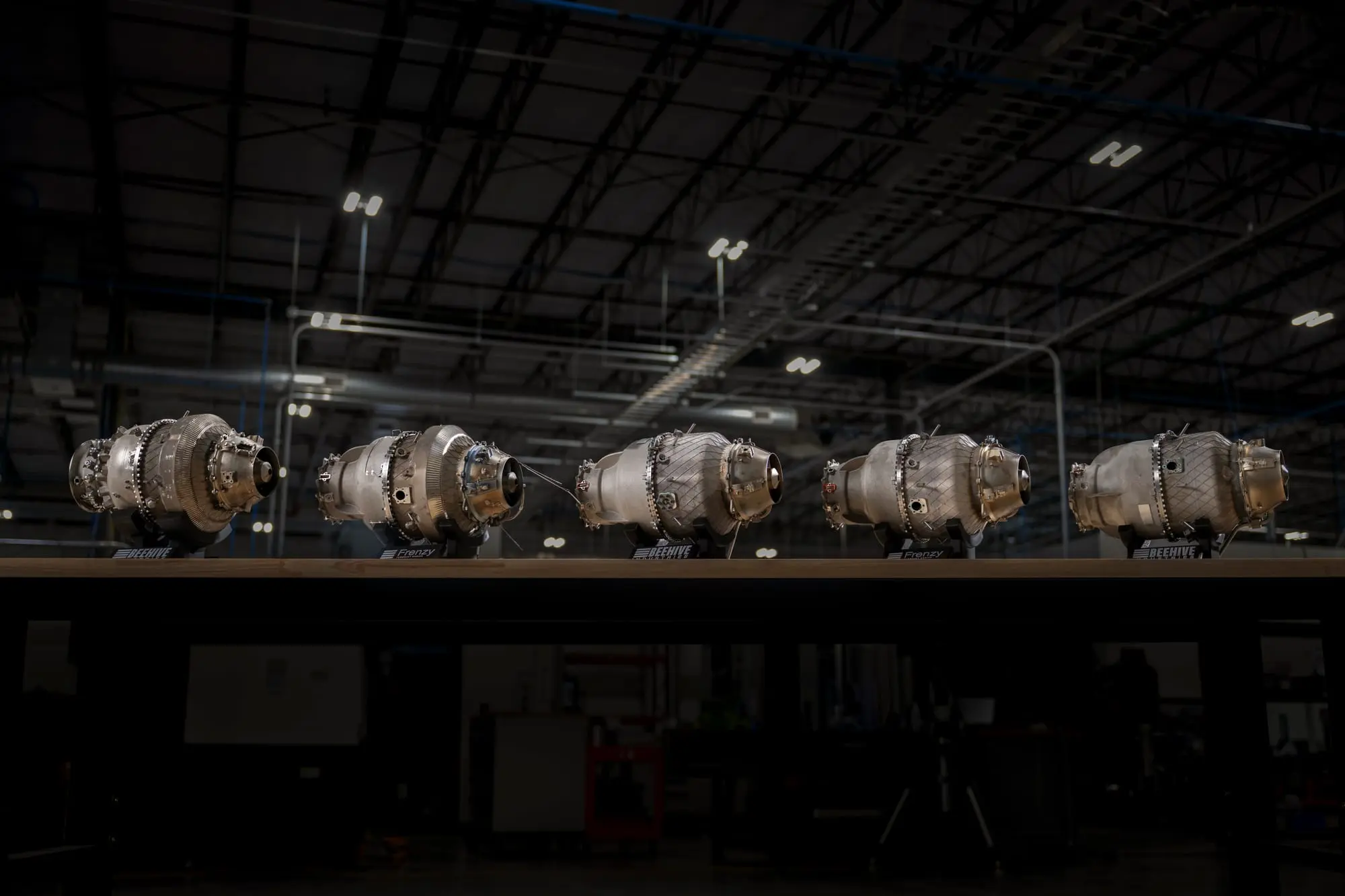
U.S. propulsion manufacturer Beehive Industries has secured a $29.7 million contract from the U.S. Air Force to advance flight testing, vehicle integration, and qualification of its Frenzy 8 engine, a 200 lbf additively manufactured jet engine developed for uncrewed aerial defense systems.
The award also covers early-stage development of the company’s 100 lbf Frenzy 6 engine, including the production of a First Engine to Test asset and options for further testing and flight demonstration. Both engines are built using additive manufacturing, a production approach Beehive has placed at the center of its strategy to deliver high-volume, low-cost propulsion at a pace conventional manufacturing cannot match.
The Program Behind the Contract
The funding is administered through the SOSSEC consortium and supports the Air Force Life Cycle Management Center’s Small Expendable Turbine, Family of Affordable Mass Munitions prototyping effort. The SET engine program sits within FAMM, a Pentagon-wide fiscal year 2026 initiative designed to move away from low-quantity, high-cost weapons systems toward a large-scale, cost-effective arsenal.
For Beehive, the contract represents both a validation of its Frenzy 8 development trajectory and a formal entry point into the Air Force’s broader push to field disposable jet engines for uncrewed systems and standoff munitions at scale.
“Beehive is honored to partner with the U.S. Air Force in redefining the speed of defense. By harnessing additive manufacturing to collapse complex supply chains into scalable, 3D printed propulsion, we are providing the ‘affordable mass’ essential to modern deterrence,” said Gordie Follin, Chief Product Officer at Beehive Industries. “This collaboration ensures our warfighters will have the high-volume, mission-ready capabilities they need to maintain a competitive edge in any theater.”
The contract follows a year of concentrated technical milestones. Beehive put the Frenzy 8 through an accelerated validation cycle while simultaneously running its Pathfinder program, an internal initiative designed to stress-test whether the company’s manufacturing model could actually support mass output. The Pathfinder results confirmed a clear production pathway, with volume ramp beginning in 2026.

3D Printed Propulsion and the Push for Affordable Mass
Beehive Industries’ position is built around a single premise: that the U.S. defense sector’s shift toward high-volume, low-cost aerial systems cannot be achieved with conventional propulsion manufacturing, and that additive manufacturing is the only credible path to closing that gap.
Beehive’s ambition extends across its portfolio: the Rampart engine, developed for the Collaborative Combat Aircraft framework, eliminates casting and tooling entirely, reinforcing how consistently Beehive has applied this approach across thrust classes and mission profiles.
The broader defense sector is moving in the same direction. Firehawk Aerospace completed the first flight test of its 3D printed hybrid rocket in 2025, reaching a vertical ascent exceeding 18,000 feet and breaking the sound barrier, a demonstration of how additive manufacturing can compress development timelines and reduce production costs for defense propulsion without sacrificing performance.
Italian firm Avio, in partnership with Raytheon Technologies, has already moved additive manufacturing into serial propulsion production, leveraging Velo3D Sapphire systems to support the annual output of 200 to 300 rockets at its Colleferro facility, a production rate that would have been logistically prohibitive under conventional manufacturing.
For Beehive, the Frenzy 8 contract represents the same inflection point these programs have been building toward: the moment additive manufacturing stops being a development tool and becomes the production infrastructure that defense programs depend on.
3D Printing Industry is inviting speakers for its 2026 Additive Manufacturing Applications (AMA) series, covering Energy, Healthcare, Automotive and Mobility, Aerospace, Space and Defense, and Software. Each online event focuses on real production deployments, qualification, and supply chain integration. Practitioners interested in contributing can complete the call for speakers form here.
To stay up to date with the latest 3D printing news, don’t forget to subscribe to the 3D Printing Industry newsletter or follow us on LinkedIn.
Explore the full Future of 3D Printing and Executive Survey series from 3D Printing Industry, featuring perspectives from CEOs, engineers, and industry leaders on the industrialization of additive manufacturing, 3D printing industry trends 2026, qualification, supply chains, and additive manufacturing industry analysis.
Featured image shows 200 lbf Frenzy 8 engine. Photo via via Beehive Industries.
