


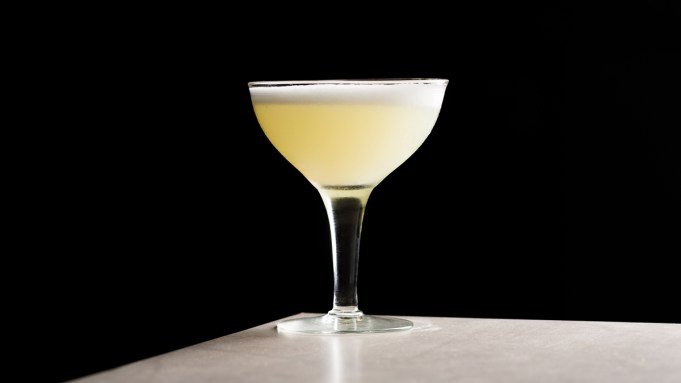
This cocktail is called the Perfect Lady. Which might seem straightforward enough, but in order to understand how to think about a “perfect lady”—in either drink or human form—it really helps to know specifically when and where we’re talking about.
Maybe your world is different from mine, but here in contemporary America, if someone I know referred to themselves as a “perfect lady,” it would invariably be ironic. “I was a perfect lady in college,” someone might say, after being reminded of the time she got drunk, vomited on herself, and tried to hook up with the Uber driver. So if the Perfect Lady cocktail were invented today, one would half expect it to be vodka and sugar-free Red Bull, garnished with a couple fringy hair-ties and a wintergreen Zyn.
By contrast, when a bartender named Sydney Cox, from the incredibly posh Grosvenor House in Mayfair, London, entered the 1936 British Empire Cocktail Competition with a mix of dry gin, peach brandy, lemon juice, and egg white, there was almost certainly no irony at work when he named it the Perfect Lady. It is, you could argue, the best name for it, as his drink was a natural continuation of a long, proud tradition of “lady” cocktails (usually gin, usually lemon, sometimes egg white, always shaken) that had been going, at that point, for more than 20 years.
First was the Pink Lady (gin, apple brandy, lemon, grenadine, egg white) printed in 1913 and named for a Broadway musical comedy of same name. Then came the White Lady (gin, lemon, Cointreau) first printed in the early ‘20s and made cannon in 1930. By the time the Cox walks into his competition, in September 1936, there are at least a dozen ladies: A cocktail book the next year additionally has recipes for the Blue Lady, Brown Lady, Golden Lady, Green Lady, and Sherry Lady, and alludes to the existence of the Chorus, Black, Creole, Chinese, and Lavender Ladies as well.
So, how does Cox’s creation measure up to its name? “The perfect lady,” according to a popular etiquette manual of the time, “is not the ornamental butterfly of society, as so many would have us believe. She is gentle, and well-dressed and graceful… and she conducts herself with the calm, unassuming grace that instinctively wins a responsive respect.” So the cocktail is thus: delicately fruited, sweet and sour in perfect balance, and topped with an egg white cap contributing a velvet texture and softening any sharp edges. With its stone fruit sweetness it’s a lovely welcome to the flavors of summer, without any of the garishness of “ornamental butterflies” like red berries or watermelon. It is demure and gentle, unassuming and understated.
There are some cocktail websites that speculate that Cox named his drink for Wallis Simpson, the twice divorced American socialite whose affair with King Edward VIII scandalized English society and led to him abdicating the throne in December 1936. Which is to say, that this cocktail was named ironically. It’s possible, but I respectfully disagree. Cox was too posh for the wry grin, and Simpson wasn’t yet discussed in public by that point, and besides, were it a combination of cherry juice, absinthe, and edible orchids, I’d consider it, but just look at it. Does it look like a harlot to you? Or does it look like a perfect lady?
Perfect Lady
- 1.5 oz. gin
- 0.75 oz. lemon
- 0.5 oz. simple syrup
- 0.5 oz. peach liqueur
- 1 egg white
Add all ingredients to a cocktail shaker. Before you add ice, seal the shaker and “dry shake” for five seconds, to whip the egg. Then open the shaker, add ice, and shake good and hard for eight to 10 seconds before straining up.
NOTES ON INGREDIENTS
Photo: courtesy Beefeater
Recipe: Some reputable sources treat this like a White Lady, which is to say, forgo simple syrup and use a whole ounce of peach liqueur. I do not recommend this. A full ounce of liqueur works in a White Lady because that liqueur is Cointreau, which is drier, 80 proof, and tight as a drum. There is no peach flavored Cointreau-equivalent. Your mileage may vary, but every way I’ve tried 1 oz. peach liqueur, it always feels, to me, like too much.
Gin: Most gins work here, though my recommendation is to go London Dry, like Beefeater or Bombay. Peach is so plush, I fear softer gins get pushed over by it.
Peach Liqueur: Sometimes known as “crème de pêche.” For most people, this is where the cocktail goes wrong. It lives or dies on the quality, clarity, and precision of the peach flavor, and there are so many peach liqueurs (sometimes “peachtree” or “schnapps”) that feel synthetic. It would be fine, I suppose, but get a good peach liqueur, like Rothman & Winter Orchard Peach or Giffard Crème de Pêche, makes the cocktail sing (note: even the good peach liqueurs can end up medicinal if they sit around too long, especially if they do so in the sun).
It’s also possible to use fresh peaches, as you wish—if so, muddle a couple slices of ripe peach in the bottom of a mixing tin, and then up the simple syrup to 0.75 oz. and the gin to 2 oz.
Simple Syrup: Equal parts sugar and water, and stir until the sugar dissolves.
Egg White: Egg white is not strictly speaking necessary, but it lends elegance to the whole equation. It’s highly recommended. If you’re iffy about raw eggs in cocktails, use pasteurized whites in a carton, which work just as well, or aquafaba (the liquid in a can of chickpeas), which is a good agent of texture as well.
Authors

Jason O’Bryan

