


As global air cargo hubs face mounting pressure from e-commerce growth, labour shortages, decarbonisation targets and rising operational complexity, airports are entering a new phase of digital transformation.
Traditional automation alone is no longer sufficient. The next generation of airport logistics requires systems capable not only of executing tasks, but also understanding environments, coordinating assets and continuously optimising operations in real time.
Westwell, a global AI company that develops smart and green solutions for container logistics, is advancing this transition through its “AI + New Energy (Ainergy)” strategy.
Originally established in smart seaport logistics, the company now serves more than 200 customers across over 30 economies, expanding its AI-Native capabilities into airports, rail logistics, land transportation and smart factories.
At the core of Westwell’s airport approach is a dual-AI architecture where intelligent vehicles, autonomous driving systems and AI-powered operational intelligence work as a coordinated whole. But technology matters only when it delivers measurable customer outcomes.
Here is how Physical AI and Operational AI translate into real value for air cargo operators, enabling airports to build scalable, adaptive and commercially sustainable operations in increasingly complex cargo environments.
Safe and Green Autonomous Execution for Reliable Airside Logistics
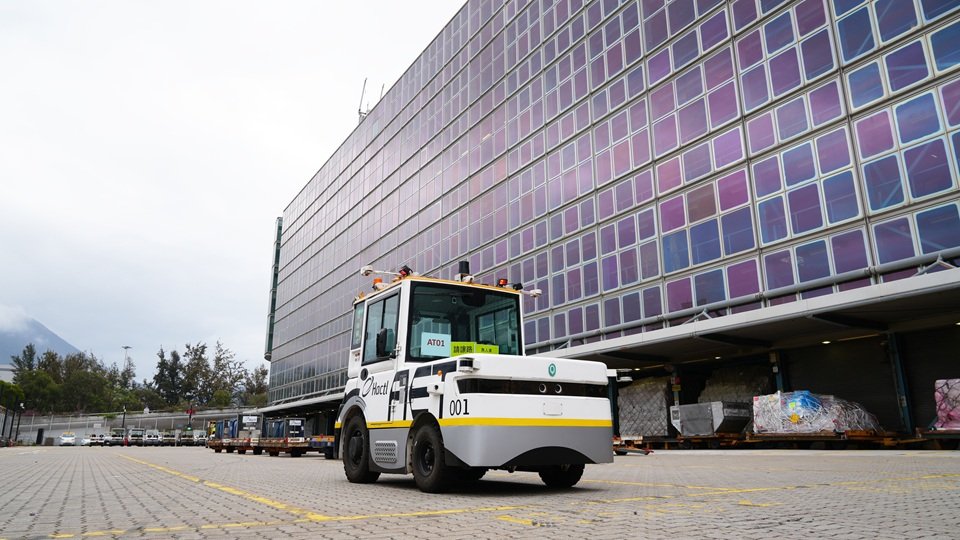
Physical AI focuses on frontline autonomous execution. Designed for demanding airside conditions, the Q-Tractor is powered by Westwell’s self-developed Q-Pilot autonomous driving platform, which integrates BEV perception, Transformer-based end-to-end models, and an intelligent scheduling system to enable safe, autonomous operations throughout complex airport environments.
Redundant safety architectures — including multi-layer sensor validation and fail-safe braking — ensure 24/7 reliability under all conditions, from bright daylight to low-visibility night shifts and adverse weather. For air cargo operators, this delivers consistent, fatigue-free cargo throughput independent of shift patterns or external factors.
Closing the last gap in unmanned logistics, the Q-Tractor’s centimetre-level automatic trailer coupling and uncoupling — currently validated across multiple airport deployments — completes the unmanned chain.
It enables autonomous cargo loading and unloading workflows, improving consistency and throughput while reducing reliance on ground-handling labour.
Powered by pure electric drive, the Q-Tractor achieves zero emissions in core operations, delivering green value for airport customers and supporting their ESG practices.
Intelligent Operational Decision-Making Driving Fleet Efficiency and Capacity Utilization
Beyond autonomous vehicle execution, Westwell’s Operational AI layer is centred on ReeWell, its intelligent operations management platform. Powered by world models and agentic decision-making systems, ReeWell provides a unified decision-making layer across flights, cargo, vehicles, equipment, personnel and energy resources.
Complementing this capability, the WellFMS fleet management system supports real-time vehicle dispatching, route optimisation and task execution, enabling more coordinated and efficient airport logistics operations.
This Operational AI functions as a “thinking brain” addressing key logistics questions such
as when to act, where to act, which resource to deploy, and in what sequence — maximising transport capacity utilisation and enabling a more efficient autonomous fleet.
This aligns with a current industry trend: airports are increasingly prioritising integrated operational intelligence capable of synchronising fragmented logistics workflows across the entire cargo chain.
Westwell’s airport projects reflect the growing adoption of AI-Native logistics technologies in increasingly complex air cargo operations.
Currently, Westwell’s Q-Tractors are being introduced at key air cargo hubs, including Hong Kong International Airport, Hong Kong Air Cargo Terminals Limited (Hactl), Shanghai Pudong International Airport, Ezhou Huahu International Airport and others.
In 2025, Westwell officially received approval to deploy new energy autonomous tractors at Hactl – the largest independent air cargo handler in Hong Kong. Westwell’s Q-Tractors power unmanned cargo transportation operations at the terminal, enhancing productivity while accelerating Hactl’s smart and green transformation.
At Shanghai Pudong International Airport, Westwell is expanding AI applications into airport safety operations beyond cargo transportation – the company is developing an industry-leading “AI + Autonomous Driving + FOD Detection” intelligent runway inspection solution, combining autonomous vehicles, radar systems and AI recognition algorithms to support the safe operation of flights.

In 2026, the company has also secured new airport projects, including Fuzhou Changle International Airport and Xiamen Xiang’an International Airport, where its autonomous logistics solutions are planned to support cargo and baggage transportation operations.
As airports continue balancing efficiency, resilience and sustainability targets, AI-Native operational systems are expected to play an increasingly strategic role in air cargo infrastructure development.
For Westwell, the future of airport logistics lies not simply in automation, but in building collaborative ecosystems where people, intelligent vehicles and AI systems work together more safely, efficiently and sustainably.
