


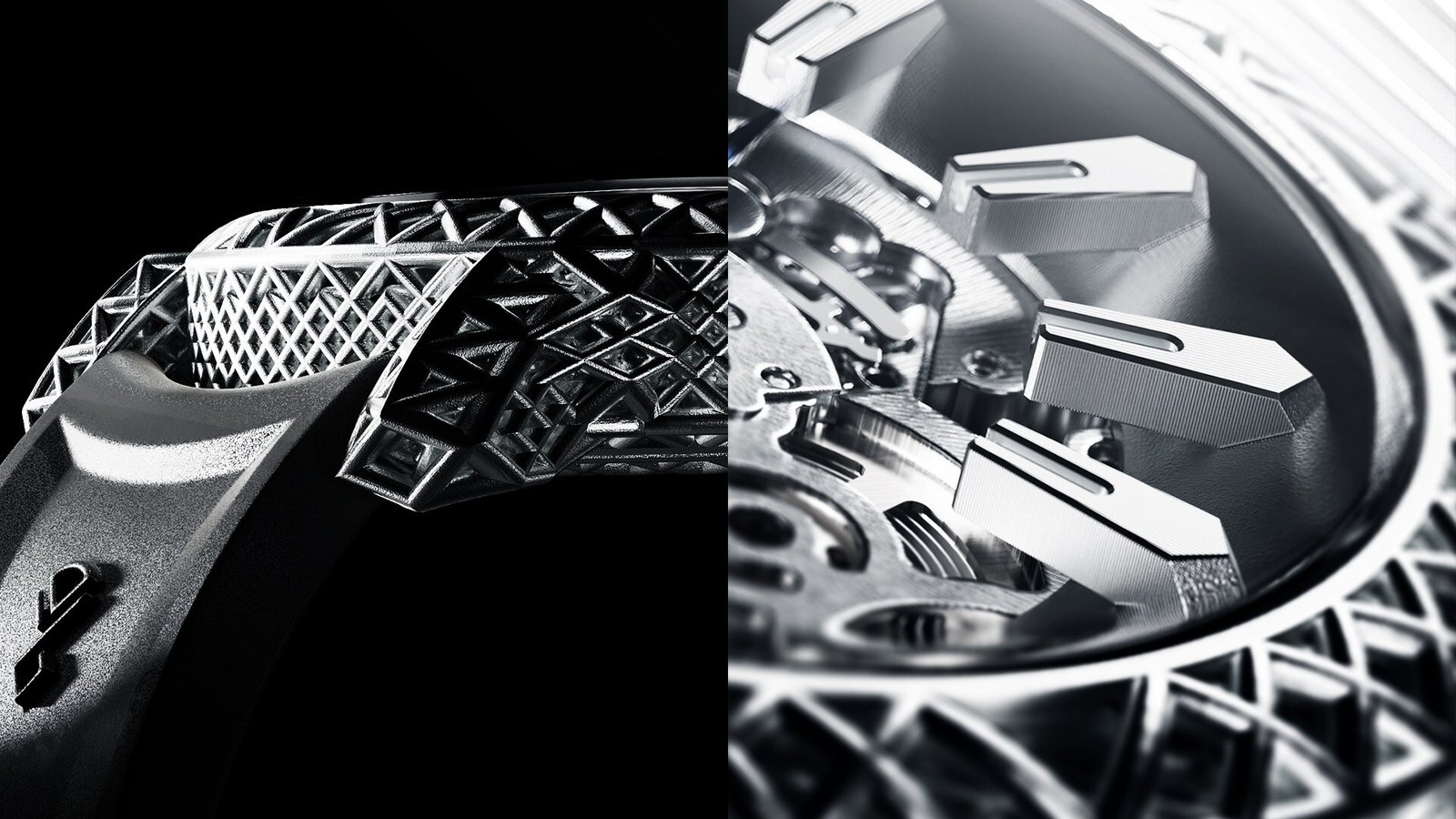
Parivas, an independent watchmaker based in Los Angeles, has presented the Exo.1, a luxury timepiece whose case is produced as one continuous 3D printed structure. Launched on May 18, 2026, as the opening piece of the brand’s Genesis Collection, the watch is the company’s attempt to establish what it calls “additive watch design,” building a case architecture that, according to the firm, could not exist through conventional machining or assembly.
The company was founded around additive manufacturing and aerospace engineering practices. Co-founders Mickey Brown (CEO) and Justin Chang (COO) bring more than 30 years of combined experience in mechanical engineering and additive manufacturing, and frame their approach to watchmaking as that of engineers rather than traditional horologists. The brand’s name traces back to the Latin phrase “Pario e Pulvas,” “created from dust,” a nod to the powder-based process behind its cases.
An exoskeleton in 316L steel
The watch takes its name from the exoskeleton-like appearance of its case: an open-worked structural lattice in 316L stainless steel that runs continuously across the bezel, body, and lugs with no joints between them. Where conventional watchmaking manufactures these elements separately and assembles them, the Exo.1 consolidates them, along with dial features, into a single printed part. The hour markers are printed with hollow cores that house tritium tubes, leaving them suspended within the lattice rather than mounted on a dial.
A second signature element is the Solar Dusted surface treatment, a finish the company developed through a proprietary sintering process. It produces a rippled, fingerprint-like texture that changes appearance in direct sunlight and varies from piece to piece, meaning no two cases are identical.
Parivas says the design predates the technology’s ability to produce it at the required standard, with development spanning roughly six years and 10,000 hours. “The Exo.1 did not adapt to the technology. The technology had to rise to meet it,” said Brown. Each watch is hand-assembled in Los Angeles by the engineering team that designed it.
Movement and specifications
Inside runs the Parivas Caliber P1001S, a customized Swiss automatic skeleton movement based on the Sellita SW300-1SA, finished with rhodium plating and soleillage decoration. The movement carries the Parivas Chronometer certification, an in-house precision program created with the Horological Society of New York and designed to surpass the ISO 3159 international chronometry standard.
The case measures 42 mm in diameter, 10 mm thick, and 49 mm lug to lug, with a 20 mm lug width and a weight of approximately 107 grams. Water resistance is rated at 6 bar, under an anti-reflective sapphire crystal. The P1001S offers a 56-hour power reserve, 25 jewels, a 28,800 bph (4 Hz) frequency, Incabloc shock protection, and antimagnetic resistance to 4,800 A/m.
The first batch is capped at 30 pieces, sold through a curated waitlist that opened to the public on May 18, 2026, on the company’s website. The Exo.1 retails at $7,500, is available only in the United States, and deliveries are expected in the first quarter of 2027.

Where additive watchmaking stands
Parivas’ strategy targets a gap between what additive manufacturing can do and how watchmaking has actually used it: in horology, 3D printing has mostly served as a prototyping aid or produced cases that imitate conventionally made designs. Rather than adding a printed component to a traditional construction, the company built its entire identity around the process.
Printed watchmaking has precedent at both ends of the market. Panerai’s PAM 578 brought a 47 mm 3D printed titanium case to the luxury segment, while in France, apprentices at Utinam Besançon printed a 316L stainless steel watch case on a Renishaw AM250 system for the metalworking association UIMM, which presented it as a first functional printed watch.
The technology has even reached the enthusiast desktop. Designer Mechanistic launched the Tourbillon Mechanica Tri-Axial, a triple-axis luxury timekeeping mechanism designed to be printed on consumer-grade FDM machines, crowdfunded for under $100 on MyMiniFactory, conceived as a functional mechanical sculpture giving users first-hand experience of assembling a luxury mechanism.
Others printed cases. Parivas is betting an entire brand on them.
3D Printing Industry is inviting speakers for its 2026 Additive Manufacturing Applications (AMA) series, covering Energy, Healthcare, Automotive and Mobility, Aerospace, Space and Defense, and Software. Each online event focuses on real production deployments, qualification, and supply chain integration. Practitioners interested in contributing can complete the call for speakers form here.
To stay up to date with the latest 3D printing news, don’t forget to subscribe to the 3D Printing Industry newsletter or follow us on LinkedIn.
Explore the full Future of 3D Printing and Executive Survey series from 3D Printing Industry, featuring perspectives from CEOs, engineers, and industry leaders on the industrialization of additive manufacturing, 3D printing industry trends 2026, qualification, supply chains, and additive manufacturing industry analysis.
Featured image shows Introducing the Parivas Exo.1. Image via Parivas.
