


SCOTUS ruling: Safety standards overrule preemption
Following recent Supreme Court rulings, the transportation industry is facing a new regulatory reality where federal preemption is no longer a blanket defense.
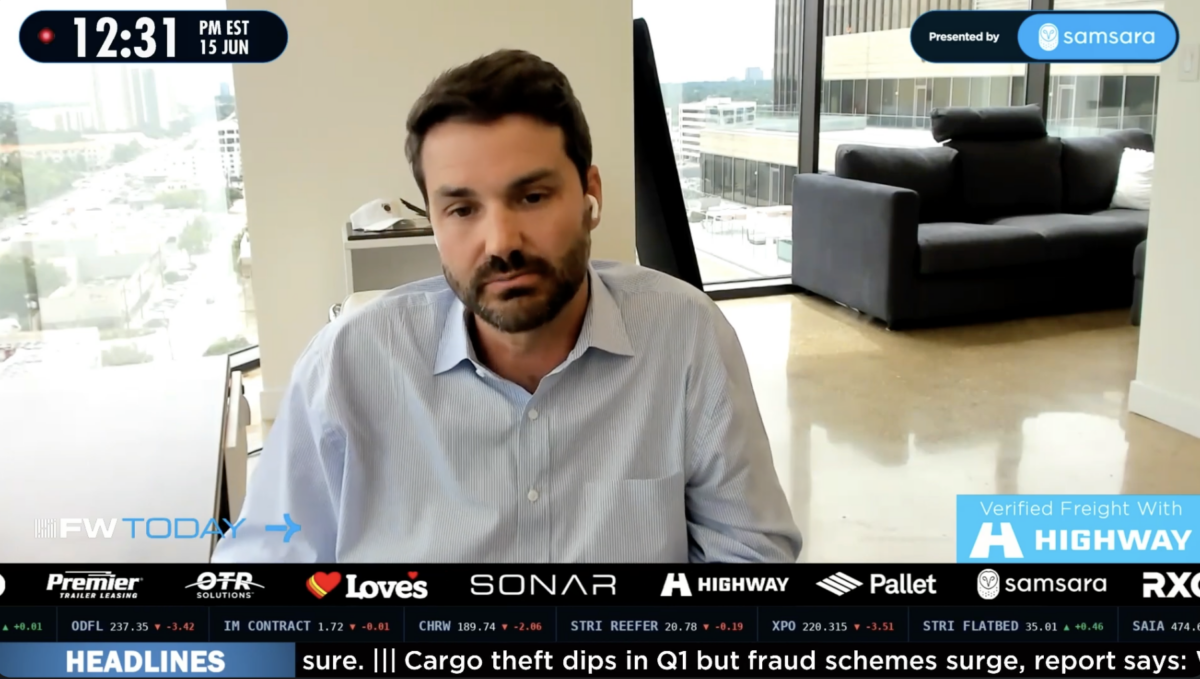
During Monday’s liveshow of FreightWaves Today, Highway CEO Jordan Graff highlighted that brokers must now aggressively integrate formal safety standards directly into their carrier vetting and auditing processes.
As a consequence, insurance underwriters are mandating stricter risk profiles, which Graff said will make it significantly more difficult for smaller or newly authorized carrier entities without established safety data to secure freight.
Cyber cartels pivot to post-tender credential hijacking
Cargo fraud has also rapidly evolved from fleet-level compliance manipulation to sophisticated identity theft.
According to Graff, international bad actors are increasingly targeting unencrypted communications to hijack carrier credentials right at the point of tendering or pickup.
In response to the trend, industry leaders are advising companies to ditch unsecured channels like email and WhatsApp in favor of encrypted transaction systems to protect highly sensitive rate confirmations and pickup numbers.
The reality of trucking margins
A stark divergence persists between massive carrier asset scale and actual bottom-line profitability in the public markets.
Seth Holm, founder and portfolio manager at West Brown Capital, said that major publicly traded players like Heartland Express, PAM Transport and Werner Enterprises frequently operate on razor-thin or negative margins. Some are even running operating ratios north of 100% –a reality that forces long-short institutional investors to carefully weigh the massive legal risks of cheap capacity against the necessity of letting carriers earn sustainable operating margins.
Fuel economics
With wholesale fuel prices dropping roughly a dollar per gallon since their peak, carriers are being urged to fundamentally re-evaluate their fuel purchasing strategies.
Industry experts recommend that motor carriers buy fuel on cost-plus “rack” arrangements rather than relying on standard retail pump pricing, which is notoriously quick to surge on the way up but sluggish to fall on the way down.
Utilizing high-frequency index data, like SONAR, allows operators to anticipate wholesale shifts up to 24 hours before traditional fuel cards update.
Keep up with the latest news on FreightWaves Today
FreightWaves Today livestreams weekdays at noon ET at
Supply Chain AI Symposium
Past the hype. Join operators, founders, and enterprise leaders figuring out how to deploy AI in supply chain.
July 15, 2026
The Old Post • Chicago, IL
Register Now
F3: Future of Freight Festival
Industry-defining keynotes, rapid-fire technology demos, and industry leaders networking in experiences across Chattanooga – plus the inaugural F3 Awards Dinner featuring the FreightTech and Shipper of Choice reveals.
October 27, 2026 – October 28, 2026
The Signal at Chattanooga Choo Choo • Chattanooga, TN
Register Now
AI
Supply Chain AI Symposium
Past the hype. Join operators, founders, and enterprise leaders figuring out how to deploy AI in supply chain.
The Old Post • Chicago, IL
Register Now
FreightTech
F3: Future of Freight Festival
Industry-defining keynotes, rapid-fire technology demos, and industry leaders networking in experiences across Chattanooga – plus the inaugural F3 Awards Dinner featuring the FreightTech and Shipper of Choice reveals.
The Signal at Chattanooga Choo Choo • Chattanooga, TN
Register Now
