


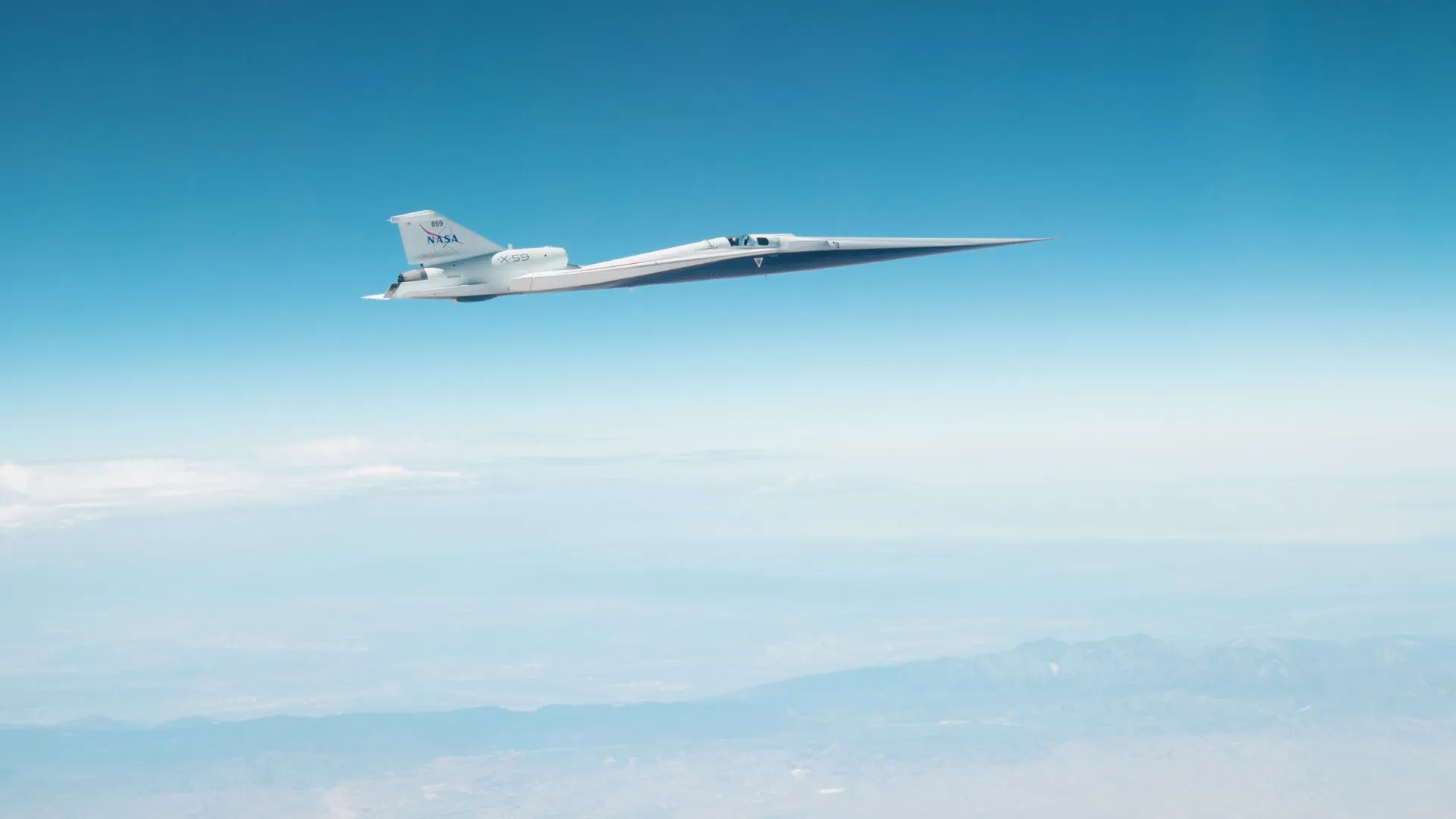
NASA steps closer to beginning a series of ‘community overflights’ to evaluate public perception of the X-59’s sonic signature.
NASA’s X-59 quiet-supersonic demonstrator reached 55,000ft and Mach 1.4 during a 12 June flight, achieving a key programme milestone six weeks after the aircraft took off for the first time.
The agency had been eager for the jet to hit that altitude and speed, as it intends to operate the X-59 at those parameters during a planned series of “community overflights”. Those flights are the ultimate mission for which the supersonic demonstrator was developed.
NASA says months of flight testing remain ahead of it before community overflights will begin. It still needs to evaluate the X-59 at various altitudes and in various conditions as part of envelop expansion work.
The team will also complete an “acoustic validation” test phase during which “researchers will thoroughly measure the aircraft’s supersonic acoustic signature – the quiet thump it’s designed to make – to confirm it is performing as intended.”
Only after completing those evaluations will NASA begin the community overflight portion of the X-59 programme.
NASA, with partner Lockheed Martin, developed the aircraft with unique features it says significantly reduces the loudness of its sonic signature when heard or measured from the ground. It has estimated people will perceive the sound similarly to that of a slammed car door – nothing like the window-shattering booms historically typical of supersonic aircraft.
After the community flights, NASA will survey the public to determine how people perceived the noise.
NASA’s end game is to submit its findings to the Federal Aviation Administration for the purpose of encouraging the regulator to lift a decades-old ban on overland civilian supersonic flight – a ban implemented largely because sonic booms have always been so disruptive.
Subscribe to gain access to all news
Already have a subscription? Log in.
Choose your subscription
Considering a corporate subscription? Contact us to find out more.
