


Airframer continues to analyse options for notional -500 variant but pledges to retain Pratt & Whitney as programme’s sole engine supplier.
Airbus appears to be leaning towards a quick and “simple” stretch of the A220 narrowbody that would add around five rows of seats, putting capacity in the region of 185 passengers, if it decides to proceed with the so-called -500 variant.
However, it sees no need to unseat Pratt & Whitney as the A220’s sole engine supplier, citing the improved performance being delivered by the propulsion specialist.
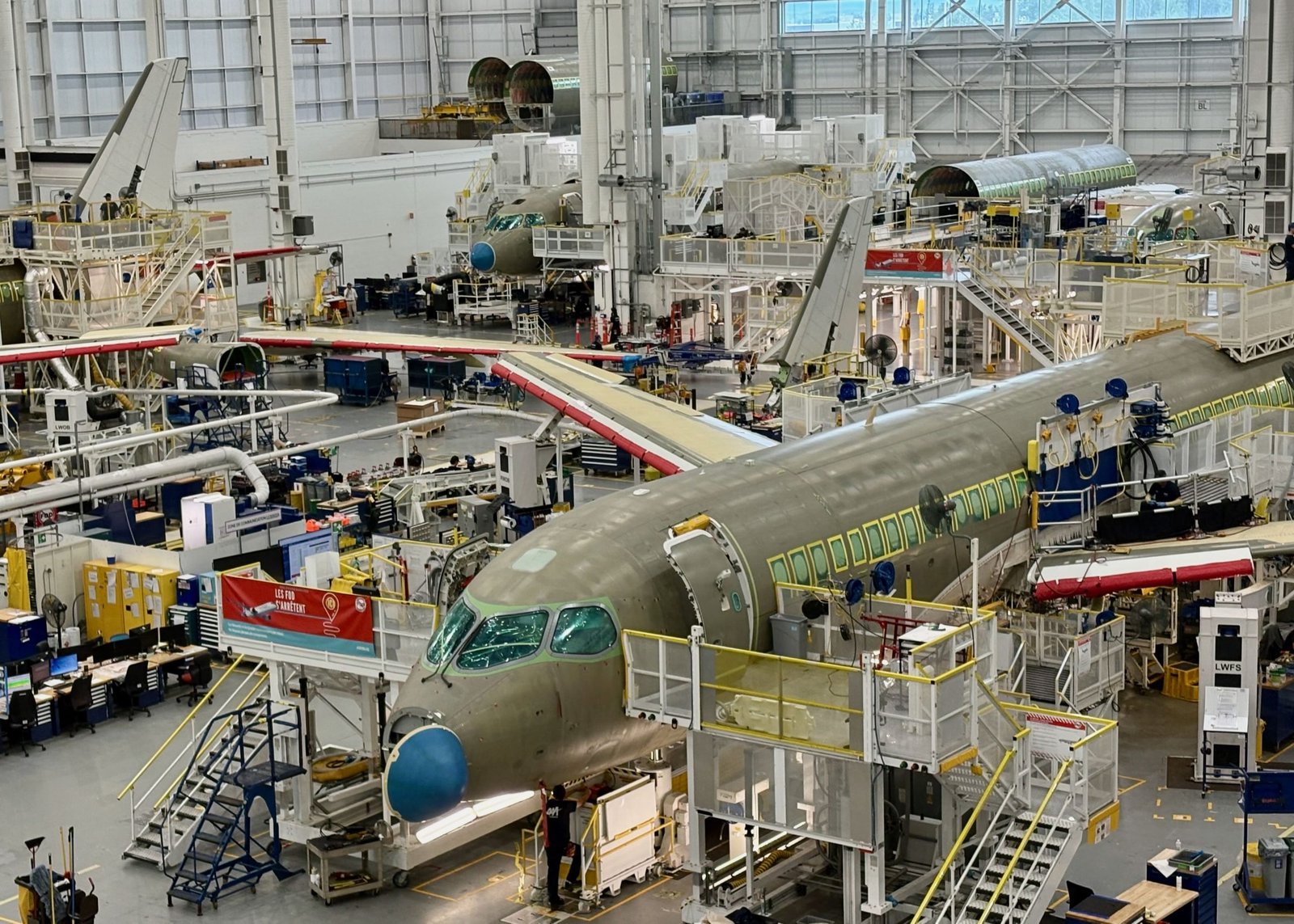
Speaking during a media briefing at its Mirabel production centre in Montreal on 23 June, Guillaume Chevasson, chief executive officer of Airbus Canada, said the company had been “working very hard” on the potential stretch and has “accelerated” its internal assessments of the jet.
Although he says it is unclear if a launch decision will come this year, Chevasson notes the airframer has had a “particular focus” on the project in 2026, conducting engineering studies and customer analysis: “We want to be ready soon to make a decision.”
But that customer feedback is pushing Airbus towards a less complicated solution, he says.
“They are looking for something simple with a time to market that will be as quick as possible. They want the lowest risk possible as a solution.”
Chevasson says trade studies are continuing to establish the optimum balance between additional capacity, weight and range.
Although he declines to specify the size of stretch under consideration, he says a maximum capacity of 185 seats is “the right ballpark”.
“We still have some work to be done. We are looking at it. We are also discussing with Pratt to make sure we have the right [engine] solution.”
Despite early signals that Airbus could look to bring CFM International into the programme, offering its Leap powerplant as a rival engine to the PW1500G, Chevasson insists it will stick with its current supplier.
“We like to have choices but in our case it would be an expensive divorce with Pratt.”
The durability and reliability improvements implemented by P&W on the PW1500G – it promises engine-related aircraft-on-ground incidents will have reduced to zero by year-end – have also reinforced Airbus’s trust in the incumbent provider, he adds.
“We have no reason to move away, especially when you look at the simple stretch approach. At this stage it is not an option,” says Chevasson.
Noting that the stretch “has not [yet] been launched”, Scott Kreamer, head of the PW1500G programme at P&W, says it has been “working very hard with Airbus on the trade studies and evaluating options for the stretch”.
“It is a little bit too early to say what exactly our engine position will be. We are 100% committed to the A220 programme and committed to any future variant,” he says.
Although Airbus has an “objective” to produce any stretch within the same final assembly line in Mirabel, some modifications will be necessary for the airframer to maintain its intended output of 13-14 aircraft per month from 2028 on the current -100 and -300 variants.
“If we introduce a new variant that won’t run at the same speed – we will have to create a surge capacity to ramp up the variant until it reaches the same speed as the legacy product,” says Daniel Wenninger, senior vice-president, A220 programme office.
Although a 185-seat capacity on the A220-500 would be close to the A320neo – currently capped at a maximum of 195 seats – Airbus is not worried by any potential cannibalisation of sales, says Christian Kley, head of single-aisle market development.
He sees considerations such as fleet commonality and the comparative production rates of the two programmes ensuring that buyers of both types remain loyal to their current choices.
“There is really not that much overlap when you think about it,” he says.
“We are creating more choices for the airlines: they will have a choice between three aircraft types in the A220 family and the classic choice on the A320 family.”
Meanwhile, the manufacturer is continuing its ramp up on the programme towards its rate 13 target in 2028.
Last year, Airbus shipped 93 A220s, up from 61 in 2024, and is on track to raise that figure again this year across its final assembly sites in Mirabel and Mobile, Alabama.
While declining to reveal its delivery goal for 2026, Kley says it is aiming for a similar year-on-year rise.
Achieving output of 13 aircraft per month is crucial to achieving programme profitability, Chevasson notes.
“We want to continue to ramp up. We want to reach profitability, which is the cornerstone of the programme. It is my priority, but there can only be a future for the programme if it is profitable.”
Airbus is “not far away” from that point, he says. “We can see it, we can touch it, now we have to make it.”
Those efforts have been helped by an easing of stresses in the supply chain, notably the integration into Airbus from late 2025 of the former Spirit AeroSystems wing production line in Belfast.
“That gives us a great level of stability and foreseeable reliability for the wing [production]. The wing was a pacing item last year,” says Wenninger.
Meanwhile, to increase supply chain resilience, Airbus is adding second sources to the production of its major fuselage structures.
Manufacturing of the centre fuselage is already split between Chinese firm SACC and Airbus, while the airframer is bringing in Leonardo alongside SACC for the rear section.
At present, SACC remains the sole supplier for the forward fuselage but “one day we will also do a forward fuselage [from a] second source”, Wenninger adds.
Subscribe to gain access to all news
Already have a subscription? Log in.
Choose your subscription
Considering a corporate subscription? Contact us to find out more.
