


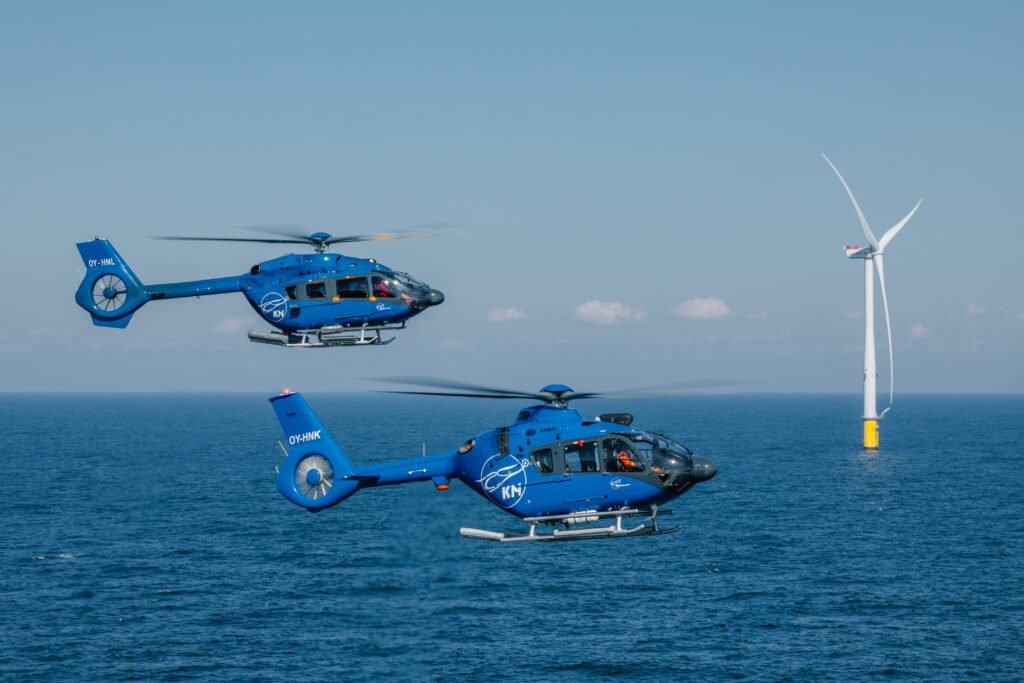
Even so, while the argument is beginning to go the way of the helicopter, there remains a strong lobby from the shipping industry.
“We are seeing clients moving toward helicopters for everything, but the shipping side is a really, really strong industry that we have to contend with,” says Kjeldahl.
Back to base
Returning to the “one-stop shop” concept that Kjeldahl and Granhøj had in mind when they founded KN Helicopters, besides the direct support of wind farms the company also has an in-house maintenance capability with a Part 145 facility with authorisations on the EC120, H135 and H145.
It also boasts an in-house ATO approval, which allows it to provide type ratings on the EC120, H135, H145 and H175, as well as IR (H), IRI (H), FI (H) and TRI (H) ratings – although the company primarily uses the pilot ratings capability to train new hire and contract pilots rather than marketing it to third parties as a profit centre.
For customers, KN can provide Helicopter Hoist Operations for Passenger (HHOP), Helicopter Landing Officer (HLO), Helicopter External Load (HEL) as well as Compressed Air EBS training.
Perhaps, though, one of the rare if not unique services it can offer customers is a heliport/base building service.
“It is unusual,” agrees Kjeldahl. “If you approach nine out of 10 companies and say to them ‘Can you go build us a base?’ they’ll say ‘No, that’s not something we do.’
“We can and we have done it two times now – building a heliport and base where there is nothing, just a cornfield.
“The customer worked with us to get the local planning permission, though it helped because they were a government body!
“But we got the planning permission in January and we started operations in April, so that was everything – helipad, hangar, passenger check-in, crew accommodation, briefing room, weather station, fuel, everything. And then when the contract was complete 18 months later, we took it all away and reinstated it as before.”

When repair or maintenance is needed, most of the work takes place on the nacelle at the top of the turbine. Helicopters can bypass the craning and hoisting and stages entailed by the use of surface vessels. Image: RotorHub International
What is perhaps more remarkable is that carrying out the design, construction and disposal of the base was still more cost-effective than using an existing airport 10 minutes’ flying time further away from the wind farm site.
“Actually, we costed it based on eight months of operation, and it was cheaper in the end – the project took 18 months, so it was an even better deal for the customer.”
Kjeldahl goes on to explain that first of all the cost of an additional 20 minutes of flying from the local airfield alone covered the cost of the base.
“The next point is that everyone working on the project was a highly paid consultant charging by the hour, so add 30 to 35 minutes to check in versus at the dedicated base walk in the door and be in the air 10 minutes later. So then that paid for the base a second time
“And finally, we did not have to pay airport landing or handling fees, so it paid for itself a third time over – it was a no-brainer for the customer.”
As a matter of fact, Kjeldahl says the hardest part of the contract was not the work associated with the base set-up and removal, but rather keeping up with the pace of flying.
“It was the sheer amount of flying we had to do – I think it was more than 7,500 passengers. With an H135 we were flying every day from 07:00 five hours a day, so 18 months with no back-up helicopter in reserve. That was the most challenging part.”
