


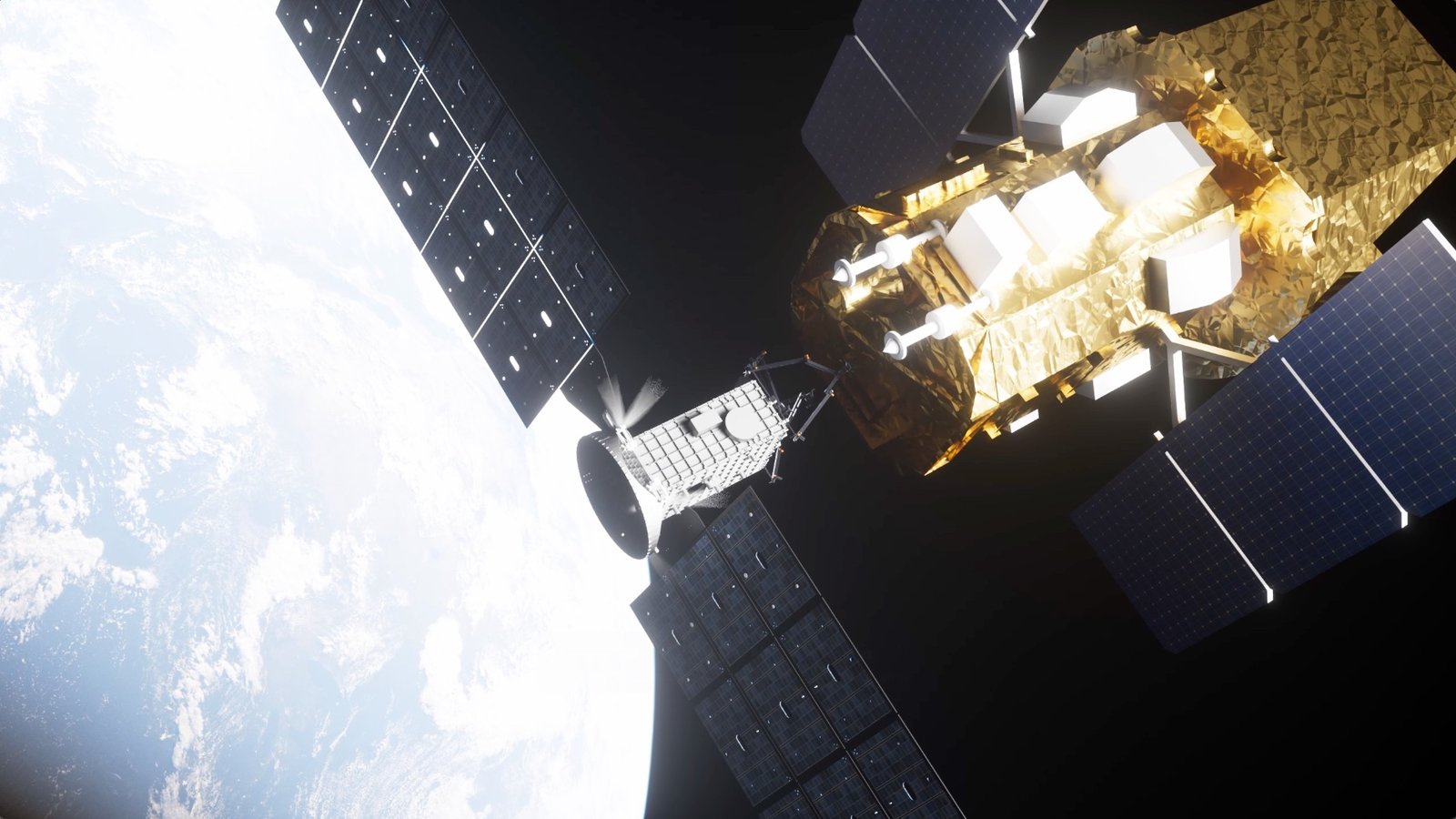
WASHINGTON — Katalyst Space and NASA have called off plans to use the company’s Link spacecraft to raise the orbit of the agency’s Swift gamma-ray observatory, citing attitude-control problems with the spacecraft.
The company announced Aug. 20 that it concluded, in consultation with NASA, that its Link spacecraft will not attempt to grapple Swift and raise its orbit as originally planned. The company said the decision was based on “ongoing attitude control issues” with Link but did not elaborate.
Katalyst launched Link July 3 on a Pegasus XL rocket on a mission to grapple Swift and raise its orbit. While the company initially reported Link was in good condition after launch, it stated July 28 that the spacecraft had entered a multi-axis spin caused by attitude-control problems, including the loss of two of its three reaction wheels. The spacecraft’s reaction control system thrusters were only partially working.
By early August, the company said it had slowed that spin from 9 degrees per second to 1.47 degrees per second by using the electric thrusters intended to change the spacecraft’s orbit.
It subsequently reported that controllers installed new flight software on the spacecraft. “We expect the updated configuration to support rendezvous operations and, in the next phase of the mission, attempt to capture and boost NASA’s Neil Gehrels Swift Observatory,” it said in an Aug. 11 post. Link was then expected to reach Swift in late August.
Neither Katalyst nor NASA elaborated on what led them to conclude that Link could not safely grapple and boost Swift. Both, though, said that Link would perform rendezvous and proximity operations in the vicinity of Swift in place of a reboost.
“Katalyst designed, developed and launched an experimental spacecraft to go after an ambitious mission on an aggressive timeline. We took on this high-risk, high-reward challenge and are proud of the milestones we reached along the way,” Ghonhee Lee, chief executive of Katalyst Space Technologies, said in a statement.
The announcement comes almost exactly a year after NASA issued study contracts to Katalyst as well as Cambrian Works, partnered with Astroscale U.S., to examine the feasibility of reboosting Swift. The studies came after agency assessments found that Swift’s orbit was decaying faster than expected because of increased atmospheric drag, linked to high solar activity, that would cause Swift to reenter as soon as late 2026.
In September, NASA awarded Katalyst a $30 million contract to carry out the reboost mission, repurposing a spacecraft the company had been developing for a low Earth orbit demonstration of its satellite servicing technology. Throughout the process, both Katalyst and NASA emphasized that this was a risky mission but one with potential benefits that went beyond simply saving Swift.
“We knew this was a high-risk, high-reward mission: a first-of-its-kind attempt, developed on an unprecedented timeline driven by the sun’s activity,” said Shawn Domagal-Goldman, director of NASA’s astrophysics division, in an agency statement. “We were all hoping for more science from Swift. But we knew the takeaways from this mission would be worthwhile either way, and we have gained so much through the series of accomplishments up to this point.”
“NASA should be willing to move quickly and take smart risks when the potential return is worth it, and that is exactly what we did with this mission,” NASA Administrator Jared Isaacman said in the statement. “The team moved with extraordinary speed to give Swift a chance to carry out more science while advancing capabilities America will need for satellite servicing in the future.”
The company said it will use the remaining operations of Link to learn lessons that can be incorporated into its future satellite servicing missions. The company was one of three selected by the Space Development Agency and Defense Innovation Unit on Aug. 13 for study contracts to provide deorbiting services.
“We have already learned a tremendous amount, and now our job is to turn those lessons into something durable: building a repeatable playbook to inform future rendezvous and proximity operations and satellite servicing,” Lee said.
The decision to call off the reboost, though, means the end of Swift, a spacecraft launched in 2004 to monitor gamma-ray bursts and other energetic astrophysical phenomena. The spacecraft is now orbiting between 343 and 347 kilometers in altitude, and NASA said it expects the spacecraft to reenter later this year.
NASA had effectively ended all science operations of Swift earlier this year as part of efforts to change the spacecraft’s operating profile and reduce atmospheric drag, buying more time for the reboost mission. The agency did not say whether it will try to reactivate those instruments for the spacecraft’s final few months.
“NASA will continue to prioritize finding new options to react rapidly to cosmic events, using current missions to help fill the gap in the meantime,” the agency stated.
