


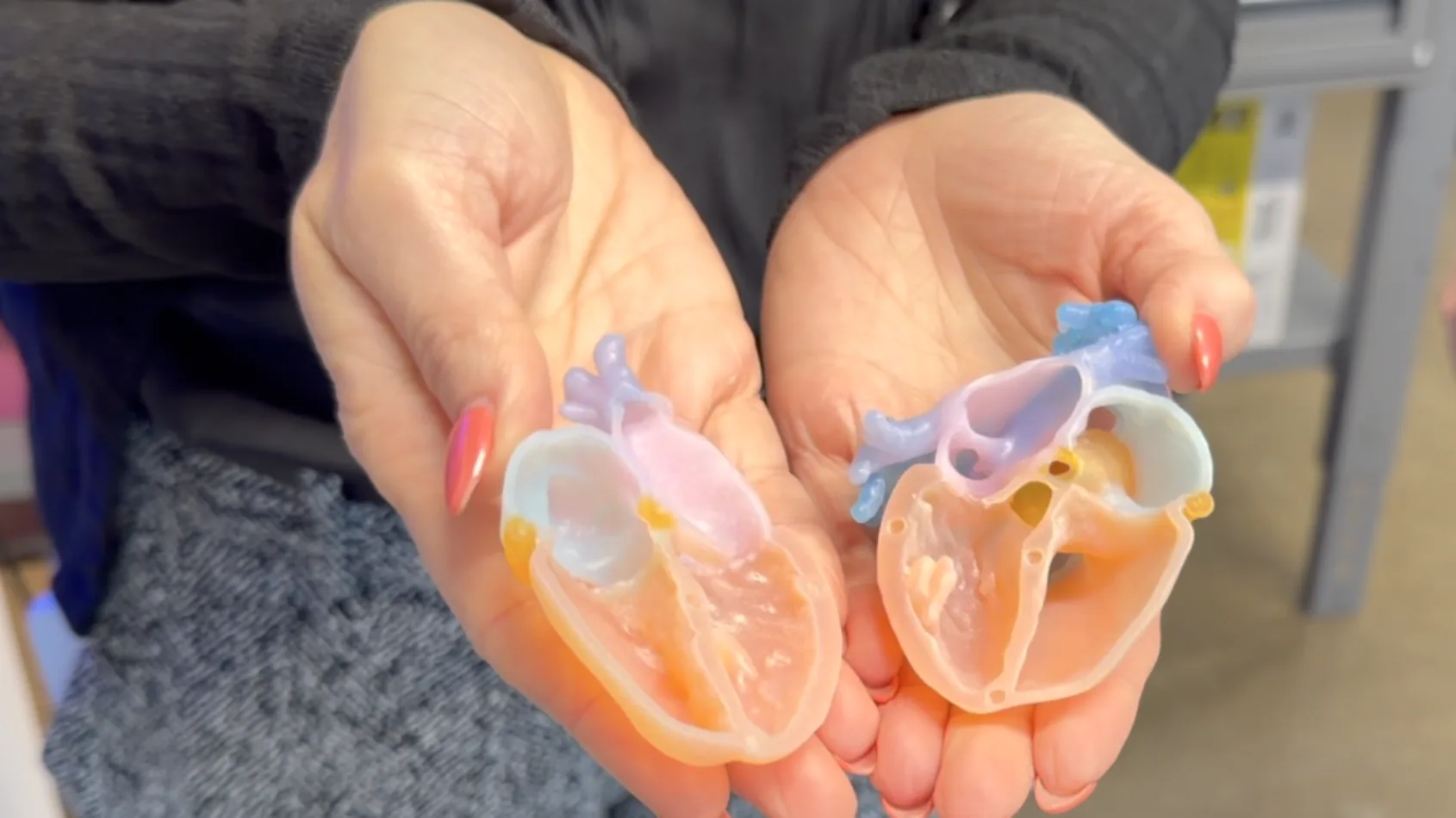
Nonprofit healthcare system located in the U.S. Indiana University Health has officially opened its upgraded 3D Print Studio at the 16 Tech Innovation District, marking the occasion with a ceremonial ribbon cutting. The facility gives IU Health clinical teams the ability to produce anatomical models tailored to individual patients, supporting more accurate diagnoses and more thorough pre-surgical preparation.
The studio ranks among the first hospital-based 3D printing programs in the United States to operate with FDA clearance. It was developed alongside Ricoh 3D for Healthcare, LLC, with IU Health physicians directly shaping its workflows and capabilities so the technology matches what surgical teams and specialists actually need.
“Being able to place a 3D printed, patient-specific model in a parent’s hands changes the conversation,” said Jeremy Herrmann, MD. “Families gain a deeper understanding of their child’s diagnosis and treatment when they can see and physically interact with the anatomy.”
What the Models Deliver in Practice
The clinical case for the studio rests on measurable outcomes. Surgeons working with 3D printed models have recorded an average 60-minute reduction in operating time, which frequently translates into shorter anesthesia exposure, less blood loss and better patient results. The models also reshape how procedures are planned: surgeons can determine precise device sizing, study angles and measurements, and prepare meshes and instruments before ever entering the operating room.
Beyond the operating theater, the models serve as cadaver-free training tools and give clinicians a tangible aid for explaining conditions to patients and families during informed-consent discussions. They also strengthen diagnostic work, helping physicians evaluate complex conditions and design more precise treatment approaches. Regulatory rigor underpins the whole operation, Ricoh’s managed services platform and FDA-cleared patient-specific anatomic models, along with select radiotherapy and surgical applications, keep the studio compliant with regulatory and legal standards.
The Hospital as Manufacturing Site
IU Health’s studio reflects a strategy of moving medical device production inside hospital walls rather than ordering models from distant service bureaus. The model has a clear precedent.
Ricoh launched its first point-of-care Innovation Studio at Atrium Health Wake Forest Baptist in North Carolina, where surgeons using 3D printed anatomical models achieved average operating time savings of 62 minutes and a 7.8% reduction in operative time, with the company signaling plans to replicate the facility across other health systems.
The trend extends beyond Ricoh’s network. Veterans Affairs Puget Sound Health Care System teamed up with the University of Washington School of Medicine on a two-year effort to build standardized pathways for creating patient-specific 3D printed models in hospitals, with the stated aim of helping the growing number of public and private hospitals acquiring 3D printers adopt best practices.
Point-of-care 3D printing is shifting from pilot projects to a repeatable hospital deployment model. IU Health is among the earliest adopters of that turnkey formula. Its results will help determine how quickly other health systems follow.
3D Printing Industry is inviting speakers for its 2026 Additive Manufacturing Applications (AMA) series, covering Energy, Healthcare, Automotive and Mobility, Aerospace, Space and Defense, and Software. Each online event focuses on real production deployments, qualification, and supply chain integration. Practitioners interested in contributing can complete the call for speakers form here.
To stay up to date with the latest 3D printing news, don’t forget to subscribe to the 3D Printing Industry newsletter or follow us on LinkedIn.
Explore the full Future of 3D Printing and Executive Survey series from 3D Printing Industry, featuring perspectives from CEOs, engineers, and industry leaders on the industrialization of additive manufacturing, 3D printing industry trends 2026, qualification, supply chains, and additive manufacturing industry analysis.
Featured image shows model of a pediatric heart. Photo via IU Health.
