


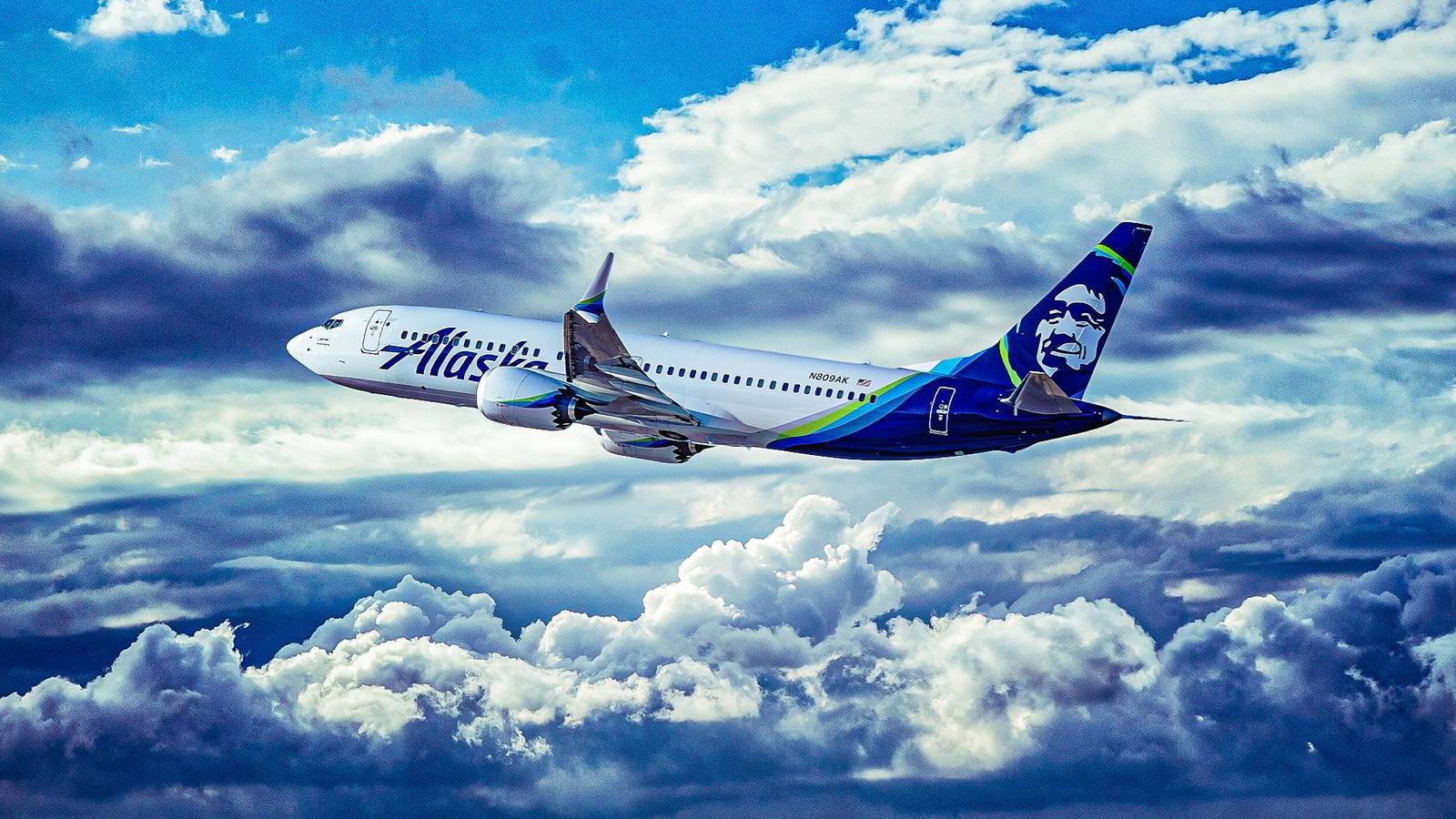
Alaska is famous for its unique geography, environment, and rugged, remote nature. The problem with visiting Alaska, however, is that it’s far away from the rest of the US, separated from the contiguous US by Canada. It’s able to support regular service from the Western US, which is much closer.
However, flights to the Northeast (the most densely populated part of the US) generally require a widebody aircraft as flights can last close to eight hours. It made these routes difficult to justify because demand was historically low. More recently, however, this has changed. Current-generation narrowbodies are now widely used with far more range than their predecessors.
Given that they have incredible fuel efficiency, it opens up a new world of possibilities for airline networks, including more services from Alaska to other US destinations. On June 13, 2026, Alaska Airlines launched new flights from Anchorage to Boston using the Boeing 737 MAX 8, further demonstrating that long-distance flights no longer require high demand to succeed.
The New Alaska Airlines Service

Alaska Airlines is now operating nonstop flights from Ted Stevens Anchorage International Airport to Boston Logan International Airport. The new flights use a Boeing 737 MAX 8, and the route only operates on Saturdays as a red-eye flight, with the returning flight departing on Monday morning.
Lasting from June 13 to August 15, it’s a short route scheduling-wise and has low opportunity costs, while the use of the 737 MAX 8 means that operating costs are low: it’s a low-risk addition that grabs low-hanging fruit. What’s remarkable about the route, however, is the length: the two cities are 2,940 NM (5,444 km) apart by great-circle distance.
Meanwhile, the blocked flight time is seven hours 15 minutes to Boston and seven hours 53 minutes for the returning flight. It’s one of the longest 737 flights in the world, and it’s only made possible by the 737 MAX 8’s low fuel burn. This keeps the fuel bill low, while the plane’s capacity of 159 passengers means that the plane shouldn’t fly empty. 15 years ago, this route would have required either a Boeing 757-200 or a widebody.
A 757-200 is a small plane, but even it typically seats close to 200 passengers, while also being an extremely fuel-thirsty aircraft. Meanwhile, a widebody aircraft burns significantly more fuel than a comparable narrowbody, a drawback that is compensated for with massive capacity. However, on a route like Anchorage-to-Boston, most of these seats would go out empty, making the route uneconomical even for a small Boeing 767.
Alaska Airlines’ Use Of The Boeing 737 MAX

The 737 MAX 8 is not a common aircraft in Alaska Airlines’ fleet. The carrier only has 20 737 MAX 8s in its fleet, with another five on order, while it has 80 737 MAX 9s and holds orders for 168 737 MAX 10s. The larger 737 variants are Alaska Airlines’ bread-and-butter aircraft, used throughout its network in North America, while the 737 MAX 8 is more of a specialized plane for specific missions.
For example, the 737 MAX 8 is flown to New York JFK in addition to Boston, and is now also operating from Seattle to Reykjavik. The larger 737 variants have enough range to serve any route within the contiguous US as well as Hawaii. Given this fact, the superior operating economics of the 737-900ER/737 MAX 9/737 MAX 10 compared to the 737-800 and 737 MAX 8, as well as Alaska Airlines’ strong market positions in its hubs, there’s sound logic behind standardizing on larger 737s.
Alaska Airlines Fleet | Number In Service | Alaska Horizon Fleet | Number In Service |
|---|---|---|---|
Boeing 737-700 | 14 aircraft | Embraer E175 | 92 aircraft |
Boeing 737-800 | 61 aircraft | Alaska Horizon Total | 92 aircraft |
Boeing 737-900ER | 79 aircraft | Full Fleet Count | 351 aircraft |
Boeing 737 MAX 8 | 20 aircraft | ||
Boeing 737 MAX 9 | 80 aircraft | ||
Boeing 787-9 | Five aircraft | ||
Mainline Total | 259 aircraft |
Most routes can support multiple larger 737s per day, while Alaska Airlines also has its regional brand, Alaska Horizon, to better match demand. It’s only on its very longest flights that the 737 MAX 8 is truly needed.
There’s a 17-seat capacity difference between the MAX 8 and the MAX 9 in Alaska Airlines’ configuration, but the MAX 8 has an extra 200 NM (370 km) of range and will carry more payload at the very edge of the 737 MAX 9’s range. As such, it effectively serves as a high-performance subfleet for Alaska Airlines, with the 737 MAX 9 and MAX 10 slated to be the airline’s default narrowbodies in the future.
737s From The Northeast To Alaska

The Anchorage-Boston route is the latest connection between the Northeast and Alaska, but it’s far from the first. Alaska Airlines and United Airlines also serve Anchorage nonstop from New York JFK/Newark, respectively, and they both use the 737 MAX 8. Delta Air Lines also previously flew from JFK to Anchorage and even deployed the Boeing 767, but it later discontinued the route after one season.
Of course, New York is the US’s largest aviation market, and it can easily support multiple daily nonstops to Anchorage. More remarkably, however,  United Airlines also operates the 737 MAX 8 to Anchorage from its hub in Washington Dulles International Airport. It’s slightly shorter than the prior routes, but in practice, they’re all roughly the same length.
Origin | Destination | Operators | Distance (NM) | Distance (km) |
|---|---|---|---|---|
Ted Stevens Anchorage International Airport | Washington Dulles International Airport | United Airlines (737 MAX 8) | 2,916 NM | 5,401 km |
Ted Stevens Anchorage International Airport | Newark Liberty International Airport | United Airlines (737 MAX 8) | 2,928 NM | 5,423 km |
Ted Stevens Anchorage International Airport | Boston Logan International Airport | Alaska Airlines (737 MAX 8) | 2,940 NM | 5,444 km |
Ted Stevens Anchorage International Airport | John F Kennedy International Airport | Alaska Airlines (737 MAX 8) | 2,942 NM | 5,448 km |
Washington DC itself is a larger market than Boston, and United operates a fortress hub out of Dulles, which significantly improves the economics of its services. Meanwhile, the 737 MAX 8 brings extremely low trip costs, making the flight feasible. Discussions about aircraft economics often center on capacity and fuel burn, but the largest factors in the equation are overall operating costs versus revenue potential, which can be viewed through per-seat costs.
While a 737 MAX 8 won’t generate much revenue, its low trip costs make it ideally suited to serve low-demand destinations or to enable an airline to operate high-demand routes with multiple frequencies. It’s a flexible aircraft, especially considering that it also has exceptional range.
Catch what other flight trackers miss
Emergency squawks, holds, NOTAMs — live signals, no signup.
Open tracker
Catch what other flight trackers miss
Emergency squawks, holds, NOTAMs — live signals, no signup.
Open tracker
The Popularity Of Narrowbodies On Long-Distance Routes

For years, the Boeing 757-200 was the default plane for long-range narrowbody flights, as it had more range than any other twinjet single-aisle plane. As previously mentioned, however, it was a fuel-thirsty airliner. Some airlines experimented with flying the Airbus A319-100 and Boeing 737-700 on transatlantic routes, but these routes were few and far between as these planes had high per-seat costs.
It’s only now with the latest generation of narrowbodies that long-distance twinjet narrowbody flying is becoming truly accessible to airlines. The 737 MAX 8 has slightly more range than the competing Airbus A320neo and also seats slightly more passengers, making it a popular choice for long-distance routes beyond just those within the US.
United Airlines, for instance, is deploying the 737 MAX 8 from its Newark hub to Nuuk, Glasgow, Santiago de Compostela, Ponta Delgada, and Funchal. Meanwhile, GOL’s route from Brasilia to Orlando is the world’s longest 737 route, spanning a distance of 3,282 NM (6,079 km) and lasting close to eight hours.
Meanwhile, the Airbus A321neo family has become the new replacement for the Boeing 757, offering similar range and capacity to the 757-200. The A321LR has become quite popular with airlines operating thin transatlantic routes, while the newer A321XLR has even more range than the 757-200. Compared to the A321LR, the aircraft also offers more payload capacity, and it’s shaping up to become the dominant aircraft for narrowbody transatlantic flights, while the 737 MAX 8 is also used to a lesser extent.
The Limitations Of Long-Haul Narrowbody Routes

One common characteristic of the 737 MAX 8’s longest routes is that nearly all of them are under eight hours. This means that Alaska Airlines can staff its Anchorage-Boston flights with the same number of crew members as a one-hour flight from Anchorage to Fairbanks. Generally, any flight that lasts over eight hours requires an augmented crew. Not only are the added crew members expensive, but a small aircraft like the 737 MAX 8 lacks crew rest facilities, requiring seats to be blocked.
Widebodies also need to operate with an augmented crew and are also affected by factors like higher fuel costs and overflight fees, just like a single-aisle plane. However, a typical twin-aisle jet will seat between 250 and 300 passengers in many cases, spreading out these costs and reducing their impact. For a 161-seat 737 MAX 8, this significantly increases per-seat costs, reducing the operating cost advantage otherwise associated with current-generation narrowbodies.
Of course, the 737 MAX 8 is mainly designed as a short-to-medium-haul airliner that can operate long-distance routes if needed. The Airbus A321LR and A321XLR, on the other hand, are designed specifically for transatlantic crossings but still suffer from the same shortcomings.
In addition, these planes are also limited in revenue potential on busier routes. There is a place for long-haul single-aisle flights, as evidenced by the successful operation of 737 MAX 8s and A321neos across oceans, but it’s ultimately a niche rather than a disruption in the industry.
