


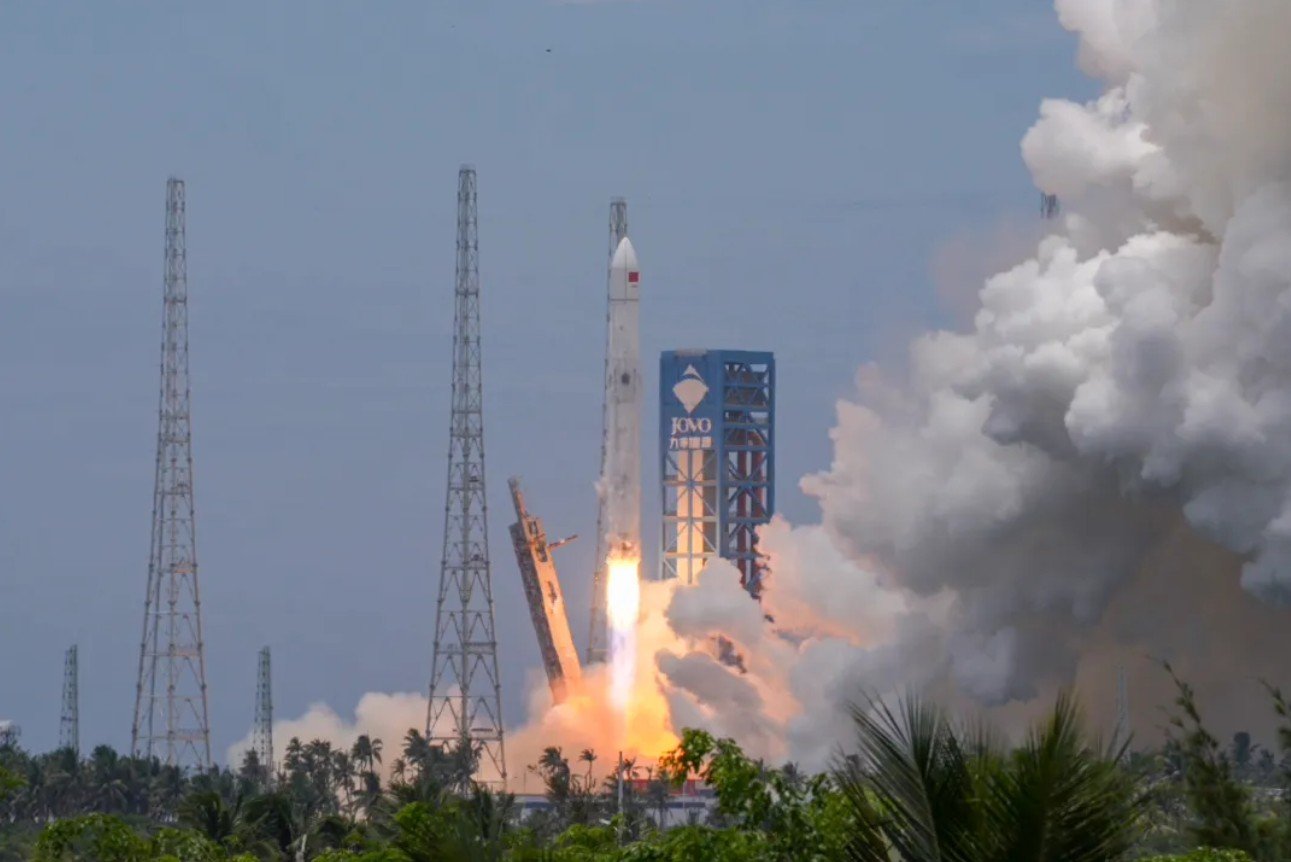
HELSINKI — China launched its Long March 10B rocket early Friday and successfully recovered the first stage, marking a huge step for the country’s reusable rocket efforts.
The first Long March 10B rocket lifted off at 12:15 a.m. Eastern (0415 UTC) July 10 from Hainan Commercial Space Launch Site on the southern island province of Hainan. The China Aerospace Science and Technology Corporation (CASC) confirmed the successful recovery of the rocket’s first stage 11 minutes later, using a sea platform equipped with a net capture system.
Videos emerging in the minutes following showed a controlled, powered descent with black smoke billowing from the top of the first stage, followed by capture by the Linghang Zhe (“navigator”) sea recovery vessel, with hooks deployed from the booster caught by a tensioned net. The recovery occurred six minutes after separation of the first and second stages.
The successful recovery sees CASC join U.S. companies SpaceX and Blue Origin in achieving recovery of an orbital booster.
The full success of the flight with insertion of an unnamed satellite into orbit was confirmed by CASC more than 90 minutes after liftoff, representing a huge boost to both China’s desire to develop reusable rocket capabilities, and for its crewed lunar program. CASC claimed the booster recovery to be the world’s first successful net-system recovery of a carrier rocket. The name, purpose and orbital parameters of the satellite were not disclosed.
The five-meter-diameter, two-stage Long March 10B is 63 meters long, with a mass of 760,000 kilograms at liftoff and has a low Earth orbit payload capacity of 16,000 kg in reusable mode.
The rocket meets the needs of various missions such as low Earth orbit satellite internet constellation deployment and large commercial satellite launches while also reducing costs, according to CASC, China’s state-owned main space contractor. CASC stated that it intended to reuse the first stage from today’s flight before the end of the year.
“Going forward, the Long March 10B carrier rocket development team will continue to optimize rocket performance and accelerate the iterative upgrade of reusable rocket technology,” CASC stated.
The recovery vessel is equipped with a flexible net capture system with hydraulic damping. The system means the first stage does not need landing legs, such as those used by the SpaceX Falcon 9 and Blue Origin’s New Glenn. China’s Long March 12A and commercial Zhuque-3 from Landspace were also equipped with landing legs, but their sole attempts at recovery failed during descent. The second Zhuque-3 launch could take place later this month, following a recent static fire test at the commercial segment of Jiuquan spaceport.
Lunar ambitions boost
The launch also marks major progress for China’s human spaceflight and crewed lunar programs. The July 10 mission was designed as a first-stage full-profile validation flight of the Long March 10A, a rocket designed to launch the new Mengzhou crew spacecraft—a larger, partially reusable successor to Shenzhou—to low Earth orbit. The full, tri-core Long March 10 will be used to launch astronauts and a landing stack to the moon, with China committed to landing a pair of astronauts on the lunar surface before 2030.
The Long March 10B is a cargo variant of the 10A. Its first stage is common to the 10A and uses seven YF-100K kerosene-liquid oxygen engines producing a total of 890 tons of thrust, while the 10B’s second stage uses an engine burning methane-liquid oxygen. The 10B is thought to be the first flight of CASC’s YF-219 methalox engine.
A Long March 10A single-stage demonstrator was used to conduct an in-flight abort test for the Mengzhou crew spacecraft in February, with the stage then performing a controlled propulsive descent and splashdown near the recovery vessel.
That test cleared the way for a launch and recovery attempt of the 10B, with the rocket first rolled out in April. Launch windows were, however, revoked, with the launch now taking place July 10.
The successful debut of the Long March 10B appears to clear the way for a first launch of the 10A, expected to carry an uncrewed Mengzhou spacecraft on a first full orbital mission. CASC did not provide a timeline for the mission, though it has hinted at such a flight in 2026 with the issuance of a Mengzhou-1 mission patch.
