


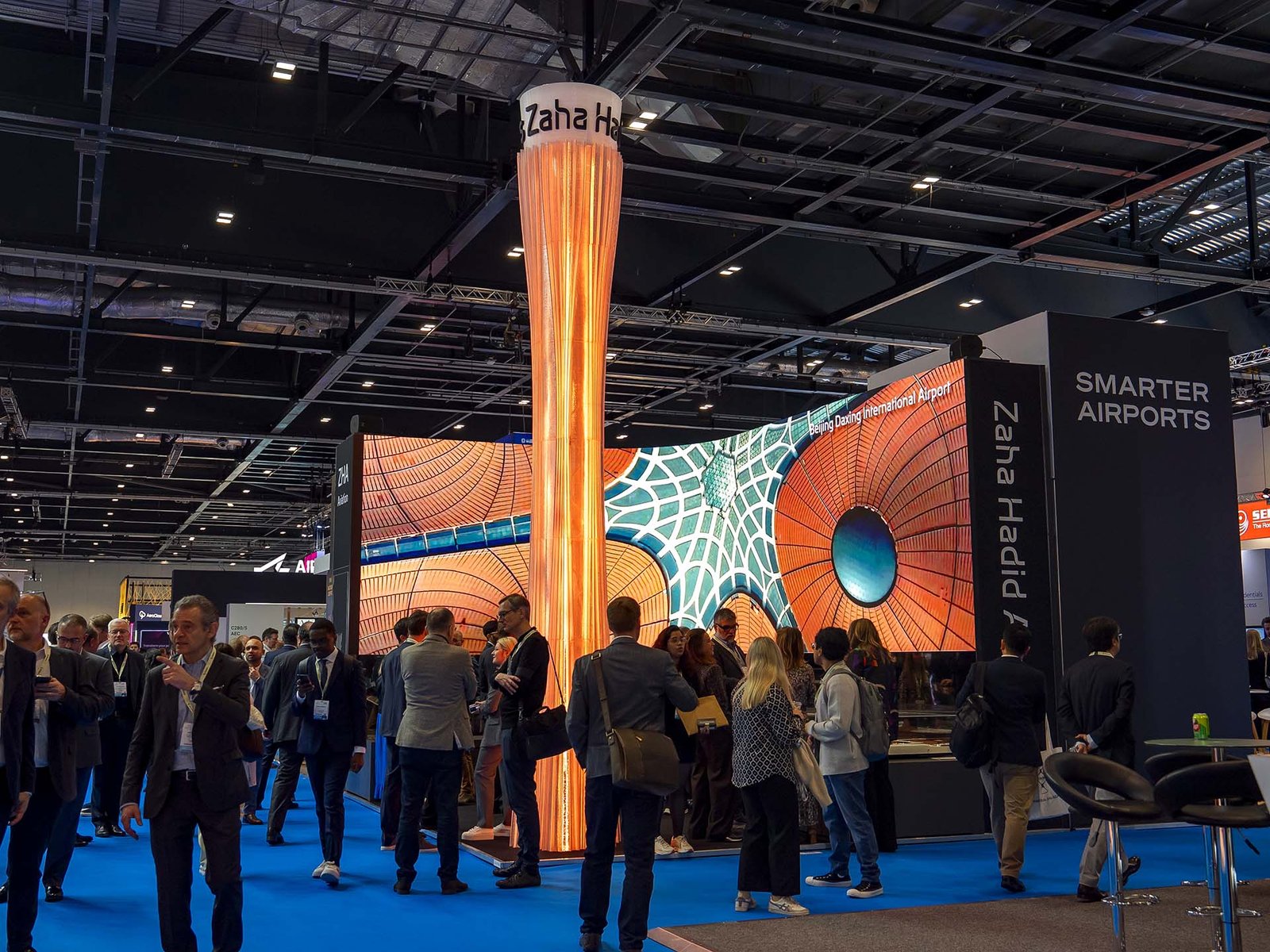
The Tech Lab of Zaha Hadid Architects (ZHA) has completed a six-meter-tall 3D printed model of an air traffic control tower, produced for the practice’s ZHAviation exhibition stand at Passenger Terminal Expo 2026 in London. Built from an original ZHA tower design, the installation ranks among the most technically demanding fabrication efforts the Lab has undertaken.
The entire piece was designed and manufactured in-house on the Lab’s WASP HDP XL extruder, mounted on a robotic arm. Fifteen modular panels, each roughly one meter tall and wide, were printed in a continuous 270-hour run. To satisfy exhibition safety rules, the team printed in fire-resistant PETG, and every panel was fitted internally with programmable LED lighting that animates the interior surface and accentuates the tower’s sculptural form.
Demountable by Design, and a First for Multi-Robot Printing
Rather than a one-off prop, the tower was engineered for a life beyond a single trade show. The printed panels attach to a structural metal frame, allowing the piece to be assembled safely inside the exhibition hall, taken apart afterward, and redeployed at future events.
The project also marks a milestone for the Lab’s fabrication setup: it is the first major job to use its newly installed second robot, enabling simultaneous multi-robot production. Working closely with Italian large-format printer manufacturer WASP, the team extended the CEREBRO robotic control system and achieved, for the first time in this configuration, coordinated multi-robot printing. The capability widens the Lab’s scope for producing large-scale architectural components robotically in the future.

Machine Time Is the Bottleneck
The strategic point of the tower is not the geometry, it’s the throughput. One tower took 270 hours of continuous printing on a single extruder. That machine-time constraint is what caps large-format robotic printing, and it’s exactly what ZHA attacked: a second robot, so big jobs can run in parallel instead of in sequence.
The practice already knows where this capability leads. ZHA’s computation group delivered Striatus, the first unreinforced 3D printed concrete footbridge, whose 53 printed blocks took 84 hours on a single robotic arm. At building scale, print hours add up quickly enough that without parallel production, deadlines become impossible to meet.
The industry is converging on the same answer: coordination software, not bigger extruders. Ai Build integrating WASP’s robotic-arm printing into its AI-powered platform, automating toolpaths and orchestrating machines to squeeze more output from the same hardware.
Large-format printing now scales through coordination, and ZHA has demonstrated it can do that in-house. The next 270-hour job could be significantly shorter.
3D Printing Industry is inviting speakers for its 2026 Additive Manufacturing Applications (AMA) series, covering Energy, Healthcare, Automotive and Mobility, Aerospace, Space and Defense, and Software. Each online event focuses on real production deployments, qualification, and supply chain integration. Practitioners interested in contributing can complete the call for speakers form here.
To stay up to date with the latest 3D printing news, don’t forget to subscribe to the 3D Printing Industry newsletter or follow us on LinkedIn.
Explore the full Future of 3D Printing and Executive Survey series from 3D Printing Industry, featuring perspectives from CEOs, engineers, and industry leaders on the industrialization of additive manufacturing, 3D printing industry trends 2026, qualification, supply chains, and additive manufacturing industry analysis.
Featured image shows Six-Meter Tower for Passenger Terminal Expo. Photo via Zaha Hadid Architects.
