


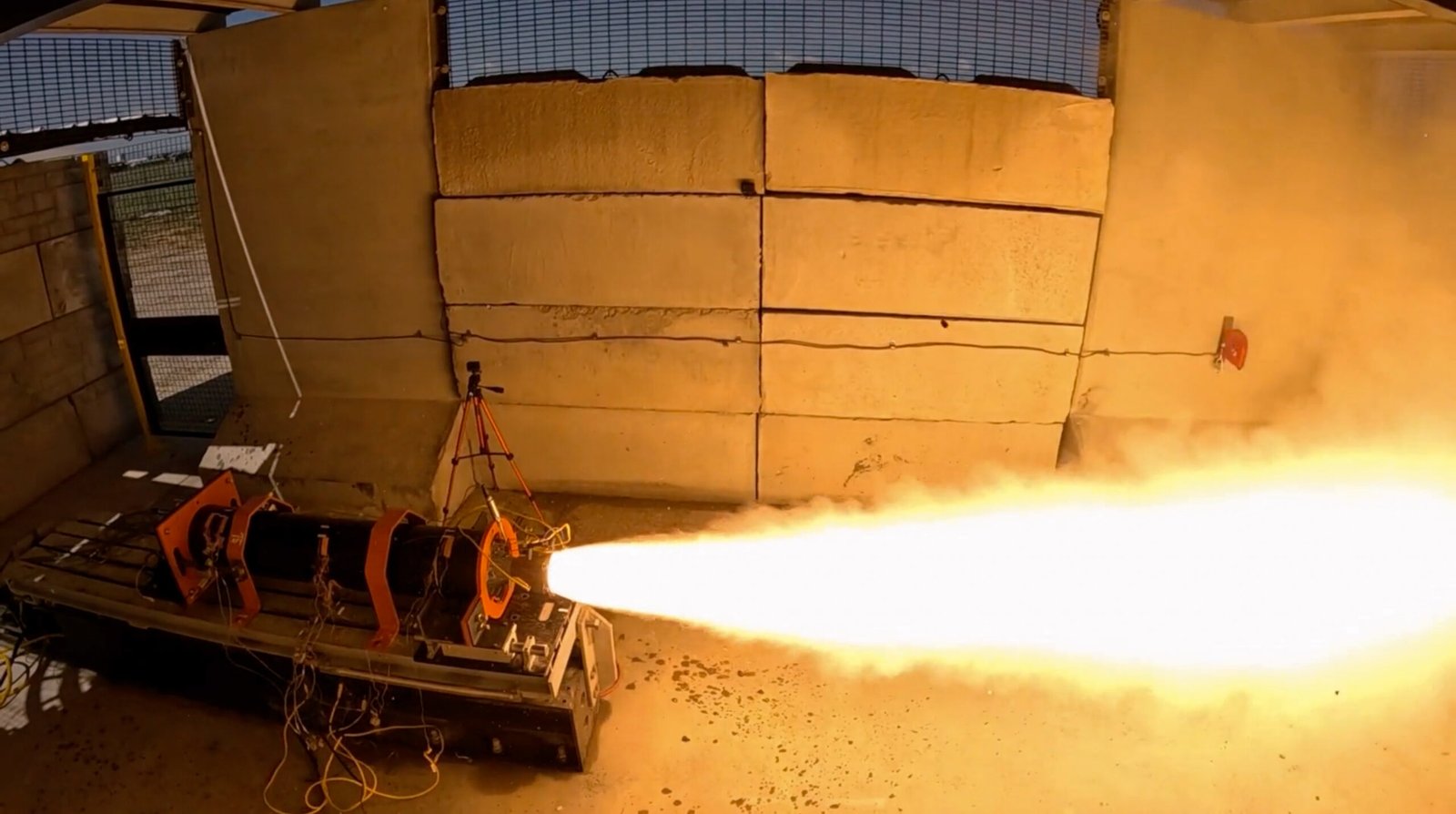
Rocket engine manufacturer Ursa Major has finished its Solid Rocket Motor (SRM) Manufacturing Pathfinder Program, a joint undertaking with the U.S. Navy and the Office of Strategic Capital (OSC). The cost-share effort wrapped up on time in February 2026 and reflects a combined $25 million commitment from the three partners. The program’s conclusion marks the end of a coordinated push to prove out domestic manufacturing capacity for a class of motors the Navy increasingly depends on.
During the program, the company reached a series of engineering and production targets. It designed, built, and static-fired a 10-inch HLG SRM prototype, and separately created and characterized a proprietary propellant for it. The motor satisfied every performance and burn-duration benchmark, establishing both a technical baseline and a manufacturing template for future Navy systems calling for a 10-inch-diameter SRM.
Turning funding into production capability
Company leadership framed the outcome as proof that targeted government investment can yield fast, tangible results. “In partnership with the Navy and OSC, we translated capital into real, measurable outcomes that scaled manufacturing capacity and advanced a production model built for speed and surge,” said Chris Spagnoletti, CEO of Ursa Major. “This program validated that when the government invests in companies that are used to doing more with less, companies that prioritize execution, innovation, and manufacturability from day one, you get capability that matters on timelines that matter. That’s how we rebuild the defense industrial base, and how we deliver credible, scalable capability to the joint force.”
To get there, Ursa Major put substantial resources into expanding its facilities and sharpening its processes, widening its overall SRM output. Each milestone was deliberately designed to serve as a stepping stone toward larger systems.
The effort also let the company refine Lynx, its shared, modular production method. Built around Highly Loaded Grain and engineered for subsystem commonality across parts, Lynx cuts tooling expenses and lead times while adding flexibility and scalability across different motor variants. The upshot is a company positioned to ramp up in line with Navy demand for solid rocket motors.
Built alongside the Navy’s technical community
The work unfolded in tight coordination with several Navy organizations: the Naval Air Weapons Center Weapons Division at China Lake, the Naval Surface Warfare Center Indian Head Division, and Naval acquisitions teams. That collaboration was aimed at smoothing development, matching technical work to specific mission requirements, and keeping the manufacturing approach grounded in operational reality.
The program fed directly into the Department of War‘s Strategic Objective Needs by emphasizing manufacturability, scalability, and the rapid qualification of SRM technologies that underpin missile and rocket systems across the joint force.
Additive manufacturing as the answer to a strained SRM supply base
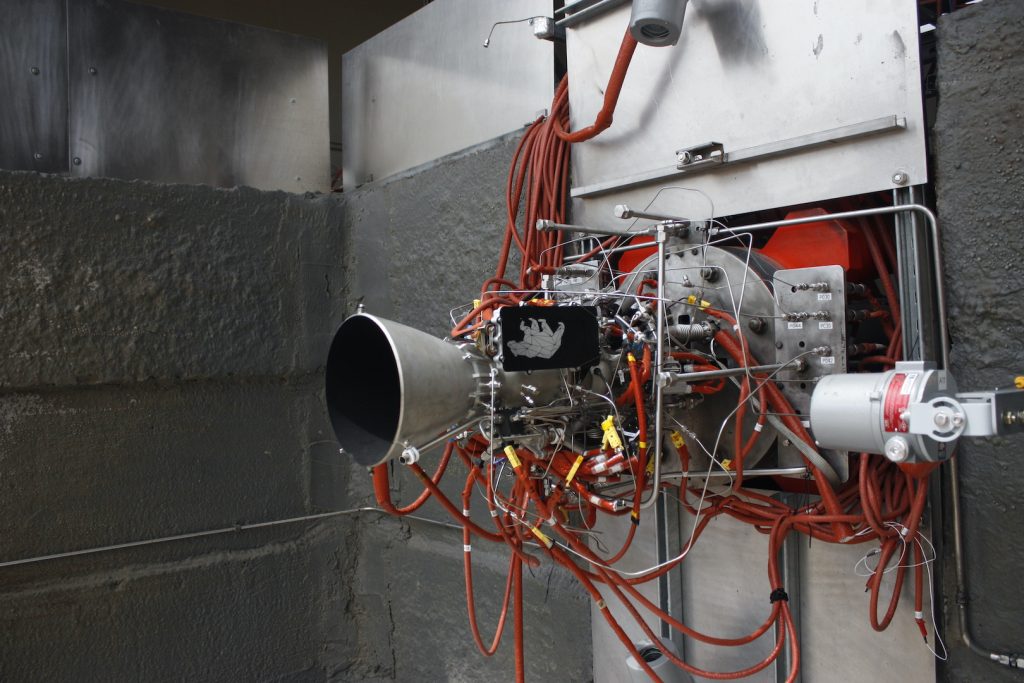
Ursa Major’s strategy uses additive manufacturing to break the bottlenecks constraining solid rocket motor production. Its Lynx approach 3D prints cases, nozzles, and igniters with product-agnostic tooling, letting one line switch between 2- and 22-inch motors without costly retooling. The Navy-OSC pathfinder is the latest step, scaling capacity to help rebuild a domestic supply base strained by high SRM demand and too few suppliers.
The same coordinated push is visible across the sector in 2026. In April, L3Harris Technologies finalized a $1 billion Department of War investment into its newly formed Missile Solutions unit, aimed at expanding and modernizing solid rocket motor production in Camden, Arkansas; Huntsville, Alabama; and Orange, Virginia.
Previously, the DoD expanded an existing agreement with X-Bow Launch Systems to $28.67 million for the development of 3D printed solid rocket motors for U.S. missiles. Together, the moves point to a deliberate strategy: fund multiple domestic suppliers to prove out additive SRM manufacturing at scale, rather than lean on a single strained source.
3D Printing Industry is inviting speakers for its 2026 Additive Manufacturing Applications (AMA) series, covering Energy, Healthcare, Automotive and Mobility, Aerospace, Space and Defense, and Software. Each online event focuses on real production deployments, qualification, and supply chain integration. Practitioners interested in contributing can complete the call for speakers form here.
To stay up to date with the latest 3D printing news, don’t forget to subscribe to the 3D Printing Industry newsletter or follow us on LinkedIn.
Explore the full Future of 3D Printing and Executive Survey series from 3D Printing Industry, featuring perspectives from CEOs, engineers, and industry leaders on the industrialization of additive manufacturing, 3D printing industry trends 2026, qualification, supply chains, and additive manufacturing industry analysis.
Featured image shows SRM Manufacturing Pathfinder Program. Photo via Ursa Major.
